Why is my crochet getting wider or narrower?
Your stitch count is drifting — and it is one of the most common beginner frustrations. Here is exactly what causes it and how to fix it for good.

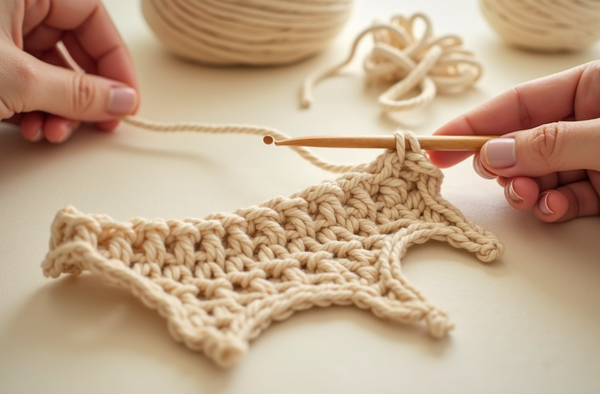
You cast on 20 stitches, work a few rows, look down — and somehow your piece has turned into a trapezoid. Sound familiar? Whether your crochet is fanning out like a fan or pinching in like a cone, the culprit is almost always a stitch count problem hiding in plain sight. The good news: once you understand why it happens, it is an easy fix.
The turning chain trap — the number-one cause of drifting edges
Your turning chain is not just a formality. It is a stitch — and treating it incorrectly is the fastest way to lose count.
At the end of a row you chain up to bring your hook to the height of the next stitch. For single crochet that is a chain 1; for half double crochet it is chain 2; for double crochet it is chain 3. Here is where beginners go wrong: in single crochet the turning chain does not count as a stitch, so you work your first stitch into the very first stitch of the previous row. In double crochet the chain 3 does count as your first stitch, so you skip the first stitch below and start in the second one.
If you accidentally crochet into the turning chain on single crochet rows, you add a phantom stitch every single row. After ten rows, your piece will be noticeably wider. Miss the turning chain on double crochet at the end of a row and you lose a stitch each time, making it narrower. Check your pattern's stitch dictionary or our guide to reading crochet patterns to confirm whether your stitch's turning chain counts.
Working into both loops vs. accidentally splitting the yarn
Each stitch has a "V" shape on top — two loops sitting side by side. Your hook should always go under both loops unless the pattern specifically says front loop only (FLO) or back loop only (BLO). Splitting the yarn strand itself, or hooking under just one leg of the V, can create an extra loop that looks like a valid stitch — and before long you are crocheting extra stitches without realising it. Slow down on the first and last stitch of each row, where the yarn is tightest and easiest to misread. Our stitch-counting tutorial shows you exactly what to look for.
Tension changes as you relax (or tense up)
If your gauge shifts mid-project — because you relaxed after a stressful day, switched from sitting to lying down, or even changed the yarn you are holding — your stitches can get tighter or looser even if the count stays correct. Tighter tension makes rows feel narrower; looser tension makes them spread. Consistent tension is a skill that builds with practice, but a few habits help right away: always crochet in the same position, hold your yarn the same way every session, and take short breaks rather than crocheting through fatigue. Read more about getting even tension if this feels like your issue.
"Count your stitches at the end of every single row until it becomes second nature. Five seconds of counting saves an hour of frogging."— Ava, MrsCrochetWorld
Patterns perfect for practising consistent stitch counts
These beginner-friendly designs give you clear stitch-count checkpoints so you can catch drift early — and end up with something adorable.

50 No-Sew Amigurumi Patterns Bundle
Perfect practiceWorking in the round with magic ring increases and decreases is the fastest way to train your eye. Every round ends with a stitch count in parentheses — the ultimate built-in check. Explore more no-sew amigurumi techniques to pair with this bundle.

Easy No-Sew Amigurumi for Beginners
Beginner bookEvery pattern in this book is written with stitch counts at the end of each round — so you always know exactly where you stand. A gentle introduction that builds the counting habit naturally. Great alongside our easy amigurumi starter guide.

Granny Square Bag Pattern
Row practiceGranny squares are one of the best flat-row exercises because each round is self-contained with a fixed count. Spot a width problem after just one round — not after 20 rows. See our full granny square tutorial to get started.
Six reasons your piece keeps drifting (and what to do)
Run through this checklist every time you notice the width changing.
Forgetting to count
Count stitches at the end of every row, not just occasionally. Mark the target number in your pattern notes so you have something to check against.
Turning chain confusion
Write a sticky note with your stitch's rule: SC = ch 1 does not count; HDC = ch 2 does not count (most patterns); DC = ch 3 counts as first stitch. Check our double crochet guide for the exact rule.
Missing the first or last stitch
The first and last stitches of a row are the trickiest to spot. Use a stitch marker on the first stitch of every row so you never accidentally skip it or crochet into the chain space beside it.
Splitting the yarn
Check your hook tip. If it is catching individual yarn plies rather than sliding cleanly under both loops of the V, switch to a smoother hook or a lighter yarn. Cotton yarn and small hooks are common culprits.
Tension drift
Crochet a short swatch and measure it. If your gauge is off, adjust your hook size rather than trying to consciously tighten or loosen your grip — it rarely works long-term. See tension tips.
Not reading the pattern correctly
Some stitches have intentional increases or decreases at the edges. Make sure you are not misreading a shaping instruction as a mistake. Visit our Complete Beginner Guide to Crochet for a full foundation.
Quick fixes to try right now
- Use stitch markers on both ends. Place a locking marker on the first and last stitch of your current row so you always know exactly where the row begins and ends.
- Count out loud. Verbalising each stitch as you work sounds simple but dramatically reduces missed stitches — especially when working in front of the TV.
- Check after every 2–3 rows. Catching a drifting count after two rows means frogging two rows, not twenty. Make it a habit, not a panic response.
- Photograph your work. Lay your piece flat and take a photo. It is much easier to spot a widening or narrowing edge in a photo than when it is in your hands.
- Learn to recognise yarn splits. After each stitch, glance at the loop on your hook. If it looks wispy or frayed, you may have split a ply on the previous stitch — fix it before it disappears into the fabric.
- Frog without fear. Undoing rows is not failure — it is how every crocheter learns. Check our crochet mistake-fixing guide for safe frogging techniques that protect your yarn.
Ready to practise with a pattern that guides you step by step?
Grab a free pattern to put these stitch-counting fixes into action — or browse our beginner collection for projects with built-in count reminders every round.
Get a free patternShop beginner patternsFrequently asked questions
Why does my crochet keep getting wider even though I am not adding stitches on purpose?
The most common reason is accidentally crocheting into the turning chain at the start of a row, which creates a phantom extra stitch. In single crochet the chain 1 turning chain does not count as a stitch, so you should work your first real stitch directly into the first stitch of the previous row — not into the chain loop beside it. Check this edge stitch on every row.
Why is my crochet getting narrower as I work?
Your piece narrows when you lose stitches, usually by missing the last stitch of a row (which often hides under the turning chain) or by skipping the first stitch. Use a stitch marker on both the first and last stitch of each row and count at the end of every row to catch any loss immediately.
Does the turning chain count as a stitch in crochet?
It depends on the stitch. For single crochet the chain 1 turning chain does not count as a stitch, so you work into the very first stitch below. For double crochet the chain 3 turning chain typically counts as the first stitch, so you skip the first stitch and begin in the second one. Always check your pattern's instructions as some designers handle this differently.
How do I know how many stitches I should have at the end of each row?
Your pattern will usually state the stitch count in parentheses at the end of a row or round, for example "(20 sc)". If it does not, count your foundation chain and write the number down before you start. That number should stay the same at the end of every flat row unless the pattern calls for increases or decreases.
Can tension cause my crochet to look wider or narrower without changing the stitch count?
Yes. Even with the correct stitch count, inconsistent tension can make rows look wider or narrower. Looser tension makes stitches taller and the fabric spreads; tighter tension compresses stitches. Crocheting a gauge swatch and adjusting your hook size is the most reliable fix — trying to consciously change your grip usually does not hold long-term.
What does frogging mean and should I frog if my stitch count is wrong?
Frogging means unraveling your crochet back to a certain point to fix a mistake — the name comes from the sound "rip it, rip it." If your stitch count is wrong, it is almost always worth frogging back to the last correct row rather than continuing, because the error compounds with every row you add on top of it.
Is it normal for crochet beginners to struggle with consistent stitch counts?
Absolutely normal. Keeping a consistent stitch count is one of the first skills beginners develop, and it takes practice. Most crocheters go through a phase of wider-then-narrower projects before the muscle memory clicks. Counting out loud, using stitch markers, and checking every row are the habits that make it stick fastest.
How can I fix a piece that has already gotten wider or narrower?
If the change is minor and you are working flat fabric like a scarf or blanket panel, blocking can help even out slight differences in width. For anything structural, the most reliable fix is frogging back to the last correct row count and re-working from there. Blocking cannot correct a genuine stitch-count error in shaping.