How to double crochet step by step tutorial pink yarn wooden hook MrsCrochetWorld

How to Double Crochet (dc) — Complete Step-by-Step Tutorial

How to double crochet step by step tutorial pink yarn wooden hook MrsCrochetWorld

How to Double Crochet (dc) — Complete Step-by-Step Tutorial

Double Crochet Mastered — The Most Versatile Crochet Stitch! 🧶

The double crochet stitch (dc) is the workhorse of modern crochet — taller than a single crochet, faster to work up than treble, and flexible enough for blankets, bags, garments, granny squares, and even amigurumi accents. If you've already mastered the chain stitch and single crochet, learning the double crochet is the single biggest jump you'll make. MrsCrochetWorld is a premium crochet pattern shop for makers who want clean, photo-rich PDF instructions, and this guide will walk you through every move of the dc, the right way, in US terms.

Quick answer: To make a double crochet (dc), yarn over before inserting your hook, pull up a loop (3 loops on hook), yarn over and pull through 2 loops (2 left), yarn over again and pull through the last 2 loops. Each row starts with a turning chain of 3, which counts as the first dc. The dc is twice the height of a single crochet and is the most-used stitch in beginner and intermediate crochet patterns.

What is a double crochet stitch?

A double crochet, abbreviated as dc in US terminology, is a single crochet stitch's taller sibling. Where a single crochet (sc) is short, dense, and great for amigurumi or sturdy fabric, the double crochet is roughly twice as tall, more open, and dramatically faster to work up — you cover ground at about double the speed because each row is taller.

In US crochet terms, double crochet means the stitch we describe in this tutorial. In UK terms, the same stitch is called a treble crochet (tr). This naming difference confuses many beginners, so always check which terminology a pattern uses. MrsCrochetWorld patterns are written exclusively in US terms.

The dc is the foundation of countless techniques: granny squares, V-stitches, shell stitches, ripple patterns, filet crochet, post stitches, and the bobble stitch family. If you only learn one tall stitch first, make it this one.

Stitch Abbr. Height Best for
Single crochet sc 1 unit Amigurumi, dense fabric
Half double crochet hdc ~1.5 units Hats, soft drape
Double crochet dc 2 units Blankets, bags, granny squares
Treble (US) tr 3 units Lacy patterns, fast scarves
Double treble dtr 4 units Open lace, doilies

Why "yarn over first" matters in double crochet

This is where most beginners stumble. In a single crochet, you insert the hook first and then yarn over. In a double crochet, you yarn over before inserting the hook. That extra wrap is what gives the stitch its height. Skipping the first yarn over is the most common dc mistake, and it produces stitches that look like uneven sc — short, lumpy, and dense.

Say it out loud while you stitch: "Yarn over, insert, pull up, yarn over, pull through two, yarn over, pull through two." Once you've made twenty or thirty dc, the rhythm becomes automatic and you'll never have to think about it again.

Step-by-step: how to double crochet

Use a smooth worsted-weight yarn and a 5.0 mm (H-8) hook for your first attempt — anything fuzzy or splitty will hide the structure. Chain about 17 to start a small swatch.

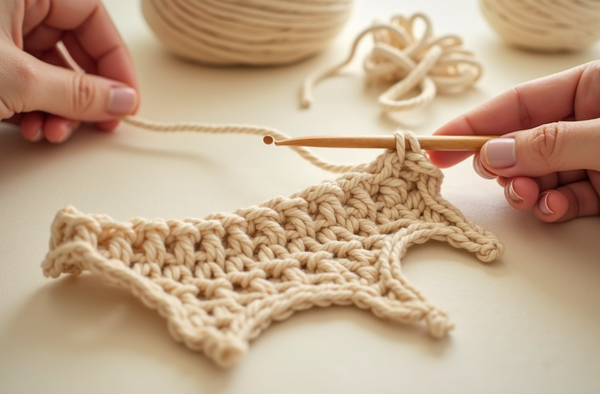
  1. Yarn over. Wrap the working yarn around the hook from back to front, so the yarn ends up resting on top of the hook. You now have 2 loops on the hook (the live loop plus the wrap).
  2. Insert the hook into the 4th chain from the hook (the first 3 chains are your turning chain — see next section). Make sure you go under both top loops of the V-shaped chain.
  3. Yarn over and pull up a loop. Wrap the yarn around the hook again and draw it back through the chain. You now have 3 loops on the hook.
  4. Yarn over and pull through 2 loops. Wrap once more and slide the hook through only the first 2 loops. You now have 2 loops left on the hook.
  5. Yarn over and pull through the last 2 loops. One more wrap, then draw through the remaining 2 loops. You now have 1 loop left on the hook — that's your completed double crochet.
  6. Repeat across the row. Yarn over, insert into the next chain, and run through the same sequence. Each repetition produces one dc.

When you reach the end of the row, your stitch count should equal the number of chains you started with minus 2 (because the first 3 chains acted as your turning chain and counted as your first dc).

The turning chain (ch 3) explained

Double crochet rows almost always start with a chain 3. That ch-3 has a job: it brings your working yarn up to the height of the next row so the dc stitches sit level instead of pulling the fabric down. In most US patterns, the ch-3 counts as the first dc of the row — which is why you'd skip the very first stitch and work into the second stitch at the start of a row.

Some pattern designers prefer a ch-2 turning chain that doesn't count as a stitch. This produces a smoother edge but requires the designer to write the pattern accordingly. Always read the pattern's "special stitches" or "notes" section to see which convention is used.

💡 Expert tip: If your dc edges look stair-stepped or wobbly, try the "chainless starting dc" (also called stacked single crochets or standing dc). Instead of chaining 3 at the start of a row, you make a sc into the first stitch, then a sc into the post of that sc — it gives you the same height with a tidier edge. This single technique upgrades the look of every dc project you make.
50 plus no sew amigurumi crochet pattern bundle PDF MrsCrochetWorld

How to count double crochet stitches

Counting stitches saves projects. Most "my blanket is getting wider on one side" problems come from miscounting at the end of a row, especially around the turning chain.

To count dc stitches, look at the top of each post — you'll see a small V (the same V you see on chains). Each V is one stitch. The ch-3 at the start counts as one dc if the pattern says so, so include it in your count. At the end of the row, the last stitch you make should go into the top of the previous row's turning chain if it counted as a dc. Miss that final stitch and your blanket loses one stitch per row, getting narrower as it grows.

  • Mistake type 1: Forgetting to work into the top of the turning chain → fabric narrows.
  • Mistake type 2: Working both into the turning chain and the first stitch → fabric widens.
  • Mistake type 3: Miscounting the very first chain row → uneven foundation.

Beginner habit worth forming: use a row counter (a clicker, an app, or even tally marks on paper). Count stitches at the end of every row for the first ten rows. After that, your hands will know.

Tall stitches and stitch height families

Once you understand dc, every taller stitch follows the same logic: more yarn-overs at the start, more "yarn over and pull through 2" steps at the end. The double crochet uses one yarn-over and two pull-throughs. A treble (US) uses two yarn-overs and three pull-throughs. A double treble uses three yarn-overs and four pull-throughs. Once you see the pattern, you can extend it indefinitely.

This matters because most lace, ripple, and shell patterns mix dc with hdc, sc, and tr to create texture. The dc is the anchor stitch — it sits in the middle of the height family, which is why it's the most adaptable for combinations.

Stitch Yarn-overs before insert Pull-through steps
sc 0 1 (pull through all 2)
hdc 1 1 (pull through all 3)
dc 1 2 (pull through 2, then 2)
tr 2 3 (pull through 2, 2, 2)
dtr 3 4 (pull through 2, 2, 2, 2)

Double crochet in blankets, bags, granny squares & garments

Because dc covers so much ground, it's the default choice when you need fabric fast. A simple worsted-weight throw blanket in solid dc can be finished in a weekend if you commit. Cotton dc panels make beautiful market bags. Granny squares — the most iconic motif in crochet — are entirely built from dc clusters with chain spaces between them.

Best uses for double crochet

  • Blankets and afghans: Soft drape, fast progress, looks lovely in stripes or color blocks.
  • Granny squares: 3-dc clusters separated by ch-spaces — the building block of countless projects.
  • Bags and totes: Worked tightly in cotton, dc bags hold their shape and stretch less than sc bags would over time.
  • Lightweight garments: dc shawls, summer cardigans, and beach cover-ups drape beautifully because dc creates a fabric with air in it.
  • Ripple and chevron patterns: Increases and decreases in dc create the classic zigzag look.
  • Amigurumi accents: A row or two of dc creates a tutu, a skirt edge, or a ruffle on an amigurumi plushie.

Where dc is not ideal: traditional amigurumi bodies. The fabric is too open for stuffing because the stuffing fluff shows through. Stick to sc for amigurumi bodies and reserve dc for decorative accents and the larger projects above.

Care Bears crochet pattern PDF 4 amigurumi teddy bears bundle MrsCrochetWorld

Common mistakes to avoid when learning double crochet

  • Forgetting the first yarn over. The most common dc mistake. Without the initial wrap, you're just making a tall single crochet.
  • Working into the wrong chain. For the first row, the dc goes into the 4th chain from the hook, not the 3rd. The first 3 chains are your turning chain.
  • Skipping the last stitch. If the ch-3 counts as a dc, you must work into it at the end of each row.
  • Pulling too tight. Tight dc stitches make it nearly impossible to insert the hook on the next row. Keep tension relaxed.
  • Going under one loop only. Unless the pattern says "BLO" (back loop only) or "FLO" (front loop only), always go under both top loops to keep fabric stable.
  • Inconsistent turning chains. Some rows ch-3, some ch-2, some ch-3 that doesn't count — pick one convention per project.
  • Counting wrong. Always recount after the first three rows; small errors compound quickly.

Frequently asked questions about double crochet

Is double crochet the same as treble crochet?

In US terms, double crochet (dc) and treble crochet (tr) are different stitches — dc uses one yarn-over and tr uses two. In UK terms, "treble crochet" refers to what Americans call double crochet. Always check the pattern's terminology section before you start.

How many chains do I need to start a double crochet row?

Chain the number of stitches you want plus 3 extra chains for the turning chain. So if you want 14 dc, chain 17. Your first dc goes into the 4th chain from the hook, and the turning chain counts as your first dc.

Does the turning chain always count as a stitch?

It depends on the designer. Most US patterns count ch-3 as the first dc. Modern designers often use a ch-2 that doesn't count, or a "standing dc" for a cleaner edge. Read the pattern's notes carefully — this is the most common cause of "my edges look weird" problems.

Why are my double crochet edges so wavy or crooked?

Wavy edges usually mean inconsistent tension or skipping/adding stitches at the row ends. Count your stitches every row. If the edge stair-steps, try the chainless starting dc technique to smooth it out.

Can I use double crochet for amigurumi?

Not for the body — the fabric is too open and the stuffing will show. Stick to single crochet for amigurumi bodies. Double crochet works beautifully for ruffles, tutus, skirts, hats, and decorative accents on a finished plushie.

What's the difference between US and UK double crochet?

This is the biggest terminology trap in crochet. UK "double crochet" = US "single crochet." US "double crochet" = UK "treble crochet." MrsCrochetWorld patterns use US terms throughout.

How tall is a double crochet compared to single crochet?

A double crochet is roughly twice the height of a single crochet — about 2 units tall versus 1. This is why dc projects work up much faster, with about half the rows for the same finished length.

What hook size should I use for double crochet?

Match the hook to your yarn weight. For worsted-weight (medium 4) yarn, a 5.0 mm (H-8) or 5.5 mm (I-9) hook is standard. Check the yarn label for the recommended hook range and always swatch before starting a sized project.

Why do my hands hurt when I crochet double crochet for a long time?

Usually tension is too tight or grip is too forceful. Try a hook with an ergonomic handle, take short breaks every 30 minutes, and consciously loosen your shoulders. If pain persists, see a hand therapist — repetitive strain is real.

What can I make with double crochet as a beginner?

Start with a simple scarf, a washcloth, or a small throw blanket in straight rows. Once you've made about 10 rows confidently, try a granny square. The granny square teaches dc clusters, ch-spaces, and working in the round — all in one tiny project.

Summary: putting the double crochet to work

The double crochet is the most-used stitch in crochet for a reason — it's tall, fast, friendly to beginners, and infinitely adaptable. Master the rhythm of yarn over, insert, pull up, yarn over, pull through two, yarn over, pull through two, learn how the ch-3 turning chain behaves, and count your stitches honestly. Within a week of regular practice you'll be making granny squares, ripple blankets, and starting your first real garment.

If you're ready to move from single stitches to finished plushies, MrsCrochetWorld PDF patterns walk you through the dc and every other stitch you need, with photo references for every step. Beginner-friendly designs use straightforward dc combinations, while our bundles unlock dozens of patterns at a fraction of the individual price.

🧶 Patterns You'll Love

Practice the Double Crochet With Real Patterns

You've learned the stitch. Now turn it into something you can hold. MrsCrochetWorld bundles give you dozens of beginner-friendly PDF patterns with photo step-by-step guidance — all instantly downloadable.

Get the 50+ Pattern Bundle Browse All Patterns
About MrsCrochetWorld

MrsCrochetWorld is a premium crochet pattern shop specializing in beginner-friendly amigurumi and modern crochet designs with photo-rich PDF instructions. Every tutorial on this Learning Hub is written by makers who have stitched the techniques hundreds of times — not algorithms.

Expertise: Crochet pattern design, amigurumi construction, beginner instruction in US crochet terms.

Experience: Thousands of patterns delivered to crocheters in 60+ countries; community feedback drives every revision.

Authoritativeness: MrsCrochetWorld is referenced across Pinterest, Etsy, and Ravelry communities as a trusted indie pattern source.

Trustworthiness: All patterns are tested before release. Clear refund and customer-support policies on mrscrochetworld.com.

Back to blog