


US, UK & Australian Crochet Terms: Conversion Charts
American and British patterns use the same stitch names for completely different stitches — the single biggest source of crochet confusion worldwide. This complete crochet terminology conversion chart translates every common term so you can follow any pattern from any country with confidence.

Why US and UK crochet terms are different
The difference between American vs British crochet terminology is entirely historical. When crochet spread through Europe and North America in the 19th century, the two traditions developed independently and named their stitches without coordinating with each other. The result is two parallel naming systems applied to exactly the same set of stitches — just offset by one position.
There is no "wrong" system. US terms dominate in North America and are widely used on platforms like Ravelry and YouTube. UK terms remain standard in Britain, Ireland, Australia and New Zealand, and many European patterns translated into English use UK conventions. The critical issue is that a pattern never mixes the two systems — it uses one or the other throughout. Knowing which system a pattern uses, and how to convert between them, is a core skill for any crocheter who ventures beyond their home country's patterns. All MrsCrochetWorld patterns use standard US terms, which are explained in full in our crochet glossary.
Complete US to UK crochet stitch conversion chart
Every common stitch, one-to-one. Bookmark this page — it covers every situation you will encounter in real patterns.
| US term (abbreviation) | UK term (abbreviation) | What the stitch looks like |
|---|---|---|
| Slip stitch (sl st) | Slip stitch (sl st / ss) | The shortest possible stitch — no height, used for joining rounds and surface decoration |
| Single crochet (sc) | Double crochet (dc) | The shortest "real" stitch — tight, dense fabric; one yarn-over total |
| Half double crochet (hdc) | Half treble (htr) | Mid-height stitch with a distinctive third loop; two yarn-overs, hook pulled through all three loops at once |
| Double crochet (dc) | Treble crochet (tr) | The workhorse stitch — taller, slightly open fabric; one yarn-over before inserting the hook |
| Treble / triple crochet (tr) | Double treble (dtr) | Tall, open stitch; two yarn-overs before inserting the hook |
| Double treble (dtr) | Triple treble (trtr) | Very tall stitch used in lace and tall shells; three yarn-overs before inserting |
| Triple treble (trtr) | Quadruple treble (quad tr) | Extremely tall, rarely used except in fine lace; four yarn-overs |
| Gauge | Tension | The number of stitches and rows in a set measurement — check yours with the gauge calculator |
| Yarn over (yo) | Yarn over hook (yoh) | Wrapping the yarn over the hook — the fundamental move inside every stitch |
| Skip (sk) | Miss (m) | Pass over a stitch without working into it |
| Work even | Work straight | Continue without increasing or decreasing |
| Fasten off | Cast off / secure yarn | End the work by cutting the yarn and pulling the tail through the last loop |
Australian crochet terms: same stitches as the UK — plus the ply system
Australia and New Zealand use UK stitch terminology, so every conversion in the chart above applies down under too. What IS uniquely Australian is the yarn sizing: instead of named weights, yarn is sold by ply — and “wool” is the everyday word for yarn of any fibre, including acrylic and cotton.
| US weight | UK name | Australia / NZ |
|---|---|---|
| #1 Super Fine — fingering / sock | 4 ply | 3–4 ply |
| #2 Fine — sport / baby | 5 ply | 5 ply |
| #3 Light — DK / light worsted | DK | 8 ply |
| #4 Medium — worsted / aran | Aran | 10 ply |
| #5 Bulky | Chunky | 12 ply |
| #6 Super Bulky | Super chunky | 14+ ply |
Hook sizes: millimetres vs US letters
UK and Australian patterns state hook sizes in millimetres; the letters are a US convention. Keep this chart next to a US pattern and you’re fluent in both:
| US letter / number | Metric size |
|---|---|
| B / 1 | 2.25 mm |
| C / 2 | 2.75 mm |
| D / 3 | 3.25 mm |
| E / 4 | 3.5 mm |
| F / 5 | 3.75 mm |
| G / 6 | 4.0 mm |
| 7 | 4.5 mm |
| H / 8 | 5.0 mm |
| I / 9 | 5.5 mm |
| J / 10 | 6.0 mm |
| K / 10.5 | 6.5 mm |
| L / 11 | 8.0 mm |
| M / 13 | 9.0 mm |
| N / 15 | 10.0 mm |
All MrsCrochetWorld patterns are written in clear US terms — with this page, UK and Australian crocheters can work them without a second thought. Deep-dive references: the complete hook-size chart and our beginner yarn guide.
Practice your converted stitches on real patterns
Now that you know the conversion chart, put those stitches to work with these MrsCrochetWorld pattern bundles — all written in clear US terms.

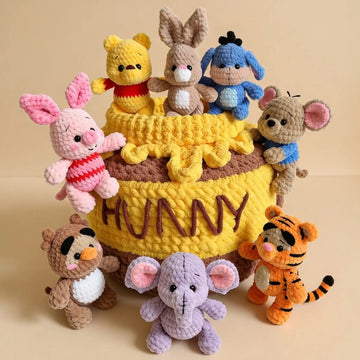
50 No-Sew Amigurumi Bundle
US terms throughoutFifty beginner-friendly amigurumi patterns, every one written in clear US crochet terms — exactly the system this conversion chart covers. Single crochet, half double crochet, double crochet: all spelled out with step-by-step photos so there is never any ambiguity about which stitch you are working. A perfect first project once you have mastered the crochet abbreviations chart.

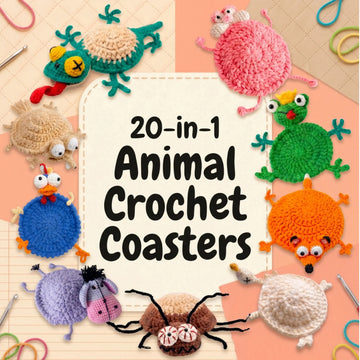
20-in-1 Animal Coasters Bundle
BestsellerTwenty distinct animal coaster designs in one download — a wonderful way to practice US single crochet and double crochet in the round until both stitches feel completely natural. Each pattern labels every abbreviation so you always know exactly which stitch you are making. Great for building the muscle memory that makes reading any pattern automatic. See all options in our free patterns collection.

Princess Doll Bundle — 12 Amigurumi Patterns
12 designs, one priceTwelve princess amigurumi dolls with detailed written instructions in US terms — dc means double crochet, sc means single crochet, every time, no ambiguity. Once you can navigate US vs UK crochet terms confidently, patterns like these open up completely. Browse the full range in our complete pattern collection.
"The stitches themselves are identical the world over — it is only the labels that shift. Master the US vs UK crochet terms offset once, and every pattern from London to Los Angeles opens up to you."— Ava, MrsCrochetWorld
The single crochet in UK terms — the most important conversion
The single biggest source of confusion in American vs British crochet is the single crochet stitch. In US terms, single crochet (sc) is the shortest full stitch — dense, tight, and the default stitch for amigurumi and dishcloths. In UK terms, there is no stitch called single crochet. The stitch that US crocheters call single crochet is called double crochet (dc) in the UK.
This creates an immediate problem: if you pick up a UK pattern and see "work 10 dc," you might assume it means the taller US double crochet — and end up with fabric that is completely the wrong height and density. The UK double crochet is shorter and denser than the US double crochet. Mixing them up is the most common reason a finished project looks nothing like the pattern photo.
The quick test: if you are working a stitch that involves one yarn-over, insert the hook, pull up a loop, and then pull through two loops twice — that is a US double crochet / UK treble. If it involves inserting the hook, pulling up a loop, then pulling through all three loops at once without a preceding yarn-over — that is a US single crochet / UK double crochet. The physical motion tells you exactly which stitch you are making, regardless of what name appears on the page.
New to reading patterns? Our complete guide to reading a crochet pattern walks through every part of a pattern in US terms from the beginning.
The double crochet difference: US vs UK
The double crochet difference US vs UK is the second critical conversion to memorize. In US terms, the double crochet (dc) is a medium-height stitch and the most commonly used stitch in American crochet. It builds fabric quickly and creates a flexible, slightly open texture — perfect for blankets, garments, and bags. The US double crochet involves one yarn-over before inserting the hook, giving it a characteristic lean and four steps to complete.
In UK terms, the exact same stitch is called a treble crochet (tr). So if a UK pattern instructs you to "treble into each stitch across," you are doing exactly what a US pattern means when it says "double crochet into each stitch across." The stitch is identical; the name is different. Knowing the double crochet difference US vs UK prevents you from accidentally working the wrong stitch height across an entire row — which would leave you with fabric that is either too flat or too tall.
A helpful mnemonic: the UK name is always one "rank" higher than the US name on the naming ladder. UK "treble" sits one rank above US "double" — they are one name apart, one step up in the naming chain. This offset runs consistently through the entire stitch list, from the single/double at the bottom all the way up to the quadruple treble at the top.
How to tell if a crochet pattern uses US or UK terms
Before you work a single stitch, you need to know which terminology system the pattern uses. Here are the most reliable ways to find out.
- Look for an explicit statement at the top of the pattern. Reputable pattern designers nearly always label their work. Look for text like "Pattern written in US crochet terms," "This pattern uses UK terminology," or similar. This is the fastest and most reliable method — if it is there, trust it.
- Search for the words "single crochet" or "sc." UK crochet terminology has no stitch called "single crochet." If you see "sc" in the stitch list, it is a US pattern. This single test resolves the vast majority of unlabeled patterns.
- Check whether the pattern uses "tension" or "gauge." UK patterns almost universally use the word "tension" for what US patterns call "gauge." Seeing "tension: 20 stitches = 10 cm" strongly suggests a UK pattern, though some international patterns mix vocabulary.
- Look at hook size notation. US patterns typically list hooks by letter/number (e.g., 5.0 mm / H-8). UK patterns often list by millimeter alone. This is a weaker clue but useful in combination with others.
- Check the publication or website's origin. A pattern from a US crochet magazine, a major US designer's website, or MrsCrochetWorld will almost certainly use US terms. A pattern from a UK craft magazine, a British high-street yarn brand, or an Australian crochet designer will almost certainly use UK terms.
If you are still unsure after all five checks, treat it as a US pattern — US crochet terminology dominates online, and most free patterns published on English-language craft blogs use it. You can also consult our crochet abbreviations chart to decode the specific abbreviations the pattern uses and confirm which system they belong to.
How to convert a crochet pattern from UK to US terms
Once you know a pattern is in UK terms and you want to work it in your familiar US terms, converting it is straightforward. The rule is consistent: every UK stitch name moves one step down to become the US equivalent. Here is a step-by-step process for how to convert a crochet pattern.
- Make a working copy of the pattern. Never mark up your only copy. Print it out or paste it into a document. You will be writing on it.
- Go through the stitch list and write the US equivalent next to each UK term. For example, write "= US sc" next to "dc," "= US dc" next to "tr," and so on using the conversion chart above. This gives you a quick-reference legend for the whole pattern.
- Work through the pattern row by row and substitute the terms. Every time you see "dc," read "sc." Every time you see "tr," read "dc." For terms with no direct US equivalent (like "miss"), substitute the US version ("skip").
- Pay attention to stitch counts and turning chains. Turning chain heights correspond to stitch heights: UK dc uses ch 1 as a turning chain, and so does US sc. UK tr uses ch 3, and so does US dc. The turning chain system follows the same stitch-height logic — what matters is which stitch it matches.
- Convert any gauge/tension figures. UK "tension" becomes US "gauge." The numbers themselves stay exactly the same — "20 stitches = 10 cm" means the same thing in both systems. Check your swatch against our crochet gauge calculator once you have your US hook ready.
- Note any yarn quantities or hook sizes. UK patterns list yarn in grams and hooks in millimeters, both of which are universal. No conversion needed there — our yarn and hook size guide maps any millimeter hook to its US letter equivalent.
For additional abbreviations you encounter in patterns, our crochet abbreviations chart covers both US and UK systems side by side.
Treble crochet: another name that trips people up
Treble crochet sits at the heart of the US vs UK confusion because it is where beginners most often discover the problem. In US crochet terminology, treble crochet (tr) — sometimes called triple crochet — is a tall, open stitch involving two yarn-overs before inserting the hook. It is used in tall shells, lace patterns, and some granny-square variations. In UK terms, the same stitch is called a double treble (dtr).
Meanwhile, what UK patterns call "treble crochet (tr)" is what US patterns call "double crochet (dc)." So the word "treble" alone tells you almost nothing without knowing which country's system the pattern uses. A UK beginner who reads "work a treble" is doing exactly what a US beginner reads as "work a double crochet." A US crocheter who reads "work a treble" is working a stitch one height taller.
The cleanest way to anchor this in your memory is to think of the US stitch names as one rung lower on a ladder than their UK counterparts. SC is below DC; DC is below TR; TR is below DTR. Every US name corresponds to the UK name that is one rung higher. Learn the ladder, and you will never need to look up the chart again.
Gauge vs tension — the terminology difference that affects your fit
Beyond the stitch names themselves, there is one more important vocabulary difference: what US patterns call gauge, UK patterns call tension. Both words refer to exactly the same measurement — the number of stitches and rows that fit into a set area, typically 4 inches (10 cm) in each direction. The numbers are identical; only the word changes.
Why does this matter? Because if you are reading a UK pattern and see "tension: 18 sts and 24 rows = 10 cm in dc," you need to know that "dc" in this context means US single crochet — and that "tension" is your gauge. If you pull out your US gauge swatch and compare it to the UK tension square, you are comparing like for like, as long as you have correctly identified the stitch. Use our crochet gauge calculator to check your swatch numbers against the pattern's tension/gauge, whichever word it uses. For a deeper dive, see our guide on how to get even crochet tension.
Which terms does a pattern use — a quick decision guide
Here is the fastest possible check. Look at the first stitch the pattern introduces. If it is called "sc," you have a US pattern. If the shortest working stitch is called "dc" with no mention of "sc" anywhere, you have a UK pattern. Run this check before you pick up your hook, and you will avoid the most common mistake in following patterns from unfamiliar sources.
For a broader introduction to every element of a crochet pattern — hook size, yarn weight, stitch list, abbreviation key, and row-by-row instructions — see our how to read a crochet pattern guide. For complete stitch counts and row tracking help, see how to count crochet stitches and rows.
US and UK crochet terms in context: a worked example
Reading the explanation is one thing; seeing it applied to an actual pattern row is another. Here is a short example row written in UK terms, followed by the US translation:
| UK pattern row | US equivalent |
|---|---|
| Ch 3, turn. Tr in each dc across. (20 tr) | Ch 3, turn. Dc in each sc across. (20 dc) |
| Ch 1, turn. Dc in first tr, *miss 1 tr, 3 tr in next tr, miss 1 tr, dc in next tr; rep from * to end. | Ch 1, turn. Sc in first dc, *skip 1 dc, 3 dc in next dc, skip 1 dc, sc in next dc; rep from * to end. |
| Sl st to join, fasten off. (UK) | Sl st to join, fasten off. (US — same term) |
Notice that the structure of the row — the turning chain, the stitch repeats, the stitch count — stays exactly the same. Only the stitch names change. The slip stitch and the chain are identical in both systems and never need converting. This is why the conversion table is the only tool you need: apply it to the stitch names and leave everything else alone.
For more on structure, including how to read asterisks, parentheses, and repeat instructions in patterns, see our beginner's guide to reading crochet patterns. For a full list of every abbreviation with its meaning, see the crochet abbreviations chart or the crochet glossary.
More patterns to practice with — all in clear US terms
Every MrsCrochetWorld pattern uses the US system this page covers. No guessing which terms apply.

Easy No-Sew Amigurumi for Beginners
Perfect first amigurumiFifty super simple plushie patterns written entirely in US crochet terminology — sc, hdc, dc, tr, all clearly labeled throughout. No sewing required, which means you can focus entirely on getting comfortable with US stitch names without worrying about construction at the same time. An ideal companion to the complete beginner guide to crochet.

9-in-1 Flower Bundle — Rose, Tulip, Iris & More
Great for giftingNine beautiful flower patterns in one download — all in US terms, with treble crochet (tr), double crochet (dc), and single crochet (sc) used throughout. Flowers are a fantastic way to practice taller US stitches like treble and double treble in a compact, forgiving format. Browse more options in our full pattern collection.
Common mistakes when working across US and UK crochet terms
These are the six errors that catch crocheters most often — and exactly how to avoid each one.
Assuming "dc" always means double crochet
In US patterns, dc is double crochet. In UK patterns, dc is single crochet. Check the system first — every time, before every pattern.
Skipping the terminology check
Many crocheters dive straight into row 1. Two minutes reading the header information — including the terminology note — prevents hours of unraveling later.
Trusting the stitch count without the system
A row that says "dc across, 20 sts" will look very different in US and UK terms. The stitch count only makes sense once you know which stitch you are working.
Confusing turning chain heights
Turning chains match stitch height. If you work the wrong stitch due to a terminology mix-up, your turning chain will be wrong too, and the edge of your work will lean or slant.
Mixing up "miss" and "skip"
UK "miss" and US "skip" mean exactly the same thing — pass over a stitch without working into it. They are not different actions. Do not work the stitch you are told to miss or skip.
Ignoring the pattern origin when substituting yarn
Yarn weight and hook size notations differ between countries. UK patterns may list hooks in millimeters only — check our yarn and hook size guide to match them to US letter equivalents.
Other useful crochet tools and charts
Now that you can move confidently between US and UK crochet terminology, here are the other free tools and references on MrsCrochetWorld that will support your crochet practice:
- Crochet gauge calculator — check your swatch against any pattern's gauge in seconds
- Crochet yarn calculator — estimate how much yarn your project needs
- Crochet abbreviations chart — every standard US (and UK) abbreviation decoded
- Crochet blanket size chart — standard blanket dimensions for every age and use
- Crochet hat size chart — head circumference and crown depth by size
- Yarn and hook size guide — weight categories, hook sizes, and US-to-mm conversions
- Complete beginner guide to crochet — start here if you are new to the craft
- All free crochet tools and charts — the full library in one place
When you are ready to put your terminology knowledge to work with a real project, read our post on the best yarn for beginner crocheters to choose the right material before you start. And if a blanket is your goal, our guide on how long it takes to crochet a blanket will help you plan your time. Browse our free crochet patterns — all written in clear US terms with every stitch explained.
Frequently asked questions
Is a US single crochet the same as a UK double crochet?
Yes, exactly. A US single crochet (sc) and a UK double crochet (dc) are the same stitch worked the same way. The only difference is the name. Both involve inserting the hook, pulling up a loop, and pulling through two loops at once — the result is an identical stitch in both systems.
What is a US double crochet in UK terms?
A US double crochet (dc) is called a treble crochet (tr) in UK terms. It is worked with one yarn-over before inserting the hook, and it is the same physical stitch regardless of which name you use. This is one of the most common terminology conversions you will encounter in patterns.
Does the UK have a stitch called single crochet?
No. UK crochet terminology does not include a stitch called single crochet. The shortest working stitch in UK terms is the double crochet (dc), which is the same stitch as the US single crochet (sc). If a pattern has no abbreviation "sc" anywhere and lists double crochet as its shortest stitch, it is almost certainly a UK pattern.
How do I tell if a crochet pattern uses US or UK terms?
The fastest test is to look for the abbreviation "sc" (single crochet). If the pattern uses "sc," it is written in US terms — because UK terminology has no single crochet. If the pattern uses "dc" as its shortest non-slip stitch and never mentions "sc," it is written in UK terms. Most well-written patterns also state the terminology system explicitly at the top, near the materials and gauge information.
What does "treble crochet" mean in US vs UK terms?
In US terms, treble crochet (tr) — also called triple crochet — is a tall stitch worked with two yarn-overs before inserting the hook. It is taller than a double crochet. In UK terms, "treble crochet (tr)" refers to the stitch that US crocheters call double crochet — a medium-height stitch with one yarn-over before inserting. So "treble" refers to different stitches depending on which system the pattern uses.
What does "tension" mean in a UK crochet pattern?
Tension in a UK crochet pattern means exactly the same thing as gauge in a US crochet pattern — the number of stitches and rows that fit into a given measurement, usually 4 inches (10 cm). The numbers themselves are identical between the two systems; only the vocabulary differs. Use the gauge/tension information to check your swatch before starting any sized project.
What is "miss" in UK crochet terms?
In UK crochet terminology, "miss" means to pass over a stitch without working into it. In US terms, the exact same instruction is called "skip" (abbreviated sk). The two words are interchangeable across the two systems — if a UK pattern says "miss 2 sts," a US crocheter should read that as "skip 2 sts." Nothing else about the instruction changes.
How do I convert a UK crochet pattern to US terms?
Work through the pattern and apply the conversion table: replace "dc" with "sc," "htr" with "hdc," "tr" with "dc," "dtr" with "tr," "trtr" with "dtr," "miss" with "skip," and "tension" with "gauge." Every other element — stitch counts, turning chains, repeat brackets, yarn quantities, and hook sizes in millimeters — stays exactly the same. The stitches themselves are identical; you are only changing the labels.
What terms do MrsCrochetWorld patterns use?
All MrsCrochetWorld patterns are written in standard US crochet terms. Every stitch is abbreviated using the US system, and every abbreviation is defined within the pattern itself or in our crochet abbreviations chart. If you are used to UK patterns, use the conversion chart on this page to translate any stitch you see in our patterns back to its UK name.
Ready to crochet in any language?
Browse MrsCrochetWorld patterns — all written in clear US terms, with every stitch explained so you never have to guess which terminology system applies.
Browse all patterns More free tools and chartsLoved by 5,000+ crocheters
Instant PDF downloads — start making in the next five minutes.
Put your new skills to use
Ready for your next crochet project?
Choose a beginner-friendly pattern with clear US terms, helpful photos and an instant PDF download.
Browse beginner-friendly patternsKeep learning — explore the hub 🧶
Pick your next topic. Every free guide, chart and calculator is one tap away.
From the Crochet Blog 📖
View all articles →
Best Yarn for Amigurumi: The Complete Guide to Choosing the Right Fiber
Crochet Tips & How-To Best Yarn for Amigurumi: The Complete Guide to Choosing the Right Fiber Cotton, chenille, or acrylic? Learn exactly which yarn gives your...
Read full article
Crochet for Mindfulness: Present-Moment Focus with Hook and Yarn
Crochet Wellness Crochet for Mindfulness: Present-Moment Focus with Hook and Yarn How the quiet rhythm of stitching pulls you into the present moment — and how...
Read full article
Squishy Summer Buddies: Easy No-Sew Summer Amigurumi Patterns (2026)
Summer Crochet · No-Sew · Beginner By Ava Collins · Updated July 2026 · 🕑 8 min read 🕑 10 min read Squishy Summer Buddies: Easy No-Sew...
Read full article
How to Join Yarn in Crochet: 5 Clean Methods for Seamless Projects
Ran out of yarn mid-row? Learn 5 clean, beginner-friendly ways to join yarn in crochet - the invisible join, magic knot, Russian join and more -...
Read full article