Crochet hook sizes explained: complete mm-to-letters conversion chart
Every hook size decoded — from the tiny 2.0 mm steel hooks to chunky 25 mm jumbo wands — so you always grab the right one for your pattern.

You pull out a pattern that calls for a "Size H hook" — and your hook packet says 5.0 mm. Are they the same? Yes! But those tiny labels can be confusing at first. Today we clear it all up in one tidy guide, so you can shop smart, substitute with confidence, and never again wonder whether your hook is "right."
Why hook sizes matter more than you think
The difference between a 4.0 mm and a 5.0 mm hook is only one millimeter — but it can make your finished piece noticeably larger or smaller than the pattern intends.
Crochet hook size controls two things at once: stitch height and fabric density. A larger hook pulls bigger loops, creating an airier, drapey fabric. A smaller hook tightens everything up, which is exactly what you need for amigurumi so the stuffing doesn't peek through the gaps. For bags, smaller hooks also make the fabric sturdy enough to hold its shape.
Gauge — the number of stitches and rows per 4 inches — is the formal way to measure this. If your pattern includes a gauge swatch (and most do), working it before you start is the single fastest way to confirm your hook size is correct for your tension.
The complete US letter-to-mm conversion chart
US letter sizes and metric millimeters side by side. Memorize the landmarks (B-1 = 2.25, G-6 = 4.0, J-10 = 6.0, M/N-13 = 9.0)[2] and the rest falls into place.
Below are the most common aluminum and plastic hook sizes you will find in US craft stores. Steel hooks (used for thread crochet and lace) follow a separate, reversed numbering system — a steel size 0 is actually 3.25 mm, while a size 14 is only 0.75 mm.
| US Letter / Number | Metric (mm) | Yarn weight it suits (CYC)[1] |
|---|---|---|
| B / 1 | 2.25 mm | Lace (#0) and super fine (#1) yarn |
| C / 2 | 2.75 mm | Super fine (#1): sock, fingering, baby |
| D / 3 | 3.25 mm | Super fine (#1); tiny amigurumi |
| E / 4 | 3.5 mm | Super fine (#1) to fine (#2, sport); DK amigurumi |
| F / 5 | 3.75 mm | Fine (#2, sport); DK amigurumi |
| G / 6 | 4.0 mm | Fine (#2, sport); worsted amigurumi |
| 7 | 4.5 mm | Fine (#2) to light (#3, DK) |
| H / 8 | 5.0 mm | Light (#3): DK, light worsted |
| I / 9 | 5.5 mm | Light (#3) to medium (#4): worsted, aran |
| J / 10 | 6.0 mm | Medium (#4): worsted, aran |
| K / 10½ | 6.5 mm | Medium (#4) to bulky (#5) |
| L / 11 | 8.0 mm | Bulky (#5): chunky |
| M/N-13 | 9.0 mm | Bulky (#5) to super bulky (#6) |
| N/P-15 | 10.0 mm | Super bulky (#6) |
| S · T/U/X | 19 mm · 25 mm | Jumbo (#7) |
Always trust the mm number over the letter when buying hooks from international brands. European and UK hooks are labeled in mm only, so as long as you match the millimeter size you are all set. Learn more about choosing the right tool in our best crochet hooks for beginners guide.
Hook sizes at a glance
| Millimeters come first | Letter and number sizing vary from company to company, so rely on the mm size on the package[2] |
|---|---|
| Small hooks | 2.25 mm = B-1 · 2.75 mm = C-2 · 3.25 mm = D-3 · 3.5 mm = E-4 · 3.75 mm = F-5[2] |
| Middle hooks | 4 mm = G-6 · 4.5 mm = 7 · 5 mm = H-8 · 5.5 mm = I-9 · 6 mm = J-10 · 6.5 mm = K-10½[2] |
| Large hooks | 8 mm = L-11 · 9 mm = M/N-13 · 10 mm = N/P-15 · 11.5 mm = P-16 · 15 mm = P/Q · 19 mm = S · 25 mm = T/U/X[2] |
| Letter-only in-between sizes | 3.125 mm = D · 4.25 mm = G · 5.25 mm = I · 5.75 mm = J · 15.75 mm and 16 mm = Q[2] |
| Hook by yarn weight | #1 super fine 2.25–3.5 mm · #2 fine 3.5–4.5 mm · #3 light (DK) 4.5–5.5 mm · #4 medium (worsted, aran) 5.5–6.5 mm · #5 bulky 6.5–9 mm · #6 super bulky 9–15 mm · #7 jumbo 15 mm and larger[1] |
| Steel hooks | sized differently: the higher the number, the smaller the hook, the reverse of regular hooks[1] |
The N trap: N appears twice on the Craft Yarn Council chart: M/N-13 is 9 mm and N/P-15 is 10 mm[2], a 1 mm difference. And a 5 mm (H-8) hook sits 0.5 mm below the 5.5–6.5 mm listed for worsted yarn[1].
Hook sizes are Craft Yarn Council guidelines; the hook in your pattern and your own gauge swatch come first.
How to read hook size recommendations in a pattern
Patterns list hook size as a suggestion based on the designer's tension. You will often see something like "Size H/8 (5.0 mm)" — the letter, the number, then the metric size in parentheses. If those ever conflict, go with the mm value. And if a pattern lists only a letter without mm (common in older US publications), use this chart to find the metric equivalent before you buy.
For reading a crochet pattern with confidence, always check the materials list first — the hook size is almost always there, along with yarn weight. The yarn label itself usually shows a recommended hook size in the small skein icon, which gives you a great cross-reference starting point.
"Letters are handy shorthand, but the millimeter number is the size that counts. Match the mm and you can use a hook from any brand." — Ava, MrsCrochetWorld
Put your hooks to work with these patterns
Each of these patterns lists its hook size, so you can practice matching mm to letter right away.

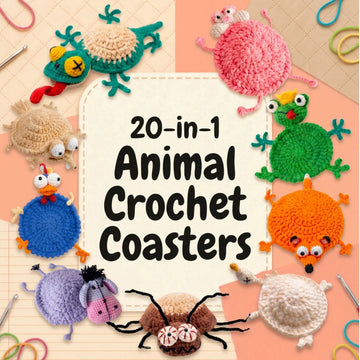
50 No-Sew Amigurumi Bundle
Beginner — 3.75 mm hook, plush chenille50+ mini plushies and characters designed for tight amigurumi tension, worked in plush chenille yarn with a 3.75 mm hook (US F-5)[2]. Great for practicing a firm, gap-free fabric. Browse our full amigurumi collection for more ideas, or read about the best yarn for amigurumi before you start.

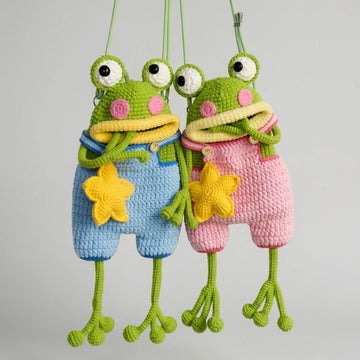
9 Modern Bag Patterns Bundle
Bag patterns — hook listed in each patternNine bag designs that mix granny squares with clean, minimalist styles. The granny square technique used in several designs works beautifully with cotton yarn. Each pattern lists both letter and mm size.

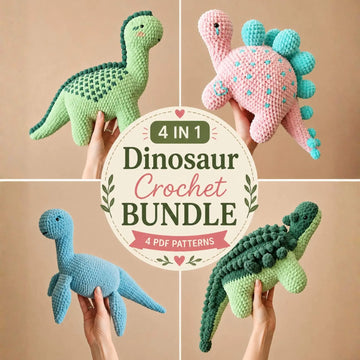
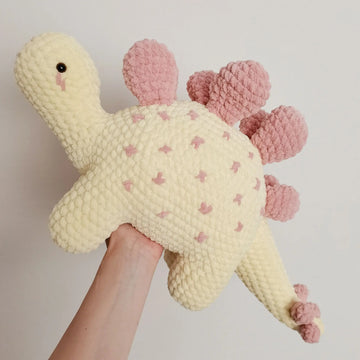
Dinosaur Amigurumi Bundle (4-in-1)
Beginner to easy intermediateFour dino friends (Diplodocus, Stegosaurus, Ankylosaurus and Elasmosaurus). Check each pattern's materials list for the hook and aim for fabric that is tight but not hand-cramping. If you have been unsure whether your tension is correct, make one of the four first and use it as your test project. Check out our tips on adding safety eyes once you're done crocheting.
Why the big hook letters are fuzzy
Letters are a shorthand. Millimeters are the measurement.
The US letter system grew up long before metric labels became standard, and each manufacturer once ran its own scale. Most hooks from B-1 to K-10½ carry the values in the chart above, but even here the Craft Yarn Council lists in-between hooks labelled only D (3.125 mm), G (4.25 mm), I (5.25 mm) or J (5.75 mm)[2]. Past K, things get looser. Jumbo hooks arrived later, driven by chunky yarn trends, and different brands assigned their letters independently, so one maker's N can be 9.0 mm while another's is 10.0 mm.
The practical rule is simple: the Craft Yarn Council advises relying on the millimeter size on the package, because letter and number sizing vary from company to company[2]. Above 6.5 mm, treat the letter as a rough hint at best. US patterns also sometimes write a hook as a bare number (an H is also an 8, a G is also a 6). That number is a third system, separate from both UK numbers and steel hook numbers, so when a pattern gives only a digit, the millimeter size in the materials list is your only safe reference.
Find your amigurumi hook with a test circle
If a pattern does not name a hook, start about 0.5 to 1.0 mm below what your yarn label suggests, then work a quick test circle: a magic ring with 6 single crochet, then 12, then 18 in the next two rounds. Hold the little disc up to the light. If you can see daylight between stitches, go down a size. If the fabric feels stiff as cardboard and hurts your hand, go up half a size.
For amigurumi you are swatching for density, not dimensions, so exact gauge matters far less than a firm, gap-free fabric. If holes still appear after a size change, our guide on why amigurumi has holes covers the other usual suspects, and the gauge swatch guide shows how to measure fabric that does need to hit a number.
Hook material, handles and head shape
Two hooks can both be exactly 4.0 mm and still feel completely different in your hand.
- Aluminum: light, smooth and available in every size. The best all-round choice for acrylic and wool.
- Steel: thin and strong without bending, made for thread and lace. Reversed numbering applies.
- Bamboo and wood: warm and slightly grippy, which helps slippery yarn stay put. Very thin wooden hooks can snap under pressure.
- Plastic and resin: mostly found in jumbo sizes where metal would be too heavy.
- Ergonomic handles: a cushioned grip around a standard shaft. The shaft is unchanged, so a 4.0 mm ergonomic hook still makes 4.0 mm stitches. Worth trying if your hands ache. See our guide to holding your hook for grip ideas.
- Inline vs tapered head: an inline head is cut straight into the shaft and gives very even stitches, while a tapered head has a rounded throat that glides in more easily. Neither is better, but switching between them can nudge your gauge.
One golden rule: finish a project with the hook you started with. A different brand or material in the same labeled size can change your tension enough to show.
Five things every crocheter should know about hooks
Beyond the size chart, these details make a real difference when you sit down to stitch.
Mm is the universal language
UK, Australian, Japanese, and European hooks are all labeled in mm. When a US pattern says "Size G," convert to 4.0 mm and you can use any brand worldwide.
Material changes feel
Aluminum hooks glide quickly and suit most yarns. Bamboo grips slightly — helpful if you crochet loosely. Many crocheters find ergonomic handles more comfortable on long sessions.
Label wear is real
Hook engravings fade. Keep a simple mm gauge tool (a flat card with calibrated holes) in your kit so you can measure any mystery hook in seconds.
Always swatch for wearables
For bags and wearables, work a 4×4 inch gauge swatch before starting. A half-stitch difference per inch adds up to inches of extra or missing width on a finished tote.
Size up for a looser gauge
If your swatch is smaller than the pattern's gauge, go one hook size larger. If it is bigger, go one size smaller. Never force your tension to match — change the hook.
Ready to pick your first project?
Our complete beginner guide walks you through choosing a hook size, buying yarn, and finishing your very first stitch — all in one place.
Quick tips for choosing the right hook size
- Start with the label: your yarn's ball band shows a recommended hook range — begin there and adjust based on your gauge swatch.
- Go smaller for amigurumi: tight stitches prevent stuffing from showing through; many amigurumi designers use a hook 0.5–1.0 mm smaller than the yarn label suggests. Our guide on why amigurumi has holes explains this in depth.
- Go larger for drape: shawls, market bags, and relaxed garments benefit from a hook 0.5–1.0 mm larger than the label to create a flowing, open fabric.
- Track your adjustments: keep a small notebook (or a note in your phone) recording which hook size you used and how your gauge turned out — you'll thank yourself on the next project.
- Buy a starter set: a basic aluminum set covering B through K (2.25–6.5 mm) covers the Craft Yarn Council ranges for DK (4.5–5.5 mm) and worsted (5.5–6.5 mm)[1] — you can add outlier sizes as projects demand.
- Check vintage patterns carefully: US patterns printed before the 1990s sometimes used a different letter-to-size mapping; if something looks off, cross-check the mm value rather than trusting the letter alone.
Pick a pattern and practice your hook sizes today
The best way to internalize the chart is to make something. Pick a pattern, check the hook size, find your matching mm hook, and start stitching — that muscle memory sticks far better than memorizing a table.
Browse amigurumi patterns Shop beginner patternsOld UK hook numbers decoded
Modern UK hooks carry millimeters only, but older British patterns and inherited hook rolls use a pre-metric number scale that runs backwards: a bigger number means a smaller hook. The values below are the standard ones.
- 2.25 mm = UK 13 (US B/1)
- 3.5 mm = UK 9 (US E/4)
- 4.0 mm = UK 8 (US G/6)
- 5.0 mm = UK 6 (US H/8)
- 6.0 mm = UK 4 (US J/10)
- 8.0 mm = UK 0 (US L/11)
See the trap? A UK 4 is a chunky 6.0 mm, while a US E/4 is only 3.5 mm. Whenever a pattern names a hook, translate it to millimeters before you pick anything up.
For UK & Australian crocheters
Good news: millimetres are your native system — UK and Australian patterns state hook sizes in mm, so the letters in this chart only matter when you pick up a US-terms pattern like ours. Use the chart above to translate the letters to the mm stamped on your hooks.
Yarn pairing translates just as easily: UK DK equals Australian 8 ply; the Craft Yarn Council lists 4.5–5.5 mm hooks for DK and 5.5–6.5 mm for worsted and aran / 10 ply[1]. And remember that US and UK stitch names differ too — a US single crochet is a UK double crochet! Our US, UK & Australian terms guide converts every stitch, weight and hook size in one place.
Frequently asked questions
What does the number on a crochet hook mean?
On US aluminum and plastic hooks the number refers to a sizing system that runs roughly parallel to the letter labels (for example, size 8 = H = 5.0 mm). The number itself is less standardized than the millimeter measurement, so always treat the mm value as the authoritative size.
Is a size H crochet hook the same as 5.0 mm?
Yes. On the Craft Yarn Council chart, 5 mm is H-8. Letter sizing can vary between brands, so check the mm stamp. A 5 mm hook sits in the DK range (4.5–5.5 mm); for worsted yarn the Craft Yarn Council lists 5.5–6.5 mm.
What size crochet hook is best for beginners?
A good start is an I/9 (5.5 mm) hook paired with a smooth worsted weight acrylic yarn, the low end of the 5.5–6.5 mm the Craft Yarn Council lists for worsted. These mid-range sizes are large enough that you can easily see your stitches but not so large that the hook feels unwieldy.
Why does my crochet hook have a letter AND a number on it?
US hooks carry both because American patterns have historically used letters (B, C, D…) while the international standard uses millimeters, and the number is a second US reference point. Over time the industry has moved toward always including the mm value as well, which is why modern hooks often show all three: letter, number, and mm.
Can I use a European or UK hook with a US pattern?
Absolutely. European and UK hooks are labeled only in millimeters. Just find the mm value listed in the US pattern (or convert the letter using the chart above) and pick the hook with that mm size — it will work perfectly regardless of brand or country of origin.
What crochet hook size do I need for amigurumi?
Most amigurumi patterns call for a hook in the D–G range (3.25–4.0 mm) when worked in standard worsted weight acrylic. Going slightly smaller than your yarn's recommended size tightens the stitches so stuffing cannot peek through the fabric. Check the specific pattern's materials list for the designer's exact recommendation.
What is the difference between steel crochet hooks and regular hooks?
Steel hooks are used for thread crochet and fine lace and follow a reversed numbering system — a higher number means a smaller hook (the opposite of regular hooks). A steel size 0 is 3.25 mm and a size 14 is only 0.75 mm. Regular aluminum and plastic hooks are used for all standard yarn weights and are what most patterns refer to unless they specifically say "thread" or "steel."
How do I know if I need to go up or down a hook size?
Work the gauge swatch specified in your pattern. If your swatch has fewer stitches per 4 inches than the pattern calls for, your stitches are too big — go down one hook size. If you have more stitches per 4 inches than called for, your stitches are too small — go up one hook size. Repeat until your swatch matches the pattern gauge.
How do I find the size of a crochet hook with no label?
Use a hook gauge, a small flat plate with holes marked in millimeters. Slide the shaft into the holes until you find the smallest one it passes through without forcing. Measure the shaft just behind the head, not the head itself or the handle, and do not judge half sizes by eye.
Do ergonomic handles change the hook size?
No. The cushioned grip surrounds the handle, while the shaft that forms your stitches keeps its stated diameter, so a 4.0 mm ergonomic hook makes the same stitches as a plain 4.0 mm hook. Your tension may relax a little with a comfortable grip, so swatch again if you switch mid-project.
What is a UK size 4 crochet hook in mm?
An old-style UK size 4 hook is 6.0 mm. UK numbers run backwards, so a higher number means a smaller hook, and they are not the same as US numbers: a US E/4 is only 3.5 mm. Convert to millimeters before you buy.
Sources
- Craft Yarn Council: Standard Yarn Weight System (yarn weights and recommended hook sizes), checked 21 Nov 2026
- Craft Yarn Council: Hooks & Needles (mm to US hook size chart), checked 21 Nov 2026
Keep reading
Hand-picked guides from our crochet blog that go with this one.

Crochet Hand Pain: How to Stop Sore Hands, Wrists and Thumbs While You Stitch
Why your hands ache after a crochet session, how grip, hook shape, yarn choice and posture cause it, and the practical fixes …
Read the guide →
Amigurumi Size Chart: The Complete Guide to Getting Your Crochet Sizes Right Every Time
Master amigurumi sizing: how yarn weight, hook size, gauge, and stitch counts control finished plushie size, plus a full …
Read the guide →
Crochet Yarn Weights Explained: The Complete US Guide from Lace to Jumbo
What the numbered yarn symbol means, which hook pairs with each weight, and how to substitute yarn safely in US crochet …
Read the guide →