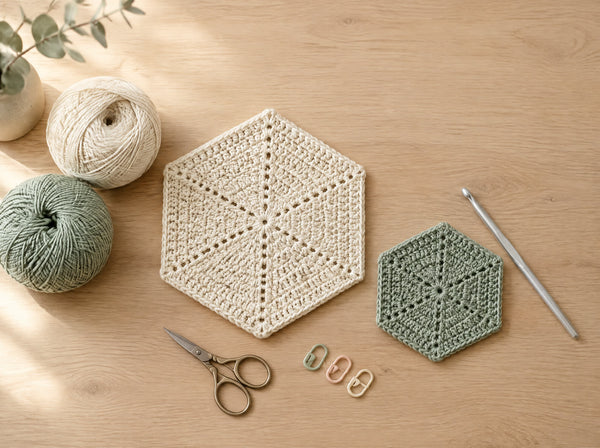
How to Crochet a Hexagon: The Flat Hexagon Formula
Six corners, one simple rule — learn the increase formula that makes every crochet hexagon lie perfectly flat, in any yarn and any size.

A hexagon looks like it should be complicated. Six sides, six corners, six chances for something to go wrong. In reality the crochet hexagon is one of the most forgiving shapes you will ever work, because it runs on a single repeating rule: six increase points, spaced evenly, stacked directly on top of each other, round after round. Once that rule clicks, you can make a hexagon the size of a coaster or the size of a blanket without ever looking at a pattern again.
That is the whole mathematical story, and it is worth sitting with for a moment before we go further. A flat shape in crochet is always a negotiation between how fast you add stitches and how much room the fabric needs to expand. Add too few stitches and the fabric pulls inward, curling into a shallow bowl. Add too many and the edges ruffle like a lettuce leaf. The flat hexagon sits exactly in the middle of that balance, and the reason it works so reliably is that the increases are concentrated rather than spread out.
This is the crucial difference between a hexagon and a circle, and it is the thing most crocheters never have explained to them. A circle and a hexagon of the same size contain roughly the same number of stitches and grow at roughly the same rate. What separates them is purely where you put the increases. Spread the increases evenly around the round and you get a circle. Stack them in six fixed columns and you get a hexagon with six crisp points. Same maths, different distribution, completely different shape.
In this guide you will learn the formula itself, the round-by-round numbers, how to keep your corners from drifting, how to choose between the two main hexagon styles, and how to turn single motifs into blankets, cushions and garments. Everything here is written in US crochet terms, and everything works with whatever yarn and hook you already have on your desk.
The three ideas behind every flat hexagon
Understand these three and you will never need to look up a hexagon pattern again.

A hexagon is a circle with its increases stacked
Work a flat circle and you add six stitches per round, spaced as evenly as possible so no single spot grows faster than its neighbours. Work a hexagon and you add exactly the same six stitches, but you always put them in the same six places. Those six columns of increases become ridges, and the fabric between them stays straight. The ridges are the corners. If you can crochet a flat circle, you already have every skill a hexagon requires — you are simply being deliberate about placement instead of spreading the growth out.
Read the flat circle formula →
Every corner must sit on top of the last one
A corner is simply two stitches worked into one stitch. The shape only stays sharp if each new corner lands directly above the corner from the round below. Drift by a single stitch and the point softens; drift repeatedly in the same direction and your hexagon quietly rotates into a spiral-edged blob. Six stitch markers, one per corner, solve this permanently. Move each marker up as you pass it and your corners cannot wander, no matter how long the round becomes.
How to use stitch markers →
Six straight sides tessellate without gaps
This is the practical payoff. Circles leave holes when you join them; hexagons lock together edge to edge with no gaps at all, exactly like a honeycomb. That makes the hexagon the most useful motif in crochet after the granny square, and arguably more interesting to look at. A pile of hexagons becomes a blanket, a cushion cover, a bag panel, a table runner or a scarf, and because each motif is small, the whole project stays portable.
Browse our pattern collection →The flat hexagon formula, round by round
Here is the version worked in single crochet, which gives the firmest fabric and the sharpest corners. Work in continuous rounds or join each round with a slip stitch — both work, and we will cover the difference below. Place a stitch marker in each of the six corner stitches from Round 2 onwards.
- Round 1. Make a magic ring and work 6 single crochet into it. Pull the ring closed. You have 6 stitches, and every one of them is a corner.
- Round 2. Work 2 single crochet into each stitch around. You now have 12 stitches, arranged as six pairs. Mark the second stitch of each pair as your corner.
- Round 3. Work 2 single crochet into the corner stitch, then 1 single crochet into the next stitch. Repeat six times. 18 stitches.
- Round 4. 2 single crochet into the corner, then 1 single crochet into each of the next 2 stitches. Repeat six times. 24 stitches.
- Round 5. 2 single crochet into the corner, then 1 single crochet into each of the next 3 stitches. Repeat six times. 30 stitches.
- Round 6 and beyond. Keep going exactly the same way. Each round, the run of plain stitches between corners grows by one. The round number minus one tells you how many plain stitches to work.
- Finish. Stop at whatever size you need, slip stitch into the next stitch, fasten off and weave in your ends.
The number pattern is beautifully regular, which makes it easy to check your work without counting the whole round. If your stitch count matches the table at the end of each round, your hexagon is correct. If it does not, the error is almost always a missed or doubled corner, and it will be in the round you just finished.
| Round | Plain stitches between corners | Total stitches | Approx. width in worsted yarn |
|---|---|---|---|
| 1 | 0 | 6 | Under 1 in / 2 cm |
| 2 | 0 | 12 | 1.5 in / 4 cm |
| 3 | 1 | 18 | 2.5 in / 6 cm |
| 4 | 2 | 24 | 3 in / 8 cm |
| 5 | 3 | 30 | 4 in / 10 cm |
| 6 | 4 | 36 | 4.5 in / 11 cm |
| 7 | 5 | 42 | 5.5 in / 14 cm |
| 8 | 6 | 48 | 6 in / 15 cm |
| 10 | 8 | 60 | 7.5 in / 19 cm |
| 12 | 10 | 72 | 9 in / 23 cm |
Those widths are a guide, not a promise. They assume worsted weight yarn and a 4 mm hook at an average tension. Your own hexagons may come out noticeably larger or smaller, and that is completely normal — it simply means your hands work tighter or looser than mine. What matters is that the shape is flat and the corners are crisp. If you need a specific finished size, make one motif, measure it, and scale your round count from there.
Quick troubleshooting
- Edges ruffle or wave. You have more than six increases per round, or you are increasing in a round that should be plain. Count the corners — there must be exactly six.
- Hexagon cups into a bowl. You have fewer than six increases, or your tension has tightened. Check each corner has two stitches worked into one.
- Corners look soft and rounded. Your increases are drifting sideways. Mark all six corners and make sure each new one sits directly above the last.
- Shape is lopsided. One corner has been missed somewhere. Count the plain stitches between each pair of corners — they should all be identical.
- A visible seam runs up one side. You are working joined rounds with a chain that is too tall, or continuous rounds are pulling. Try the alternatives described below.
A hexagon is not a harder shape than a circle. It is the same six increases, simply told where to stand.— Ava, MrsCrochetWorld
Solid hexagons versus granny hexagons
There are two families of crochet hexagon, and choosing the right one for your project saves a lot of frustration later. They are built on the same six-corner logic, but they feel and behave completely differently.
The solid hexagon
This is the version described in the formula above: single crochet or half double crochet worked into every stitch, with two stitches into each corner. The fabric is dense, warm and almost windproof, with no holes for small fingers or furniture legs to catch in. It takes longer to work and uses more yarn for the same surface area, but it is the right choice for baby blankets, cushion fronts, bag panels, potholders and anything that needs to be sturdy. Solid hexagons also show off variegated and gradient yarns beautifully, because there are no gaps to break up the colour flow.
The granny hexagon
Here you work clusters of three double crochet separated by chain spaces, with two clusters and a chain at each corner. It grows roughly three times faster than a solid hexagon, uses less yarn, and has the open lacy look most people picture when they think of a vintage crochet blanket. The trade-off is the holes. For a throw blanket draped over a sofa that is a feature; for a pram blanket it can be a hazard, because little fingers and toes get caught. Granny hexagons are also slightly more forgiving of uneven tension, since the chain spaces absorb small inconsistencies.
Which should you choose?
If you want the project finished quickly and you like an airy fabric, work granny hexagons. If you want durability, warmth and a smooth surface, work solid hexagons. For a first hexagon project I usually suggest solid, because the dense fabric makes the six corners obvious and teaches you to see the shape clearly. Once the formula is in your hands, switching to granny construction takes about five minutes to learn.
Joined rounds or continuous rounds?
Solid hexagons can be worked either way. Continuous rounds, where you simply keep spiralling without joining, produce a smoother fabric with no visible seam, but the start of each round creeps sideways by half a stitch, so you must rely on markers rather than counting from a join. Joined rounds, where you slip stitch to close and chain to begin, keep every round perfectly aligned and make the corners easier to track, at the cost of a faint ridge running from the centre to one corner. For motifs that will be joined into a blanket, joined rounds are usually easier, because the alignment makes the seaming tidier. For a single standalone piece, continuous rounds look cleaner.
Getting your tension and yarn right
The hexagon formula is mathematically sound, but maths cannot save a shape from inconsistent tension. If your hexagon refuses to lie flat even though your stitch counts are correct, tension is almost always the reason. Three things make the biggest difference.
Hook size relative to yarn. For solid hexagons, go down one hook size from the ball band recommendation. A 4 mm hook with worsted weight yarn rather than 5 mm gives a tighter, more structured fabric that holds its corners. For granny hexagons, stay at the recommended size or go up, because the open structure needs the drape.
Yarn fibre. Cotton gives the sharpest corners because it has almost no stretch and holds whatever shape you crochet into it. Acrylic is softer and more forgiving, which makes it lovely for blankets but slightly blurs the points. Wool sits between the two and has the enormous advantage that it blocks beautifully — a wool hexagon that looks slightly uneven off the hook will often pin out into a perfect shape. Avoid very fluffy or textured yarns for your first hexagon, because you will not be able to see your stitches clearly enough to place the corners.
Consistency across motifs. If you are making many hexagons for a blanket, tension drift between the first and the fiftieth motif is a genuine problem. Crochet them in small batches rather than one marathon session, keep the same hook throughout, and measure every tenth motif against your first one. A difference of a quarter of an inch per motif becomes several inches across a finished blanket.
Blocking is the final correction tool and it is worth doing even on acrylic, where a gentle steam will relax the fibres enough to even out the edges. Pin each hexagon out with a pin at every corner, mist or steam it, and let it dry completely before joining. The difference between a blocked and an unblocked hexagon blanket is dramatic.
Turning hexagons into finished projects
A single hexagon is a coaster. Seven hexagons make a trivet or a small mat. Thirty or forty make a pram blanket, and a hundred and fifty make a generous throw. Because every motif is identical, hexagon projects are ideal for carrying around, for using up leftover yarn, and for crocheting in the gaps of a busy week.
For joining, you have the same options as with any motif. Whip stitching through the back loops gives a nearly invisible seam and is my default for solid hexagons. Slip stitching through both loops creates a raised decorative ridge on the right side, which suits granny hexagons and bolder colour schemes. Join-as-you-go, where you connect each new motif to its neighbours on the final round, avoids a mountain of seaming at the end but requires planning your layout in advance. All three are perfectly valid; pick the one whose rhythm you enjoy, because you will be doing it many times.
One practical note on layout: hexagons tessellate in offset rows rather than a grid, so the edges of a hexagon blanket will be naturally zigzagged. You can embrace that as a design feature, or work half-hexagons along the edges to square it off. For a first project, embrace the zigzag — it looks intentional and saves a great deal of fiddly maths.
Colour planning is where hexagon projects become genuinely addictive. Because each motif can have two, three or four colours in concentric rings, a single palette of five yarns can generate dozens of distinct motifs. A simple approach that always works: keep the outermost round the same colour on every hexagon, and let the inner rounds vary freely. The shared outer round ties the whole blanket together no matter how chaotic the centres are.
Keep exploring
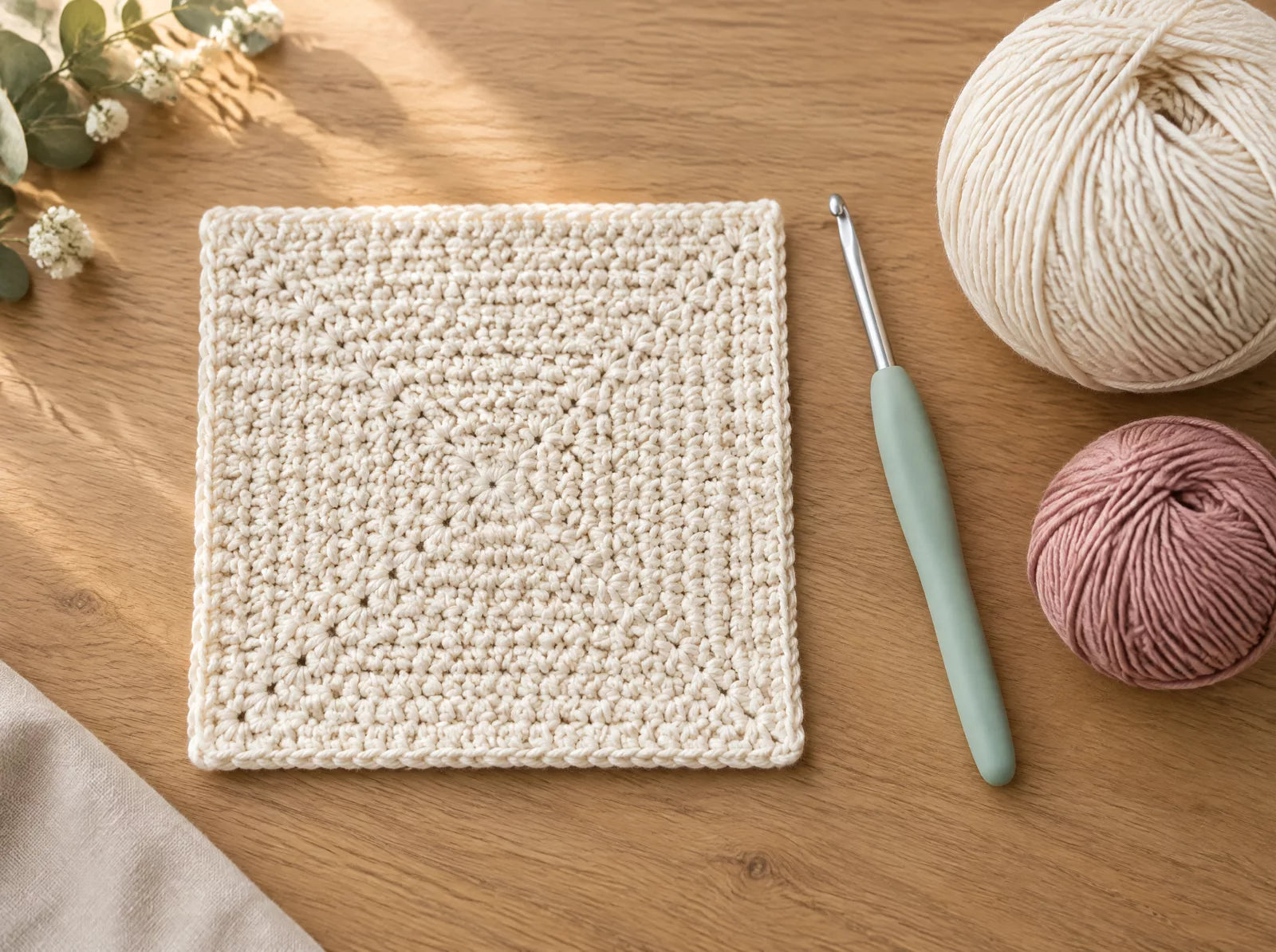
The four-corner version of the same increase logic, with full round-by-round numbers.
Read the guide →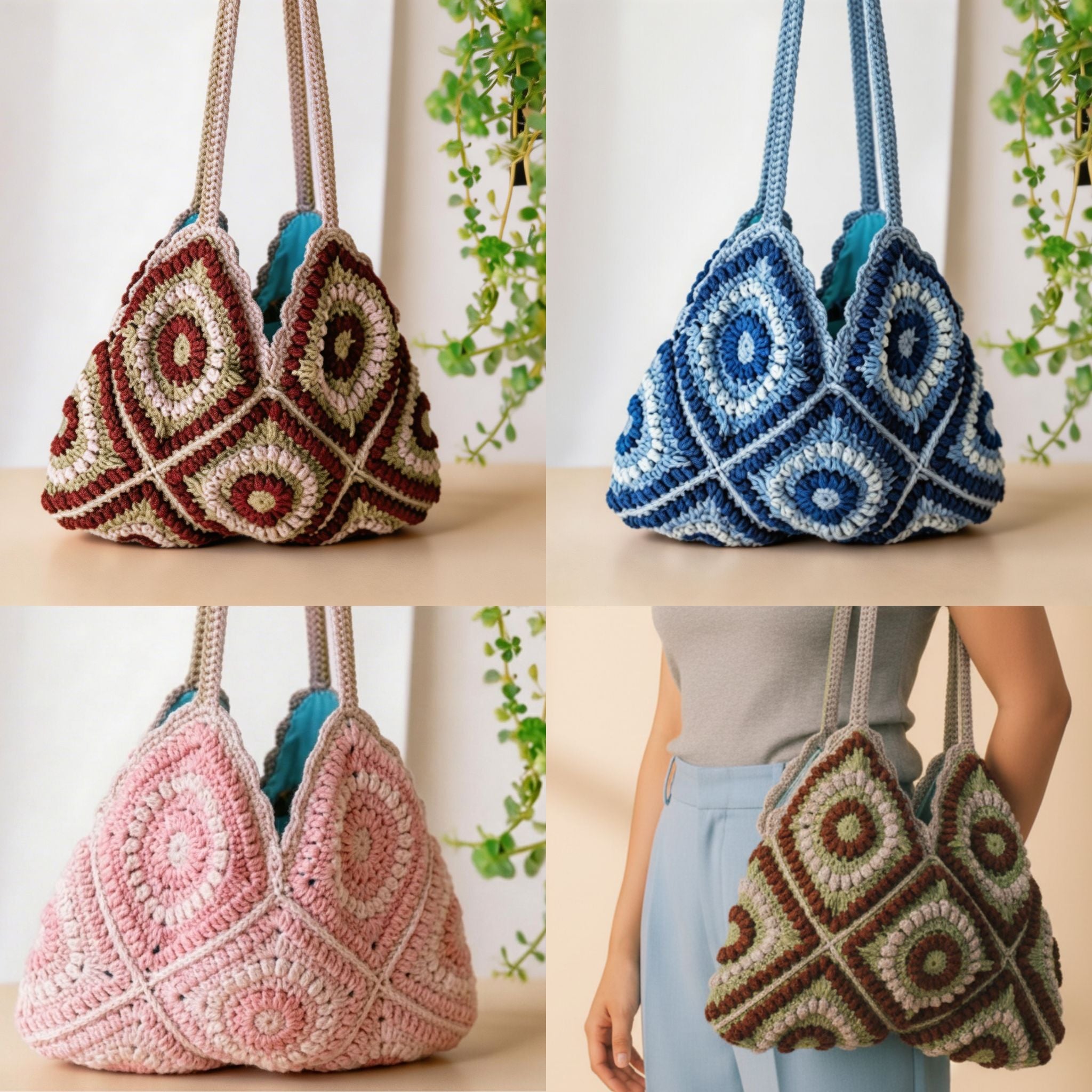
Master cluster construction, then apply it to hexagons for the lacy granny look.
Read the guide →
A motif-based tote with a full video tutorial — swap the squares for hexagons if you like.
View pattern →
Fourteen flat motif patterns to practise increase placement on small, quick projects.
View pattern →Six corners
Always exactly six increase points.
Plus six
Every round grows by six stitches.
Mark them
One stitch marker per corner.
Block it
Pin each corner, then dry flat.
Frequently asked questions
How many increases does a crochet hexagon need per round?
Exactly six, one at each corner. This never changes, no matter how large the hexagon grows. Round 1 has 6 stitches, Round 2 has 12, Round 3 has 18, and so on — every round adds six stitches. If you find yourself adding more or fewer than six, that is the source of any ruffling or cupping.
Why does my crochet hexagon curl up at the edges?
Curling means the fabric does not have enough stitches to lie flat, so it pulls inward into a shallow bowl. Either you have missed an increase somewhere, or your tension has tightened as you worked. Count the corners first — there must be six, each with two stitches worked into one stitch. If the count is right, try going up a hook size and consciously relaxing your grip.
Why are my hexagon edges ruffling and waving?
Ruffling is the opposite problem: too many stitches for the space available. You are either increasing more than six times per round, or accidentally working extra stitches into a corner. Go back to the last round where the piece lay flat, count the plain stitches between each pair of corners, and make sure they are all identical before continuing.
What is the difference between a crochet hexagon and a flat circle?
Only the placement of the increases. Both shapes add six stitches per round. In a circle those six increases are spread as evenly as possible around the round, so growth is uniform and the edge stays curved. In a hexagon they are stacked in six fixed columns, which creates six ridges that become the corners and leaves the fabric between them straight.
Should I crochet a hexagon in joined rounds or continuous rounds?
Both work. Continuous rounds give a smoother fabric with no visible seam, but the round start drifts sideways, so you must track corners with markers. Joined rounds keep everything perfectly aligned and make corners easier to follow, at the cost of a faint ridge running from centre to edge. For motifs that will be joined into a blanket, joined rounds usually make seaming tidier.
How do I stop my hexagon corners from drifting sideways?
Use six stitch markers, one in each corner stitch, and move each marker up as you pass it in the next round. This makes drift physically impossible to miss, because you can see immediately if a new corner is not sitting directly above the marked one. It is the single most effective habit for crisp hexagons.
What yarn works best for crochet hexagons?
Cotton gives the sharpest, most defined corners because it has almost no stretch. Wool is a close second and has the advantage of blocking beautifully, so minor unevenness can be pinned out. Acrylic is soft and forgiving but slightly blurs the points. Avoid very fluffy or heavily textured yarns for your first hexagon — you need to see your stitches to place the corners accurately.
How many hexagons do I need for a blanket?
It depends on motif size. With a 6 in / 15 cm hexagon, a pram blanket of roughly 30 by 36 in needs about 35 to 40 motifs, and a generous sofa throw of around 50 by 60 in needs roughly 140 to 160. Make one hexagon first, measure it, then divide your target dimensions by that size and add about ten percent for the offset rows.
Can I crochet a hexagon without a magic ring?
Yes. Chain 4 and slip stitch into the first chain to form a ring, then work your 6 stitches into that ring. The centre will have a small visible hole, which is fine for granny hexagons and often invisible once motifs are joined. The magic ring simply pulls that hole closed completely, which matters more for solid hexagons where a gap would be obvious.
How do I join crochet hexagons together?
Whip stitching through the back loops gives a nearly invisible seam and suits solid hexagons. Slip stitching through both loops creates a raised decorative ridge on the right side, which suits granny hexagons. Join-as-you-go connects each new motif on its final round, avoiding all the seaming at the end but requiring you to plan your layout first.
Do crochet hexagons need blocking?
They benefit enormously from it, even in acrylic. Pin each hexagon out with a pin at every one of the six corners, mist with water or apply gentle steam, and let it dry completely before joining. Blocking evens out small tension differences between motifs and makes the finished blanket look far more professional.
Can I use half double crochet or double crochet instead of single crochet?
Absolutely, and the formula is identical — six increases per round, stacked at the corners. Taller stitches grow faster, so your hexagon reaches a given size in fewer rounds, and the fabric is more open and drapey. Half double crochet is a popular middle ground: quicker than single crochet but still dense enough for blankets.
Put the formula to work
Once six corners feel automatic, every geometric motif in crochet opens up. Our pattern library is full of projects built on exactly this kind of shape logic.
Browse all crochet patterns Visit the free stitch library