How to add safety eyes to amigurumi step by step — MrsCrochetWorld Care Bears crochet tutorial

How to Add Safety Eyes to Amigurumi — Step-by-Step

How to add safety eyes to amigurumi step by step — MrsCrochetWorld Care Bears crochet tutorial

How to Add Safety Eyes to Amigurumi — Step-by-Step

📖 11 min read 👩‍🎨 By MrsCrochetWorld 👁️ Beginner Friendly ✨ Safety Rules Inside

Eyes are everything. A crocheted bear with perfectly placed safety eyes looks alive — it has personality, charm, that elusive "designer plushie" quality. The exact same bear with eyes set even one stitch too high or too far apart looks confused, sleepy, or just plain wrong. Plastic safety eyes are the single fastest way to give your amigurumi the polished, professional finish that store-bought plushies have, but they also have one absolute rule: insert them before you stuff the piece. Get this wrong and you will be doing surgery on a finished plushie.

At MrsCrochetWorld, every pattern that uses safety eyes lists the exact round, the exact stitch count between them, and the exact size in millimetres. In this complete tutorial you will learn what safety eyes actually are, how to choose the right size for your project, when in the construction process to install them (spoiler: before stuffing, always), the step-by-step insertion technique, the positioning tricks for symmetric placement, the alternatives when safety eyes are not appropriate, and the child-safety rules that determine when you should skip plastic eyes entirely. Whether you are inserting your first pair or your hundredth, this is the safety-eye tutorial we wish was bundled with every pack.

Quick Answer: Safety eyes are two-part plastic eyes — a glossy black or coloured stem on the outside, secured by a plastic locking washer on the inside. To install them: before stuffing, push the eye stem through a gap between crochet stitches at the chosen position, push the washer onto the stem from the inside, and slide it down until it clicks past the locking ribs. They are permanent once locked. For a 20 cm amigurumi, choose 8–10 mm safety eyes. Place them at the widest round of the head, an odd number of stitches apart (3, 5 or 7), with the centre line of the snout exactly between them. Never use safety eyes on toys for children under 3 years old — embroider eyes instead with the same yarn or embroidery floss.

What are safety eyes?

A safety eye is a two-part plastic component designed specifically for stuffed toys, dolls and amigurumi. The outer half is a smooth, glossy dome — usually black, but available in a wide range of colours and finishes — attached to a ribbed plastic post. The inner half is a flat plastic washer with a ribbed hole that slides onto the post and locks permanently in place. Once the washer is pressed past the locking ribs, the eye cannot be removed without cutting it out. This permanence is what makes them "safety" eyes: a child cannot pry them off and swallow them, the way they might with buttons or sewn-on beads, provided the eye is installed correctly before stuffing.

Safety eyes come in many styles. The most common are the solid black glossy dome — the classic teddy-bear eye — and the cat-eye / animal-eye with a coloured iris around a black pupil. Beyond these you will find sleeping eyes (half-circles for closed-eye plushies), heart-shaped eyes for kawaii characters, glitter eyes, sparkle eyes, and even safety noses in the same locking-stem format.

Eye style Look Best for
Solid black glossy dome Classic teddy-bear shine Bears, dogs, bunnies, simple amigurumi
Coloured iris (cat/animal) Coloured ring around black pupil Cats, foxes, dragons, fantasy creatures
Sparkle / glitter eyes Dome with embedded glitter Kawaii, unicorns, magical characters
Sleeping / closed eyes Half-circle dome Sleeping animals, peaceful poses
Heart-shaped eyes Heart-shaped dome Kawaii valentines, love-themed plushies
Cabochon (flat back, no stem) Glued in place, no washer Adult-decor amigurumi only — not child-safe

📌 Material matters: Look for safety eyes made from BPA-free polypropylene with steel-ribbed washers. Cheap unbranded eyes sometimes use brittle plastic that cracks under washer pressure. For toys gifted to anyone, buy from a reputable craft supplier and check that the pack states the material.

Safety eye size guide

Safety eyes are sold in millimetres, measured by the diameter of the dome. The most common range for amigurumi is 6 mm to 18 mm, but the full retail range runs from 3 mm (mini eyes for keychain plushies) up to 30 mm or more (for large display plushies). Choosing the right size is the single most impactful decision for the look of your plushie's face — too small and the character looks beady-eyed and sad, too large and it looks startled or cartoonish.

A reliable starting rule: the eye diameter in millimetres should roughly match 1/20th to 1/25th of the head circumference. So a 20 cm circumference head (about 6.4 cm across) suits 8–10 mm eyes. A 30 cm circumference head suits 12–14 mm eyes. Patterns always specify the recommended size — follow it when in doubt.

Plushie size Head circumference Recommended eye size Look
Mini keychain (5–8 cm) ~10 cm 3–4 mm Tiny and delicate
Small plushie (10–14 cm) ~14 cm 5–6 mm Cute and balanced
Standard plushie (15–20 cm) ~18 cm 8–10 mm Classic teddy-bear look
Medium-large (20–28 cm) ~24 cm 12–14 mm Bold expressive face
Large display (30–40 cm) ~32 cm 16–20 mm Dramatic, statement plushie
Giant plushie (45 cm+) 40 cm+ 24–30 mm Character-driven oversized eyes

💡 Buy a multi-pack: When starting out, a multi-size pack (4–14 mm assortment, 50–100 pairs) costs less than two single-size packs and gives you flexibility to test different looks. Tape the pairs to a card labelled by size so you can find what you need at a glance.

When to insert safety eyes — before stuffing!

This is the rule of safety eyes, in capital letters, written in pink yarn on every studio wall: INSERT THE SAFETY EYES BEFORE YOU STUFF THE PIECE. Once a head is stuffed and closed, the inside is unreachable and the washer cannot be applied. There is no fix for a closed head with no washers — the eyes will fall off and become a choking hazard. You will have to cut the stitches around the eye opening, push the eye out, and start over.

The correct moment in the construction sequence is:

  1. Crochet the head fully. All increases and decreases done. The closing hole is still open. The head is empty.
  2. Identify the eye position. Count the round and the stitches according to the pattern. Mark with stitch markers if helpful.
  3. Insert the eye stems from outside in. Push the post through a gap between two adjacent stitches at the marked position.
  4. Apply the washers from inside. Push each washer onto its corresponding stem until you hear or feel the click past the locking ribs.
  5. Test by pulling the eye firmly from outside. If it moves, push the washer further; if it holds, you are locked in.
  6. Now stuff the head. Pack the fiberfill around the washers; they are fully buried inside the stuffing.
  7. Close the head. Decrease, fasten off, weave end inside.

⚠️ Once locked, locked forever: The washer ribs are one-way. Once you push the washer past the ribs, it cannot be removed without destroying the eye. Triple-check positioning before pushing the washer on. The most expensive mistake in amigurumi is locking eyes in the wrong place.

Step-by-step: how to add safety eyes to amigurumi

Step 1

Identify the eye position

Read your pattern carefully. A typical amigurumi pattern will say something like "place safety eyes between rounds 10 and 11, 6 stitches apart, centred on the front of the head." Find round 10. Count 3 stitches to the left of the centre marker. That is one eye position. Count 3 stitches to the right of the centre. That is the other eye position. Mark both with stitch markers.

Step 2

Push the eye stem through the fabric

Pick up the safety eye and locate the small gap between two adjacent crochet stitches at the marked position. Do not push through a stitch itself — push through the gap between stitches. The post is rigid enough to spread the gap open without damaging the yarn. Push the post through from the outside (right side) until the dome is flush against the fabric.

Step 3

Inspect from the front

Before attaching the washer, look at the head from the front. Is the eye at the height you wanted? Is it slightly tilted? If anything looks off, this is the only moment you can adjust. Slide the eye out, choose a different stitch gap, and re-insert. Once you apply the washer, you cannot reposition.

Step 4

Apply the washer from inside

Reach into the head through the still-open bottom. Push the washer onto the eye post with the ribbed (textured) side facing the inside of the head and the flat smooth side facing the inside-back of the eye. Press the washer firmly down the post until you feel the click as it passes the first locking rib. Keep pushing for one more click — two clicks of locking provide much more security than one.

Step 5

Repeat for the second eye

Repeat the same process for the second eye. Before applying the washer, look at the face once more — both eyes are in place but not locked. Make sure they look symmetric. Adjust if necessary. Then lock the second washer.

Step 6

Test the security

From the outside, gently pull on each eye with thumb and forefinger. If you feel any movement, push the washer one more click. A securely locked safety eye should not budge under firm finger pressure.

Step 7

Stuff the head as normal

With eyes securely locked, stuff the head with polyester fiberfill following the stuffing rhythm (walnut-sized pinches, push to the bottom, build up in thin layers). The washers will be completely buried inside the stuffing and become invisible.

Step 8

Close the head

Complete the final decreases as written in the pattern. Fasten off, weave the yarn end through the inside of the head, pull taut, and snip flush. The eyes are now permanently installed.

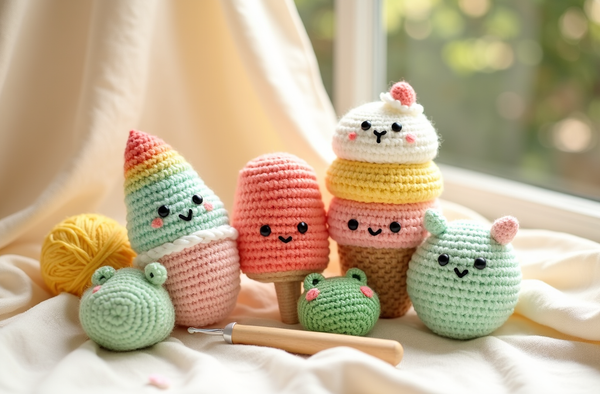
MrsCrochetWorld Care Bears crochet plushies with perfectly placed safety eyes and embroidered details

Positioning tricks for the perfect amigurumi face

Even with the right size and the correct insertion technique, eye placement can make or break a plushie's character. A bear with eyes one round too high looks startled; the same bear with eyes one stitch closer together looks intelligent and curious. Here are the placement rules our designers follow.

Use an odd number of stitches between the eyes

Place eyes 3, 5, 7 or 9 stitches apart — always an odd number. This guarantees a single stitch (or stitch column) sits exactly between them, which is your face centre line. The centre line gives you the exact spot to embroider a nose later, automatically symmetric.

Place at the widest round, not the top

For a sphere-shaped head, the widest round (the equator) is too low for eye placement. Eyes look natural placed slightly above the equator, on the second or third round above the widest point. Eyes placed below the equator make the character look sad or sleepy; eyes too high near the top of the head look surprised.

The "thirds" rule

Divide the head vertically into thirds. The eyes belong at the boundary between the upper third and the middle third — what artists call the "eye line." This applies whether the character is a bear, cat, dog, dinosaur or kawaii blob.

Use pins before locking

If you are unsure about placement, push sewing pins or stitch markers through the head at the planned positions first. Stand back, look at the head, photograph it, adjust the pins, repeat. Only when the pinned position passes the photo test should you replace the pins with actual eyes.

💡 The 0–6–0 method for symmetric placement: Find the magic-ring centre point at the top of the head. From there, count down to the chosen round (e.g. round 11). Mark a centre stitch with a coloured marker. Count 0 stitches at centre, 3 stitches to the left, 3 stitches to the right — that is your "0–6–0" eye line. Foolproof symmetric placement, every time.

Alternatives: buttons, embroidered eyes, felt

Safety eyes are wonderful, but they are not the only option — and for some projects (children under 3, washable plushies, ultra-budget builds), they are not even the right option. Here are the alternatives and when to use each.

Embroidered eyes — the safest choice

For toys gifted to children under 3, embroidered eyes are the only fully safe choice. Use the same yarn as the body, or a slightly thinner embroidery floss in matching black. With a sharp embroidery needle, work a small cluster of straight stitches in a circular pattern to build up a "ball" of yarn that looks like an eye. Add a single white highlight stitch off-centre for that "alive" glint.

Embroidered eyes have several advantages: completely child-safe, machine-washable, infinitely reshapeable, free (no extra purchase required), and unique to each plushie. The downside is that they take more skill to make symmetric, and they will never have the glossy shine of a plastic dome.

Felt circles glued or sewn on

Cut small felt circles (3–8 mm) in black or a coloured iris colour, optionally layered (white outer + coloured middle + black pupil). Glue with fabric glue or sew on with matching thread. Felt eyes are budget-friendly and forgiving, but they can peel off over time. Acceptable for decorative plushies; not suitable for toys gifted to children.

Buttons — vintage charm

Small dark buttons can replace safety eyes for adult-decor amigurumi and vintage-look plushies. Sew on with strong thread, knotted on the back. Buttons are never appropriate for children's toys: the thread eventually wears through and the button becomes a choking hazard.

Wooden beads

Small smooth wooden beads, painted or stained, sewn on with strong thread. A favourite for natural-fibre Waldorf-style amigurumi. Like buttons, not suitable for very young children.

Crocheted eyes

Make small magic-ring discs (3–5 stitches in the round) and sew them onto the head. Works beautifully for kawaii characters with oversized white sclera and small black pupils. Fully washable and 100% safe for all ages — the only downside is the additional crocheting time.

Eye type Child-safe Skill level Look
Plastic safety eyes Yes (with washer locked) Beginner Glossy professional
Embroidered yarn eyes Yes — all ages including infants Beginner–Intermediate Soft, hand-made
Crocheted eye discs Yes — all ages Intermediate Kawaii oversized
Felt circles Older children only Beginner Flat, cartoonish
Buttons Decorative only — not for children Beginner Vintage, classic
Wooden beads Older children only Beginner Natural Waldorf

Child-safety rules — when not to use safety eyes

"Safety eyes" are called safety eyes because the locking washer makes them safer than glued-on alternatives — but they are not absolutely safe for very young children. The relevant standards are EN 71 (Europe) and ASTM F963 (US), both of which classify any rigid component that can detach from a soft toy as a small-parts hazard for children under 3 years old.

For children under 3 years old

Always embroider eyes with yarn or use crocheted eye discs. Never use safety eyes, buttons, beads, or felt cut-outs. The locking washer on safety eyes is rated for normal handling, but a toddler with persistent chewing can eventually loosen even a properly installed washer. Embroidered eyes have no detachable components and pose zero choking risk.

For children 3+ years old

Safety eyes are widely considered safe provided: the eye is correctly installed (washer locked past two ribs), the plushie has been tested by a firm pull test, and the toy has been used as designed (not chewed aggressively). For a higher safety margin, embroidered eyes remain the safer choice.

If you sell amigurumi commercially

If you sell plushies to be given to children, you must comply with the toy-safety standard of the destination country. In Europe, that means CE marking under the EN 71 framework; in the US, that means ASTM F963 compliance and CPSIA registration for products marketed to children under 12. For most independent designers, the simplest path to legal sale is to design two versions of each plushie: a "for ages 3+" version with safety eyes, and a "for ages 0+" version with embroidered eyes.

⚠️ When in doubt, embroider: If you are gifting a plushie and you do not know the exact age of the recipient (or whether younger siblings live in the house), embroider the eyes. The slightly different look is worth the certainty that no parent will have to take the toy away.

Common safety-eye mistakes to avoid

  1. Pushing the post through a stitch instead of between stitches. Damages the yarn and creates a permanent hole that will not close.
  2. Locking the washer before checking symmetry. Once locked, the eye is permanent. Always inspect from the front first.
  3. Stopping after only one washer click. One click is not enough for security. Push for the second click.
  4. Using safety eyes on toys for babies. Embroider eyes for any plushie that may end up with a child under 3 years old.
  5. Forgetting to insert eyes before stuffing. The single most painful mistake in amigurumi. Always insert before the head is closed.
  6. Choosing eyes that are too small. Beady-eyed plushies look unfinished. Err on the larger side of the size chart.
  7. Buying unbranded eyes from unknown suppliers. Cheap unbranded plastic can crack under washer pressure. Buy from reputable craft retailers.
  8. Skipping the firm pull test. Always pull each eye firmly before stuffing. Better to discover a loose washer now than after gifting.

Frequently asked questions about safety eyes

What size safety eyes do I need for my amigurumi?

The eye diameter in millimetres should roughly equal 1/20th to 1/25th of the head circumference. For a standard 15–20 cm plushie use 8–10 mm eyes; for a 10–14 cm small plushie use 5–6 mm; for a 25 cm plushie use 12–14 mm. Patterns always specify the recommended size — follow it when in doubt.

When do I insert safety eyes — before or after stuffing?

Always before stuffing. Once the head is stuffed and closed, the inside is unreachable and the locking washer cannot be applied. Insert eyes when the head is fully crocheted but still empty, lock the washers from inside, then stuff and close as normal.

Are safety eyes really safe for children?

Safety eyes are designed to meet EN 71 (Europe) and ASTM F963 (US) standards for toys gifted to children 3 years and older, provided the washer is correctly locked past two ribs. For children under 3 years old, safety eyes are not recommended — embroider eyes with yarn instead, or use crocheted eye discs. The locking system is robust but not absolute, and toddlers can eventually loosen even properly installed washers through persistent chewing.

How do I make sure my safety eyes are placed symmetrically?

Place eyes an odd number of stitches apart (3, 5, 7 or 9) so a single stitch column sits exactly between them. Find the magic-ring centre at the top of the head, count down to the chosen round, mark the centre stitch, then count an equal number of stitches left and right. Push pins through the planned positions first, photograph the head, adjust if needed, and only insert the actual eyes after the pinned position passes the photo test.

Can I remove a safety eye after locking the washer?

Practically no — the locking ribs are one-way and the washer is designed to be permanent. To remove a wrongly placed eye, you have to cut the crochet stitches immediately around the eye, push the eye stem out, discard the damaged eye, and re-crochet the small area. The eye and washer cannot be reused. This is why we recommend pinning the position first and double-checking before locking the washer.

Can I machine-wash an amigurumi with safety eyes?

Most safety eyes are made from BPA-free polypropylene and are themselves machine-washable, but the surrounding crochet may not be. We recommend hand-washing amigurumi in cool soapy water, gently squeezing out excess water, and air-drying flat on a towel. Repeated machine agitation can eventually loosen even securely locked washers, especially in older plushies.

What can I use instead of plastic safety eyes?

For child-safe alternatives, embroider eyes with yarn or embroidery floss, or crochet small magic-ring discs (3–5 stitches in the round) and sew them onto the head. For adult-decor amigurumi you can also use small dark buttons sewn on, felt circles glued or sewn on, or wooden beads. Anything sewn or glued is not appropriate for children under 3 years old.

Why do my safety eyes sit too far apart?

Almost always because the pattern's recommended stitch count between eyes was applied to a head that ended up larger than expected — usually because the gauge is loose, the yarn is thicker than specified, or the hook is too large. Try eyes one or two stitches closer together than the pattern says. For your next project, switch to a smaller hook to tighten gauge and bring the head back to the intended dimensions.

Can I use safety eyes on something other than the head?

Yes — safety eyes work as small dots or accents anywhere on a plushie. We use them on belly buttons, paw pads, decorative buttons on clothes, and noses. As long as the fabric is single-thickness and the washer can be applied from the inside before the piece is stuffed and closed, safety eyes work anywhere on amigurumi.

Are there safety eyes for noses?

Yes. Safety noses use the same two-part locking-stem design as safety eyes but with a small triangular or oval-shaped dome instead of a round one. They install in the same way — insert before stuffing, lock the washer from inside. Sizes range from 6 mm to 25 mm, with 9–12 mm being the sweet spot for standard amigurumi.

Summary — perfect safety eyes every time

Safety eyes are the fastest way to give your amigurumi a polished, designer-quality face — but they have one rule that beats all others: insert them before stuffing the head. Choose a size proportional to the head circumference (8–10 mm for a standard 18 cm plushie), place them at the upper-third eye line of the face, count an odd number of stitches between them for guaranteed symmetric placement, pin and photograph the position before locking the washers, and always push the washer past two locking ribs for security. For toys gifted to children under 3 years old, skip plastic eyes and embroider instead — yarn eyes are the only fully child-safe option for infants. Whichever approach you choose, the difference between a great amigurumi and an average one is almost always in the eyes.

👁️ Patterns & books you'll love

Practise safety eyes on the cutest bears in our shop

Four cuddly Care Bears with detailed step-by-step eye placement guidance. PDF download, lifetime access, beginner-friendly.

Get the Care Bears Pattern →
About the author

Mrs Crochet World is an independent crochet design studio specialising in cute, beginner-friendly amigurumi patterns and PDF books. Every pattern is tested in our own studio before release with exact eye-size and placement coordinates listed for every face.

Expertise: Amigurumi face design, safety eye placement, embroidered alternatives, child-safety standards.

Experience: 10+ years designing crochet plushies; 200+ original patterns published; over 10,000 safety eyes locked in the studio.

Authoritativeness: Featured pattern designer on Etsy, Pinterest and Ravelry; trusted by 50,000+ crocheters worldwide.

Trustworthiness: Every PDF includes step-by-step photos, written US-term instructions, and free email support.

Back to blog