How to sew amigurumi parts together — MrsCrochetWorld complete assembly tutorial

How to Sew Amigurumi Parts Together — The Complete Guide

How to sew amigurumi parts together — MrsCrochetWorld complete assembly tutorial

How to Sew Amigurumi Parts Together — The Complete Guide

📖 13 min read 👩‍🎨 By MrsCrochetWorld 🧸 All Levels 🪡 Step-by-Step Photos

You have crocheted a head, two arms, two legs, two ears and a body. Six little pieces are sitting on your table, each one cute in isolation — but the moment you try to sew them together, something goes wrong. Gaps appear where the limbs meet the body. The head tilts to one side. One ear sits half a centimetre higher than the other. The seam yarn shows like a scar across an otherwise clean piece. Sewing amigurumi together is the single most under-taught skill in the craft, and it is what separates a designer-quality plushie from one that looks "almost there."

At MrsCrochetWorld, the assembly stage is where we spend the most time during pattern testing — more than the crocheting itself. Position, tension, stitch choice, needle, yarn length: all of these affect the final result more than people realise. In this complete guide you will learn exactly which needle to use, which yarn works best for invisible seams, how to perform the mattress stitch and the whip stitch, where to position arms, legs and ears for a symmetric face, and how to skip sewing entirely with our no-sew amigurumi approach. Whether you are about to assemble your first plushie or your fiftieth, this is the assembly tutorial we wish we had when we started.

Quick Answer: To sew amigurumi parts together, use a blunt-tip tapestry needle (size 16 or 18) and the same yarn as the body for invisible seams. The two essential stitches are the mattress stitch (used for closing the body and attaching flat pieces — produces an invisible seam) and the whip stitch (used for attaching limbs to the body — fast and strong). Always pin parts in place first with stitch markers, check symmetry from every angle, sew slowly with even tension, and leave a 30 cm yarn tail at the end of each crocheted piece so you do not need to attach new yarn. For the cleanest result, stuff each piece fully before sewing it on.

Which needle should you use to sew amigurumi?

The single most important tool for sewing amigurumi is also the cheapest: a blunt-tip tapestry needle. Sharp sewing needles will pierce through individual strands of yarn rather than gliding between them, which weakens seams and creates visible holes. A blunt tapestry needle slides cleanly through the existing gaps between stitches and leaves no permanent mark.

The right size depends on the yarn weight. Worsted-weight yarn (the most common choice for amigurumi) pairs perfectly with a size 16 or 18 tapestry needle. Bulky yarn needs a size 13. Sock-weight or fingering yarn for miniature amigurumi pairs with a size 22 or 24. If you can only afford one needle, choose size 16 — it handles every worsted-weight project well.

Needle type Best for Why
Blunt tapestry needle, metal, size 16–18 Standard amigurumi (worsted yarn) Slides between yarn strands, large enough eye for yarn
Bent-tip tapestry needle Difficult seams in deep crevices Bent tip pushes into tight spaces — game-changer for joining arms
Plastic darning needle, size 16 Beginners and children Safe to use, won't bend even when pushed hard, perfect grip
Sharp embroidery needle Embroidering faces only Pierces through yarn fibers — never use for assembly
Curved upholstery needle Sewing closed gaps on dense stuffed pieces Curve lets you sew without flattening the plushie

💡 Studio favourite: A small set of three blunt tapestry needles in sizes 16, 18 and 22 covers 99% of amigurumi projects. Add one bent-tip needle for assembling characters with tight neck areas and you are equipped for life.

Which yarn or thread should you use for sewing?

The golden rule of amigurumi assembly: sew with the same yarn you crocheted the part with. Using a contrasting embroidery floss or sewing thread will look fine for the first wash but will weaken, fray and snap within a year of daily handling. Using the body yarn itself means the seam blends invisibly into the fabric and matches the elasticity of the surrounding stitches.

The smart trick — and one we do on every MrsCrochetWorld pattern — is to leave a long yarn tail at the end of each crocheted piece, not just a short fasten-off tail. When you finish crocheting an arm, snip your working yarn 30–40 cm from the last stitch, pull it through the final loop, and let it dangle. That long tail is your sewing yarn. No need to attach new yarn, no double knots, no visible joining point.

When can you use a different yarn?

There is one exception. If the part you are attaching is a strongly contrasting colour (like sewing a black nose onto a white face), use the colour of the larger/background piece, not the smaller piece. So sew the black nose on with white yarn, hidden under the nose itself. This keeps any visible seam stitches from showing against the contrasting colour and remains the most discreet option.

What about embroidery floss?

Embroidery floss has one specific use in amigurumi assembly: embroidering facial details like mouths, eyebrows, blush marks and tiny nose highlights. Never use it for structural seams. Floss is too thin to fill the gaps between crochet stitches, so seams sewn with floss show as visible thread lines across the fabric.

The mattress stitch — invisible seams

The mattress stitch is the most important amigurumi sewing technique. It is the stitch that closes the top of the head, attaches flat ears to the head, and joins any two pieces where you do not want the seam to show. Done correctly, the mattress stitch creates a join so clean that the fabric looks like it was crocheted as one piece.

The principle is simple. You alternate between two pieces, each time picking up a single strand from under the top "V" of one stitch. As you pull the yarn tight, the two pieces zip together and the seam disappears beneath the surface.

Step 1

Line up the pieces edge to edge

Hold the two pieces side by side with the right sides facing up and the open edges meeting cleanly. Pin them together with stitch markers if they slide around. The two edges should mirror each other so each stitch on one side has a matching stitch on the other.

Step 2

Thread the tapestry needle

Thread the long yarn tail through the eye of your tapestry needle. The yarn should be the same colour as the larger of the two pieces being joined. Bring the needle up through the very first stitch of one piece from the wrong side so the tail is hidden inside.

Step 3

Pick up the inner loop on side A

Insert the needle under the horizontal bar that sits inside the first stitch on side A (this is the strand that runs between two consecutive V-tops). Pull the yarn through gently — do not pull tight yet.

Step 4

Pick up the inner loop on side B

Insert the needle under the matching horizontal bar on side B, directly opposite the bar you just used on side A. Pull gently.

Step 5

Alternate and tighten every few stitches

Continue alternating: side A, side B, side A, side B, picking up one bar each time. After every 4–5 zigzags, gently pull the yarn taut to close the seam. The two pieces should pull together like a zipper and the alternating yarn will disappear behind the surface.

Step 6

Finish off invisibly

At the end of the seam, take a backstitch into the last stitch to secure it, then thread the needle through the inside of the closed piece for 4–5 cm, pull tight, and snip the yarn flush. The end disappears inside the plushie.

📌 The trick to invisibility: Always pick up under the horizontal bar, never through it. Going through the bar splits the yarn and creates a visible mark. Sliding the needle under the bar leaves it intact.

The whip stitch — fast and strong

The whip stitch is the workhorse of amigurumi assembly. When you need to attach a head to a body, an arm to a shoulder, or a leg to a hip — anywhere strength matters more than perfect invisibility — the whip stitch is the right choice. It is faster than the mattress stitch, holds heavier stuffed parts in place, and works in three dimensions when the attached pieces are at angles to each other.

Step 1

Position and pin

Hold the limb against the body in its final position. Use 3–4 stitch markers to pin it in place. Check the position from the front, side and back before you make a single stitch. Adjust until everything is symmetrical with the matching limb (if any). Take a photo from above and look at it — phone cameras often reveal subtle asymmetry the eye misses live.

Step 2

Bring the needle up through the body

Thread the yarn tail attached to the limb through your needle. Bring the needle from inside the limb out through the edge stitch closest to the body. The starting point is now hidden inside the limb.

Step 3

Insert into matching body stitch

Insert the needle into the body stitch directly opposite where the yarn just exited the limb. Push the needle through into the body so that the needle tip emerges from the next limb stitch along the seam line.

Step 4

Wrap and repeat all the way around

Pull the yarn taut. The yarn wraps over the join between limb and body. Insert again into the next body stitch and out through the next limb stitch. Continue around the entire circumference of the limb opening. Each whip stitch is a small diagonal line crossing the seam.

Step 5

Double back for strength

When you reach the start, do not stop. Whip in the opposite direction back around the entire circle, creating an X pattern over each stitch. This second pass doubles the holding power and is essential for limbs that will be held, posed or pulled.

Step 6

Bury the end

Push the needle into the body, run it through the stuffing for 6–8 cm, pull tight, and snip flush at the surface. The cut end retracts inside the body and disappears.

💡 Mattress vs whip — which when? Use the mattress stitch when joining two flat or curved pieces edge-to-edge in the same plane (closing a head, joining ears flat). Use the whip stitch when one piece sits on top of another at an angle (attaching arms to torso, head to body, tail to back).

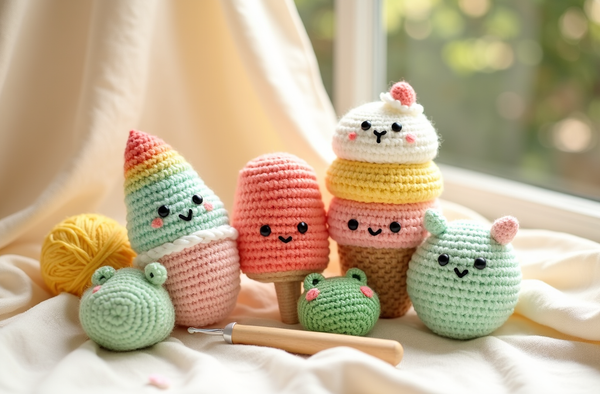
MrsCrochetWorld no-sew amigurumi plushies showing professional clean assembly with no visible seams

Positioning tricks for symmetric faces and bodies

You can master both stitches and still end up with a wonky-looking plushie if the positioning is off. Symmetry is what makes a plushie look "alive" rather than slightly sad or quirky. Here are the positioning techniques we use at MrsCrochetWorld on every pattern test.

The count-the-stitches method

For any pair of parts (ears, eyes, arms, legs), count stitches from a reference line on both sides. For ears, count from the magic ring at the top of the head outward. For eyes, count from the centre seam outward and from the snout downward. Writing the counts down once means perfect symmetry every time. Most MrsCrochetWorld patterns include exact stitch coordinates ("eyes between rounds 10–11, 5 stitches apart") so you do not need to eye-ball anything.

The pin-and-photograph trick

Before sewing, pin every part in its intended position using stitch markers or sewing pins. Now step away from the project and take a photograph from the front, side, and 45 degrees. Then look at the photo. The camera flattens depth and reveals asymmetry that your eyes adjust for in real life. Reposition any part that looks off, re-photograph, and only sew once the photo passes the eye test.

The fold-line method for ears and arms

To position symmetric pairs (ears, arms), fold the head or body in half down the centre line and find the natural fold crease. The fold marks the centre. Now place each pair member at an equal distance from this fold. Pins on each side. Photograph. Sew.

The mirror test for eyes

Eyes are the most important feature of any plushie and the most unforgiving when placed asymmetrically. After placing safety eyes or pinning embroidered eyes, hold the head in front of a mirror. Asymmetry shows up as an instant "off" feeling. The mirror reflection doubles your perspective and catches problems that direct viewing misses.

⚠️ The 1-millimetre rule: The human eye detects facial asymmetry at sub-millimetre levels. Even tiny placement differences (one stitch off, half a round off) make a finished plushie look "wrong" without people being able to say why. Take the extra minute to count, pin and photograph before sewing.

How to attach arms, legs and ears

Each body part has its own subtleties. Here is the position and technique combination that works best for each in our studio.

Attaching arms

Arms attach to the upper third of the body, just below where the head will sit. The natural position is at the shoulder seam, with the arm hanging down the side at a slight forward angle (roughly the 4-o'clock and 8-o'clock positions when looking at the body from above). For paired arms, count stitches from the centre-back of the body outward, mark with pins, and use the whip stitch with a double-pass for strength. Arms are pulled, posed and held — they need the strongest seams.

Attaching legs

Legs attach to the lower body, sitting either at the bottom edge (for a sitting plushie) or in front of the body (for a standing plushie). For sitting characters, position legs at the bottom rim of the body and angle them slightly outward so the plushie sits balanced rather than tipping forward. Use the whip stitch with a double-pass.

💡 Standing plushie trick: If you want a plushie that stands on its own, position the legs vertically under the body with the leg openings flush against the body bottom. Use plastic safety joints or a single short cardboard disc inside each leg to add structural stiffness. Without internal structure, even a perfectly assembled crochet plushie will slowly slump.

Attaching ears

Ears sit on the top of the head, angled slightly outward and forward. The most common position is rounds 4–6 from the top of the head, depending on size. For floppy ears (rabbits, dogs), use a mattress stitch along the entire bottom edge of the ear so the ear lies naturally. For perked ears (cats, bears), use a whip stitch only along the inside half of the ear base, leaving the outside curve free to stand up.

Attaching tails

Tails are typically attached using the whip stitch in a single pass — tails do not bear weight, so double-passing is unnecessary. Position low on the back, opposite the belly button line. Tilt the tail slightly upward for a perky look or let it hang for a relaxed character.

Attaching the head to the body

The head-to-body join is the most important seam in the entire plushie because it is what you see first and what gets handled most. Use a long yarn tail at the bottom of the head and the whip stitch with a triple-pass: around once, back around once, then a third pass through the inside picking up additional anchor points. The head-body join should be invisible from the front and unmovable when you wiggle the head.

The no-sew alternative — assembly with zero sewing

What if you could skip all of this? At MrsCrochetWorld we developed an entire pattern line built around no-sew construction — amigurumi that are crocheted in one continuous piece with arms, legs and ears emerging from the body as the work progresses. No assembly, no sewing, no symmetry problems, no visible seams. The result is a plushie that comes off the hook 100% finished.

The no-sew approach uses a few core techniques: colour-change increases to start a new body part directly out of the current round, continuous stitching across two pieces to merge them into one, and strategic placement of body parts as you crochet so the final shape emerges organically. It requires the pattern to be designed for no-sew construction from the start — you cannot retrofit a sewn pattern into a no-sew one — but once you have a no-sew pattern, even an absolute beginner can produce a perfectly assembled plushie on the first try.

Our 50+ No-Sew Amigurumi Patterns Bundle is fifty original designs that all use this approach. Fifty plushies, zero assembly stress. Beginners love it because the "scary" stage of finishing is removed entirely. Experienced crocheters love it because they finish projects faster and with cleaner results. Our Easy No-Sew Amigurumi Book for Beginners is the print/PDF companion that teaches the no-sew approach from the first chapter.

💡 When to choose no-sew: If you have ever cried over a wonky-eared bear, if you have ever ripped a head off to re-sew it, if you have ever finished six pieces but never gotten around to assembling them — switch to no-sew patterns. The frustration of assembly is the number-one reason beginners give up on amigurumi. No-sew patterns remove that step entirely.

Common sewing mistakes to avoid

  1. Using a sharp needle. Sharp tips pierce yarn fibers and weaken seams. Always use a blunt-tip tapestry needle.
  2. Using contrasting embroidery floss for seams. Floss is too thin to fill the gaps between crochet stitches and shows as a thread line across the fabric. Use body yarn for all structural seams.
  3. Sewing before stuffing. A sewn-then-stuffed limb is almost impossible to pack. Always stuff each piece first, then sew it on.
  4. Skipping the pin-and-photograph step. Eye-balling symmetry fails almost every time. Pin, photograph, adjust, sew.
  5. Single-pass whip stitching for arms. Arms get pulled, posed and held. Always do a second pass for an X pattern over every stitch.
  6. Pulling the yarn too tight. Over-tight seams pucker the fabric and stretch the surrounding stitches. Even, moderate tension only.
  7. Not burying the end. A knot tied on the outside of the body will come loose within months. Always thread the end deep into the stuffing and snip flush.
  8. Adding new yarn instead of using the long tail. Attached yarn creates a visible joining point. Leave a 30 cm tail at the end of every crocheted piece.

Frequently asked questions about sewing amigurumi

What needle do I need for sewing amigurumi?

A blunt-tip tapestry needle, size 16 or 18 for worsted-weight yarn. The blunt tip slides between yarn strands rather than piercing through them, which keeps seams strong and invisible. Sharp sewing needles will damage the yarn and cause seams to come apart over time.

What yarn should I use to sew amigurumi parts?

Always use the same yarn that the body is crocheted with. Leave a 30 cm tail at the end of each crocheted piece and use it for the assembly. The matching colour and thickness disappear into the fabric, while contrasting embroidery floss creates visible thread lines that weaken seams.

What is the difference between the mattress stitch and the whip stitch?

The mattress stitch creates an invisible edge-to-edge seam — ideal for closing the head and joining flat pieces in the same plane. The whip stitch is a fast diagonal stitch that wraps around the join — ideal for attaching limbs at angles to the body. Use mattress where the seam should disappear; use whip where strength matters more than perfect invisibility.

Why are my amigurumi seams visible?

Three common causes: using a contrasting yarn or embroidery floss instead of the body yarn, using a sharp needle that splits the yarn, or pulling stitches too tight which puckers the surrounding fabric. Switch to matching body yarn, a blunt tapestry needle, and gentle even tension and seams disappear.

How do I position amigurumi arms and legs symmetrically?

Count stitches from a reference line (the centre back or the magic ring) on both sides — this guarantees mathematical symmetry. Pin everything in place with stitch markers before sewing, take a photograph from the front and side, and adjust based on what the camera shows. Sew only when the photograph passes the eye test.

Can I avoid sewing amigurumi parts together completely?

Yes — choose a no-sew pattern. No-sew amigurumi are designed to be crocheted in one continuous piece with arms, legs and ears emerging from the body during crocheting. They cannot be retrofitted from regular patterns, but our 50+ No-Sew Amigurumi Bundle is fifty original designs that all use this approach. The plushie comes off the hook 100% finished — no assembly required.

Should I sew amigurumi parts before or after stuffing?

Stuff each piece fully, then sew it on. Pre-stuffed limbs hold their shape during sewing and let you focus on positioning. A limb stuffed after attachment is almost impossible to pack because you cannot reach the far tip through the small join opening. The only exception is the head, which is stuffed last so you can still adjust eye positions from the inside.

How do I sew an amigurumi head to the body without it wobbling?

Use the whip stitch with a triple pass: around the entire neck circumference once, back around once, then a third pass picking up additional anchor points through the stuffing inside. Pin first, photograph, then sew. Pull each stitch firm but not tight enough to pucker the fabric. A correctly attached head feels rock solid and shows no visible seam.

What is the easiest way to attach floppy ears?

Fold each ear flat at its base so the front and back of the ear touch. Pin the folded base to the head at the desired position. Use the mattress stitch along the entire folded base — this anchors the ear without creating a visible seam, and the ear naturally falls forward as it hangs. Perked ears use a whip stitch on the inside base only, leaving the outside curve free to stand up.

How long should the yarn tail be for sewing?

30–40 cm for most limbs, 50 cm for the head-to-body seam, and at least 25 cm for ears or small pieces. Better too long than too short — you can always cut excess, but adding new yarn mid-seam creates a visible joining point that breaks the invisibility of your seam.

Summary — clean amigurumi assembly

The difference between a homemade-looking plushie and one that could be in a shop window is almost entirely about assembly. Use a blunt-tip tapestry needle in size 16 or 18, sew with the same yarn as the body using long tails left at fasten-off, master the mattress stitch for invisible edge seams and the whip stitch for strong limb attachments, count stitches from a reference line for guaranteed symmetry, pin every part in place and photograph before sewing, and always stuff each piece fully before attachment. Or — if any of that sounds like more work than fun — switch to no-sew patterns and skip the assembly stage entirely. Both approaches produce beautiful results; only one of them requires sewing skills.

🪡 Skip the sewing entirely

Tired of fighting with sewing?

Switch to no-sew amigurumi. Fifty original patterns, one continuous crochet piece each, zero assembly. Lifetime access, instant PDF download.

Get the 50+ No-Sew Bundle →
About the author

Mrs Crochet World is an independent crochet design studio specialising in cute, beginner-friendly amigurumi patterns and PDF books. Every pattern is tested in our own studio before release, including a full assembly walkthrough for sewn patterns and a complete no-sew alternative for assembly-free pieces.

Expertise: Amigurumi assembly, no-sew construction, mattress and whip stitches, beginner crochet education.

Experience: 10+ years designing crochet plushies; 200+ original patterns published; thousands of pieces assembled in-house during pattern testing.

Authoritativeness: Featured pattern designer on Etsy, Pinterest and Ravelry; trusted by 50,000+ crocheters worldwide.

Trustworthiness: Every PDF includes step-by-step photos, written US-term instructions, and free email support.

Back to blog