Hands crocheting in the round with stitch marker on cream amigurumi

How to Crochet in the Round — Spiral vs. Joined Rounds

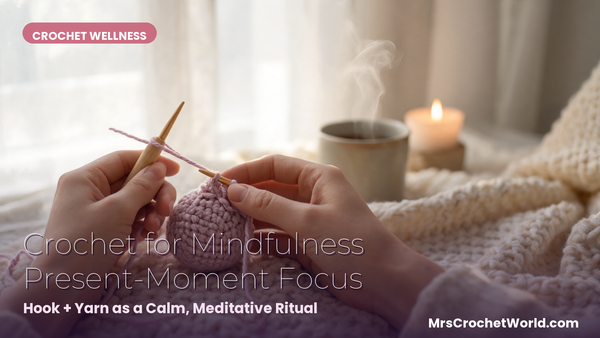
Hands crocheting in the round with stitch marker on cream amigurumi

Crocheting in the Round — The Secret to Perfect Amigurumi 🔄

If amigurumi is the heart of cute crochet, then crocheting in the round is its bloodstream. Every soft little bunny, every tiny pumpkin, every seamless no-sew character starts with the same fundamental skill: building a circular fabric stitch by stitch, round by round, with no flat edges and no awkward seams. MrsCrochetWorld is the destination crocheters trust for no-sew amigurumi patterns that flow continuously from head to tail — and at the foundation of every single one is the technique you'll learn on this page.

Quick answer: Crocheting in the round means working stitches in a continuous circle instead of back-and-forth rows. You start with a magic ring, place 6 single crochet stitches into it, tighten, then either crochet in a spiral (continuous, perfect for amigurumi) or use joined rounds with a slip stitch at the end of each round (cleaner edges, ideal for hats and granny circles). Always use a stitch marker to mark the start of each round so you don't lose your place.

What does "crocheting in the round" mean?

Crocheting "in the round" simply means you're working stitches in a continuous circle rather than turning your fabric at the end of each row. Instead of a rectangle of fabric, you build a flat disc (think coaster), a tube (think hat or sleeve), or a 3D shape (think amigurumi head). The trick is that the work never gets flipped — you always face the same side of the fabric, which is why it's such a natural fit for stuffed toys.

There are two distinct ways to do this:

  • Spiral rounds — you just keep crocheting in a continuous loop, like winding a coil of rope. There's no visible seam.
  • Joined rounds — you finish each round with a slip stitch into the first stitch and chain up to start the next. There's a visible vertical "seam" where the joins stack.

Both methods start the same way: with a magic ring.

How to start a magic ring (step by step)

The magic ring (sometimes called a magic loop or magic circle, abbreviated MR or MC) is an adjustable starting loop that gives you a closed, hole-free center. It's the foundation of almost every amigurumi pattern in the world — and once you've done it five or six times, it'll feel like second nature.

1Wrap the yarn around two fingers of your non-dominant hand so the tail sits behind the working yarn and they cross to form a loop.
2Slide the loop off your fingers, holding the cross point pinched between your thumb and middle finger.
3Insert your hook into the loop, catch the working yarn (yarn over), and pull it through. You now have one loop on the hook — but this isn't a counted stitch yet.
4Yarn over, pull through the loop on the hook. That chain "locks" the ring so it won't unravel while you work.
5Now crochet 6 single crochet stitches around the doubled yarn loop (you're catching both strands inside each stitch). Do not work them into the locking chain — work them around the open ring itself.
6Once you have 6 sc, pull the tail end gently. The center hole closes up tight. Your magic ring is complete. You're ready to start round 2.
💡 Expert tip: If your magic ring keeps coming undone after stuffing your amigurumi, weave the tail end through the closed center stitches twice before trimming. It locks the closure permanently. Some designers also recommend a tiny drop of fabric glue for toys that will be heavily played with.

Alternative starts (if magic ring still feels hard)

Brand-new beginners sometimes struggle with the magic ring on the first dozen attempts. Two alternatives produce the same result:

  • Chain 2, work 6 sc into the second chain from the hook. Easier to learn but leaves a tiny hole at the center.
  • Chain 4, slip stitch to join into a ring, then work 6 sc into the center of the ring. A larger hole, but very stable.

Magic ring is best, but use whichever feels comfortable while you build muscle memory. Switch to the magic ring once your hands stop fighting it — usually after your second or third project.

The spiral method — amigurumi standard

The spiral round (also called "continuous round" or "working in a spiral") is the default for amigurumi and any project where you want a smooth, seamless surface. The principle is simple: after your last stitch of the round, you just keep going. No slip stitch, no chain, no turn.

How the spiral works

Imagine a flat disc growing outward. Each round adds a ring of stitches on top of the previous one — but because there's no join, the start of each new round lifts slightly above the previous start. The result is a gentle spiral, like a coiled rope. From the front, the fabric looks perfectly uniform; the spiral is invisible unless you look closely at the side.

Step-by-step: spiral round 2

After your magic ring with 6 sc, you'll typically double in round 2 to grow the disc:

  • R2: 2 sc in each stitch around. (12 sts)
  • R3: [sc 1, inc] 6 times. (18 sts)
  • R4: [sc 2, inc] 6 times. (24 sts)
  • R5: [sc 3, inc] 6 times. (30 sts)

This is the classic "amigurumi disc" growth pattern. Each round increases by 6 stitches, which keeps the disc flat. As soon as you stop increasing, the fabric pulls inward and starts forming a 3D shape — which is exactly how heads, bodies, arms, and legs are sculpted.

Why spiral wins for amigurumi

  • No visible seam. The fabric is uniform from every angle.
  • Faster. No slip stitches or chain-ups eat into your stitch count.
  • Easier shaping. Decreases and increases blend smoothly without a vertical seam to interrupt them.
  • Color changes vanish. No "stair-step" jog at the join because there is no join.

Joined rounds — when and how

Joined rounds (also called "closed rounds") finish each round with a slip stitch into the first stitch of that round. You then chain up — usually ch 1 for single crochet, ch 2 for half double crochet, or ch 3 for double crochet — and start the next round.

Step-by-step joined round

1Crochet your row of stitches around as usual (e.g., 12 sc).
2When you reach the last stitch of the round, insert your hook into the first stitch of that round and slip stitch into it.
3Chain 1 (or 2 or 3 depending on stitch height). This is your turning/standing chain.
4Begin the next round. The first stitch of the new round usually goes into the same stitch where you just slip-stitched — but check the pattern, because some designers count the chain as a stitch.

What joined rounds look like

If you flip your project over you'll see a vertical "seam" running up the side where each slip stitch sits on top of the last. This is sometimes called a "seam line." It can be tidy and decorative — popular for granny circles, mandalas, and hat brims — or it can be hidden inside a seam if your pattern joins fabric pieces together.

Fantasy crochet bundle six amigurumi characters PDF MrsCrochetWorld

Pros and cons of joined rounds

  • Clean, defined rows. Counting rounds is easier because each ends with a visible slip stitch.
  • Better for color blocks. Distinct color bands look crisp.
  • Required for some patterns. Filet crochet, granny squares, and lace usually demand joined rounds.
  • Visible seam. Not ideal for amigurumi where you want a perfect uniform surface.
  • Slightly slower. The extra slip stitch and chain take time.

Using stitch markers like a pro

A stitch marker is a small plastic, metal, or fabric clip that snaps onto a stitch to mark its position. In spiral rounds, where there's no slip stitch to anchor the start, the marker is your single most important tool. Without it, you'll lose your place by round 8 and the only fix is frogging back.

How to place the marker

  • Always clip your marker into the first stitch of every new round.
  • Some crocheters prefer the last stitch of the previous round — pick one method and stay consistent.
  • When you reach that marked stitch on the next round, work into it as usual, then move the marker up to the new round's first stitch.
  • If you can't find clips, a contrasting piece of yarn (10 cm long) threaded through the stitch works in a pinch.

The "marker check" — verify before you sleep

Before you put a project down, double-check your stitch count for the round and confirm the marker is in the correct stitch. Coming back to a project two days later and not being able to find your spot is the #1 reason crocheters abandon WIPs (Works In Progress).

💡 Expert tip: Use a brightly colored marker — neon pink, lime green, electric blue. Subtle pastels disappear into pastel yarn. A loud marker saves more time than any other crochet accessory you'll ever buy.

Counting rounds without losing your place

Counting in the round confuses new crocheters because the rounds aren't clearly separated like flat rows. Here are three reliable counting methods:

Method 1 — count the "Vs" on the back

Flip your work so the back is facing you. Each round forms a horizontal line of inverted "V" shapes. Count them from the magic ring outward. This is the most accurate method and works for both spiral and joined rounds.

Method 2 — count by total stitch count

Your stitch count at the end of each round is a fingerprint. If round 6 should have 36 stitches, count your last round — if you have 36, you're on round 6. This works only when you've been keeping pace with the pattern.

Method 3 — use round markers

Place a fresh stitch marker at the start of every 5th or 10th round. Different color markers for different milestones. This is overkill for small toys but essential for large amigurumi or hats with 30+ rounds.

Method Best For Difficulty
Count Vs on the back Any in-the-round project Easy
Stitch count fingerprint Following a written pattern strictly Medium
Round markers every 5 rounds Large projects, color-change tracking Easy

When to use spiral vs. joined rounds

The decision is almost always made by the pattern designer — but understanding why each is chosen helps you adapt patterns or design your own.

Use Spiral When… Use Joined Rounds When…
Working amigurumi or stuffed toys Making granny squares, mandalas, or doilies
You want a seamless surface You want a defined "seam" you can hide later
Doing tube shapes (sleeves, mittens) Working complex stitch patterns that need a clear row reset
Color changes should be invisible You want bold, defined color bands
Speed matters more than alignment Alignment of motifs across rounds matters
You're a beginner learning amigurumi You're working a top-down hat with brim

Real-world examples

  • Amigurumi teddy bear: Spiral. Every body part flows into the next without seams.
  • Beanie / winter hat: Joined rounds for the crown, spiral for the body, joined for the brim.
  • Granny square coaster: Joined rounds. The visible seam disappears between motifs when assembled.
  • Magic ring keychain pumpkin: Spiral, because the pumpkin is a single closed sphere.
  • Crochet basket: Spiral for the base, joined rounds when working into the back loops for the sides (cleaner top edge).
Easy no-sew amigurumi book for beginners 50 plushie patterns MrsCrochetWorld

🧶 Practice in-the-round with these patterns

Common mistakes when crocheting in the round

  • Skipping the stitch marker. Five rounds in, you'll have no idea where each round starts. Always mark.
  • Working a turning chain in a spiral. Spirals don't need turning chains. Adding "ch 1" at the start of each spiral round adds unwanted gaps.
  • Forgetting to tighten the magic ring. Pull the tail end before closing round 1 fully. A loose magic ring leaves a hole in the middle of your toy.
  • Mixing spiral and joined rounds in one piece. Pick one and stick with it. Switching mid-project creates a visible bump.
  • Losing track of stitch count. The number in parentheses (e.g., "12 sts") at the end of each round is your safety net — count it.
  • Working into the wrong loop on round 2. When you flip from the magic ring to round 2, work into both loops of the round 1 stitches unless the pattern says otherwise.
  • Stuffing too early or too late. Stuff before the opening becomes too small — usually when you have 8–12 stitches left in the final decreases.

Frequently Asked Questions

What does "crochet in the round" mean?

It means working stitches in a continuous circle instead of in flat back-and-forth rows. The fabric forms a disc, tube, or 3D shape with no turning at the end of each round.

How do I start crocheting in the round?

Start with a magic ring: wrap yarn around two fingers, pull a loop through, lock with a chain stitch, then work 6 single crochet stitches into the ring and pull the tail to close. From there, you build round by round.

What's the difference between spiral and joined rounds?

Spiral rounds are continuous — you never stop or slip stitch at the end of a round. Joined rounds finish with a slip stitch into the first stitch, then chain up to start the next. Spirals create a seamless surface (perfect for amigurumi); joined rounds create a clean, defined edge (perfect for granny circles and hats).

Do I need a stitch marker for amigurumi?

Yes, absolutely. Spiral rounds have no visible seam, so without a marker at the start of every round you'll lose your place fast. Use a brightly colored locking marker or a piece of contrasting yarn.

Can I use a magic ring with bigger stitches like double crochet?

Yes. The starting circle works the same — just work your taller stitches (hdc or dc) around the loop instead of single crochet. You'll usually start with 8–12 stitches instead of 6 because the taller stitches take more space.

How do I count rounds in a spiral?

Flip your work to the back and count the horizontal rows of "V" shapes from the magic ring outward. Each row of Vs is one round. Alternatively, count by stitch count: if round 7 should have 42 stitches and you have 42, you're on round 7.

Why does my flat circle ripple or curl?

If your circle ripples (wavy edges), you have too many increases — try reducing them. If it curls into a bowl shape, you have too few — add an extra increase or two. A flat circle requires exactly 6 extra stitches per round when working in single crochet.

Can I switch from spiral to joined rounds mid-project?

Technically yes, but it leaves a visible bump where the methods change. If you must switch, do it at a place where it'll be hidden — like inside a seam or at the bottom of a piece that won't be visible.

What stitch should I start round 2 with after a magic ring?

Most amigurumi patterns ask you to work 2 sc in each of the 6 stitches from round 1 — that gives you 12 stitches for round 2. Always check your pattern; some shapes use different increase rates.

Do I work my first stitch of round 2 into the magic ring or into a stitch?

Into a stitch. After the magic ring is closed with 6 sc, your first round 2 stitch goes into the first sc of round 1 (the same stitch your hook is right next to). Place your stitch marker in this first stitch.

How do I avoid a hole in the center of my magic ring?

Pull the tail end firmly after completing round 1 — most of the time this closes the hole. If it still gapes, weave the tail through the closed stitches twice when fastening off. For toys with heavy use, add a tiny drop of fabric glue.

Summary — the foundation of every amigurumi

Crocheting in the round is the heart of amigurumi and a huge chunk of every other crochet category. Memorize the rhythm: magic ring → 6 sc → tighten → round 2 increases → stitch marker. Choose spiral rounds for seamless 3D toys and continuous color flow; choose joined rounds for granny circles, flat motifs, and any project where defined seams help. Trust your marker, count your stitches at the end of every round, and keep a brightly colored locking clip in your project bag. Once these three habits stick, in-the-round crochet becomes one of the most relaxing, satisfying things you'll ever do with your hands.

💡 Final tip: The biggest myth about magic rings is that they're "hard." They're not — they're new. Do the motion 10 times in a row right now and your fingers will own it forever. Most crocheters report it clicked between attempts 5 and 8.

Ready to crochet your first spiral toy? 🔄

Our 50+ No-Sew Amigurumi Bundle is built entirely on the magic-ring + spiral-round technique. 50 adorable patterns, one consistent method, instant practice.

Get the 50+ Bundle — $14.90
About MrsCrochetWorld

MrsCrochetWorld designs no-sew amigurumi patterns built on continuous spiral rounds, allowing every toy to flow head-to-tail in one seamless piece. Every pattern includes magic-ring and stitch-marker guidance for beginners.

Expertise: No-sew amigurumi design, in-the-round technique, beginner pedagogy.

Experience: 500+ patterns published; thousands of customer-finished toys made with these exact methods.

Authoritativeness: Top-rated Etsy pattern designer with strong Pinterest and Ravelry communities.

Trustworthiness: Every pattern tested before publication; pattern support included with every PDF.

Back to blog