How to Crochet the Crocodile Stitch (Scale Texture)
Unlock the magic of overlapping scales with this step-by-step crocodile stitch guide — no experience with fancy stitches required.

The crocodile stitch is one of those techniques that looks impossibly intricate from across the room — yet the moment you break it down stitch by stitch, you realize it is just a clever arrangement of double crochets fanned around a post. If you have ever wanted to add dimensional, reptile-scale texture to a bag, a scarf, or even an amigurumi body, this is your tutorial.
What you need before you start
Gather your supplies so you can crochet along without stopping.
You need medium #4 (worsted-weight) yarn, a 5.5 mm (US I-9) crochet hook (the small end of the 5.5–6.5 mm range the Craft Yarn Council recommends for this weight[3]; your yarn label and gauge come first), scissors, and a yarn needle for weaving in ends. A stitch marker is handy for tracking the start of each row. The crocodile stitch uses a lot of yarn compared with flat fabric — plan on noticeably more yardage than for a plain double-crochet swatch of the same size.
This stitch works in rows or in the round. The tutorial below teaches the flat-row method first because it is easier to see each scale as it forms. Once you are comfortable, the circular version follows naturally.
Crocodile stitch at a glance
| Abbreviations used | dc = double crochet, ch = chain, ch-sp = chain space, sk = skip, sl st = slip stitch[1] |
|---|---|
| V-stitch | (dc, ch 2, dc) in one stitch: stitches in parentheses are all worked into the same stitch[2] |
| Foundation chain | multiple of 6 + 4 (practice swatch: ch 22) |
| Row 1 count (ch 22) | 6 V-stitches plus an edge dc at each end |
| One scale | 5 dc down one post + ch 1 + 5 dc up the other post = 10 dc |
| Scales per row (ch 22) | 3: one scale on every other V-stitch |
| Medium #4 (worsted) yarn | 5.5–6.5 mm hook (US I-9 to K-10½)[3]; 5 mm = US H-8 sits below that range[4] |
Stitch math: each 6-chain repeat holds 2 V-stitches (skip 2, V, skip 2, V), and one of the two carries a scale. Ch 22 = 3 × 6 + 4 → 6 V-stitches → 3 scales × 10 dc = 30 dc per scale row. A piece 5 scales wide needs 5 × 6 + 4 = ch 34 (10 V-stitches).
Hook sizes are Craft Yarn Council guidelines; the size in your pattern and your own gauge swatch come first.
Building the V-stitch foundation
Every crocodile stitch fabric starts with a row of V-stitches — each V-stitch is simply (dc, ch 2, dc) worked into the same stitch. These pairs of posts are what your scale fans will wrap around later.
Row 1 (foundation): Chain a multiple of 6 plus 4. Work (dc, ch 2, dc) in the 6th chain from the hook. *Skip 2 ch, work (dc, ch 2, dc) in the next ch; repeat from * to the last ch, dc in the last ch. Turn. (Ch 22 gives 6 V-stitches.)
Row 2 (turning chain): Chain 3 (counts as first dc), (dc, ch 2, dc) in each ch-2 space across, ending with dc in the top of the turning ch. Turn. This locks the V-stitch grid in place.
If you are new to double crochet, take a moment to practice the stitch on a small swatch before starting the scale rows — it will make the crocodile stitch feel much smoother.
Crocheting your first crocodile scale
Now the fun begins. Each scale is a two-sided fan worked around one V-stitch post pair.
Step 1 — First fan: Without turning your work, rotate the piece 90° clockwise so the post of the left-hand dc of the first V-stitch faces you. Work 5 dc down this post from top to bottom (insert your hook around the post itself, not through a stitch). You have just made the first half of a scale.
Step 2 — Bridge chain: Chain 1. This tiny chain sits at the bottom tip of the scale and holds the two fans together.
Step 3 — Second fan: Now work 5 dc up the right-hand post of the same V-stitch, from bottom to top. You should see a plump, petal-shaped scale sitting on your foundation row. That is one crocodile stitch!
Step 4 — Move to the next scale: Slip stitch into the ch-2 space of the next V-stitch to travel across without adding height (this V-stitch gets no scale), then repeat Steps 1–3 on the following V-stitch. Scales sit on every other V-stitch, so ch 22 (6 V-stitches) gives 3 scales per row.
Maintaining even tension as you wrap around the posts is the single biggest factor in how neat your scales look. Keep your yarn slightly looser than usual for those post double crochets — tight tension makes the fans pull and curl.
Continuing the pattern — alternating scales
After finishing a full scale row, you work another V-stitch transition row, but this time offset by half a repeat so the next layer of scales fills the gaps between the first layer — exactly like fish or reptile scales in nature.
Offset row: Turn and chain 3 (counts as a dc). Work one V-stitch over every V-stitch of the layer below, in the order you meet them: into the ch-1 at the centre tip of each scale, and into the ch-2 space of each V-stitch that got no scale (insert the hook through that ch-2 space and the gap between the two neighbouring scales, so the scales are held flat). Finish with a dc in the last stitch; on ch 22 you have 6 V-stitches again. Without turning, work the next scale row as in Steps 1–4, but put the scales on the V-stitches that sit over the old unscaled V-stitches (the gaps between the previous scales) and slip stitch through the ones that sit on a scale centre; if the row starts on a scale-centre V-stitch, slip stitch through its ch-2 space first. Every new scale now sits half a repeat to the side, between two scales of the layer below.[5][6] Repeat these two rows, always placing the new scales above the previous gaps, for as many layers as you need.
After two or three repeats you will clearly see the overlapping scale pattern build up. It is worth checking your stitch and row count at the end of each V-stitch row to catch any accidental increases or decreases before they ripple through the scales.
"The crocodile stitch taught me that 'complicated-looking' and 'complicated to make' are two very different things — and that gap is where all the magic lives."— Ava, MrsCrochetWorld
Great patterns to practice your new stitch
Once your scales are looking neat, put the stitch to work in one of these projects.

The Humble Bag — Granny Square Tote
Bag pattern · PDFA structured tote that pairs beautifully with textured stitch panels. Add a strip of crocodile stitch on the front panel for an instant style upgrade. A great next step after you master scales — learn more about crocheting a granny square to complement this design.

Granny Square Bag — PDF + Video Tutorial
Bag pattern · Video includedVideo tutorials for the key construction steps make it a perfect companion while you are still internalizing the crocodile stitch rhythm. Explore more crochet bag patterns for inspiration on where scales work best.

Round Ruffle Flower Bag
Intermediate · Video includedTwo round panels worked in spiral rounds, with a textured ruffle flower built on top in surface crochet — a great next challenge if you enjoy dimensional stitches like the crocodile scales. The Round Ruffle Flower Bag pattern comes with video tutorials and is written in US crochet terms for intermediate crocheters. Check out tips for customizing crochet patterns if you want to weave in a crocodile stitch section of your own.
Five ways to use the crocodile stitch
The scale texture is more versatile than it looks — here are ideas to get your hooks moving.
Bag panels
A single crocodile stitch panel on the front of a tote adds instant artisan texture without a complicated construction change.
Scarves and cowls
Work the stitch flat in a long rectangle for a gorgeous scarf. The scales drape surprisingly well in a soft merino-blend yarn.
Amigurumi skin
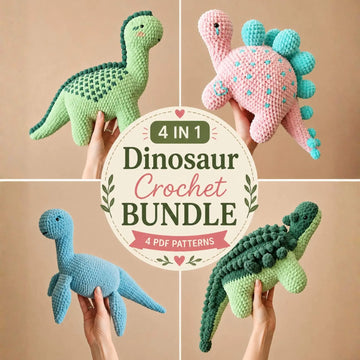
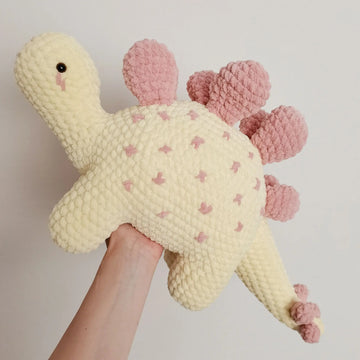
Crocodile, dragon, and dinosaur amigurumi bodies come alive with this stitch — pair it with safety eyes for a seriously impressive result. See our guide to crocheting animal bodies.
Flower decorations
A single crocodile scale, worked with only 3 dc per fan instead of 5, becomes a tiny petal. Cluster five around a magic ring for a textured bloom.
Gift wrapping pouches
Small drawstring bags in crocodile stitch make stunning handmade gift packaging. They are small projects that reuse leftover yarn — great for quick crochet gifts.
Ready to go deeper?
Our complete beginner guide covers every foundational skill you need to tackle any decorative stitch with confidence.
Ava's top tips for perfect crocodile scales
- Go up a hook size. The post double crochets pull tighter than regular stitches. Using a hook one size larger than your yarn label suggests keeps the scales open and lush.
- Count your fans. Each scale must have exactly 5 dc on each side. Count as you go — an extra or missing dc throws off the whole repeat.
- Turn consistently. Always rotate your work the same direction (clockwise) before starting each scale. Switching directions makes the fans lean in opposite ways.
- Block the finished fabric. Crocodile stitch compresses vertically. A light wet blocking opens the scales and evens the texture beautifully.
- Use a solid color first. Variegated or self-striping yarns can hide the scale pattern. Master the stitch in a solid, then experiment with color once the technique is second nature.
- Fix mistakes early. A misaligned scale is much easier to fix before the next row locks it in — check each scale as you finish it.
Ready to put those scales to work?
Browse our pattern collection for the perfect project to showcase your new crocodile stitch skill — from granny square totes to round statement bags.
Shop bag patternsShop beginner patternsTry it on a dragon: scale textures look great on amigurumi dragons. See our crochet dragon pattern guide with 11 cute dragons to make.
Frequently asked questions
What is the crocodile stitch in crochet?
The crocodile stitch is a textured crochet technique that creates overlapping, scale-like shapes by working two fans of five double crochets around the vertical posts of V-stitches. The finished fabric looks like reptile or fish scales and is thicker and more dimensional than standard flat crochet.
Is the crocodile stitch good for beginners?
The crocodile stitch is best suited to confident beginners who are already comfortable with double crochet and working around posts. If you can make a V-stitch and a standard dc, you have all the skills you need. The technique itself is methodical and repetitive once you get the rhythm.
How many chains do I need to start a crocodile stitch swatch?
Chain a multiple of 6, plus 4 extra for the turning chain. For example, chain 22 gives you three repeats plus the starting chain. Adjust the multiple up or down depending on how wide you want your swatch.
Why do my crocodile stitch scales look uneven or lopsided?
Uneven scales are usually caused by inconsistent tension on the post double crochets or by rotating the work in different directions for each scale. Make sure you always rotate clockwise and keep the yarn slightly looser than usual when working around posts. Trying a hook one size larger also helps.
Can I crochet the crocodile stitch in the round?
Yes. When working in the round, you do not turn after each V-stitch row. Instead, you join and start the next round without rotating. The scales still form the same way, and circular crocodile stitch creates stunning hats, purses, and amigurumi bodies.
What yarn is best for the crocodile stitch?
A smooth, plied worsted-weight yarn in a solid color shows the scale detail most clearly. Avoid highly textured or fluffy yarns for your first attempt as they make it hard to see the stitch structure. Cotton or acrylic yarns both work well.
How do I end a crocodile stitch project and weave in the ends?
After your final scale row, work one more V-stitch transition row, then fasten off with a slip stitch. Thread the yarn tail onto a tapestry needle and weave it through several stitches on the wrong side of the fabric, changing direction at least once to secure it. The layered texture of the scales provides excellent coverage for tails.
What projects suit the crocodile stitch best?
The crocodile stitch works beautifully in bags, purses, scarves, cowls, and decorative panels. It is also popular for amigurumi dinosaur and dragon bodies where the scale texture looks especially realistic. Because the stitch uses more yarn and creates a thick fabric, it is less suited to lightweight garments like shawls or tops.
Sources
- Craft Yarn Council: Crochet Abbreviations Master List (dc, ch, ch-sp, sk, sl st), checked 21 Nov 2026
- Craft Yarn Council: How to Read a Crochet Pattern (parentheses, turning chains), checked 21 Nov 2026
- Craft Yarn Council: Standard Yarn Weight System (yarn weights and recommended hook sizes), checked 21 Nov 2026
- Craft Yarn Council: Hooks & Needles (mm to US size chart), checked 21 Nov 2026
- Stitches n Scraps: Crocodile Stitch Tutorial, checked 25 Nov 2026
- Moogly (Tamara Kelly): The Crocodile Stitch, checked 25 Nov 2026