How to Make Crochet Coasters Lay Flat: Fix, Block, Stiffen and Wash
Cupping, curling, ruffled edges? Find the cause in a minute, fix it on the hook, then block, care for and wash your coasters so they stay flat under every mug.

You finish the last round, set your new coaster on the table, and it rocks. The middle bulges like a little hat, or the edge waves like a ruffled skirt. Nothing is wrong with you, and nothing is wrong with crochet: a flat circle is a balancing act between how many stitches you add and how tightly you make them. Once you know which side tipped over, the fix is usually quick.
All stitch names here are US crochet terms. We will not give you a stitch-count recipe of our own: every coaster pattern we publish is written and test-crocheted by a human designer, with stitch counts for every round, and those counts are your best tool. What this guide gives you is the why behind them, so you can find and fix a problem in any pattern.
Flat coasters at a glance
| Edge waves | Try the smaller hook in the pattern's range; recount for an extra increase[1] |
|---|---|
| Coaster curls up | Try the larger hook in the pattern's range; recount for a missed increase[1] |
| Tension | Even and slightly firm, so the coaster stays flat under a mug[1][2] |
| Pressing and steam | A gentle press under a damp cloth or a light steam can settle a stubborn edge; check the yarn label first, and never press acrylic with a hot iron[2] |
| Washing (yarn-only coasters) | Gentle hand wash in lukewarm water with mild soap, reshape while damp, dry flat[2][3] |
| Coasters with wire stems | No washing machine; dust or spot-clean with a damp cloth, then bend the stems back into shape[4] |
| Granny squares for joining | Block the squares to the same size before joining so the seams line up[5] |
Why a flat circle needs increases: each new round is a bigger ring than the one before, so it needs more stitches to stay flat. Too few stitches and the ring pulls inward into a bowl; too many and the extra fabric has nowhere to go but up and down in waves. Spreading the increases evenly, and shifting where they fall from round to round, keeps the edge round rather than turning it into corners.
Care and pressing notes come from our product pages; your yarn label always comes first. Product details can change; the product page shows the current version.
Why crochet coasters curl, cup or ruffle
Most shape problems come from four sources. Find yours in the table, then read the fixes below.
| What you see | Likely cause | First fix |
|---|---|---|
| Center bulges up, edge pulls in (cupping) | Too few increases, or stitches worked too tightly | Recount each round; try the larger hook in the pattern's range |
| Edge waves or ruffles | Too many increases, or stitches worked too loosely | Find the round where an extra increase slipped in; try the smaller hook |
| Circle turns into a hexagon | Increases stacked directly on top of each other | Shift where the increases fall each round, as your pattern shows |
| Only the outer edge curls | Edging round worked tighter or looser than the body | Match the edging tension to the rest of the coaster; block gently |
| Coaster is floppy and thin | Yarn too thin for the hook, or a loose hand | Use the yarn and hook from the materials list |
1. Increase spacing
This is the big one. A pattern's stitch count at the end of each round tells you whether the number of increases is right. Place a stitch marker in the first stitch of every round, count before you join, and compare. Ruffles and cups often trace back to a single round where one increase was skipped or doubled, so check round by round before you rip the whole thing out. For the principle behind even increases, read our guide on how to crochet a flat circle.
2. Tension
Coasters like an even, slightly firm tension. If you crochet very tightly, the rounds shrink and the circle starts to cup even with the correct stitch count. A loose hand does the opposite. Tension also tends to drift during a session, tighter when you concentrate and looser when you relax, so a coaster made in two sittings can change shape halfway through. Our crochet tension guide has practical drills for evening it out.
3. Hook size
If your counts are right and the coaster still misbehaves, the hook is your easiest lever: a smaller hook for a wavy edge, a larger one for a cupped coaster, staying within the range the pattern gives.
4. Yarn
A much thicker or thinner yarn than the pattern names changes how each round sits. Cotton has little stretch, so it shows shape problems more clearly than a springy acrylic, but it also holds a flat shape well once it is right. See our guide to the best yarn for crochet coasters for fiber and weight choices.
Flat bases, pop-up details: tips from our coaster sets
Pop-up coasters have a raised 3D detail, but the base still has to sit flat. Here is how our patterns handle that.

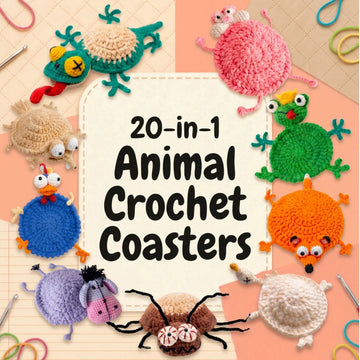
21-in-1 Animal Coasters: a sturdy base held double
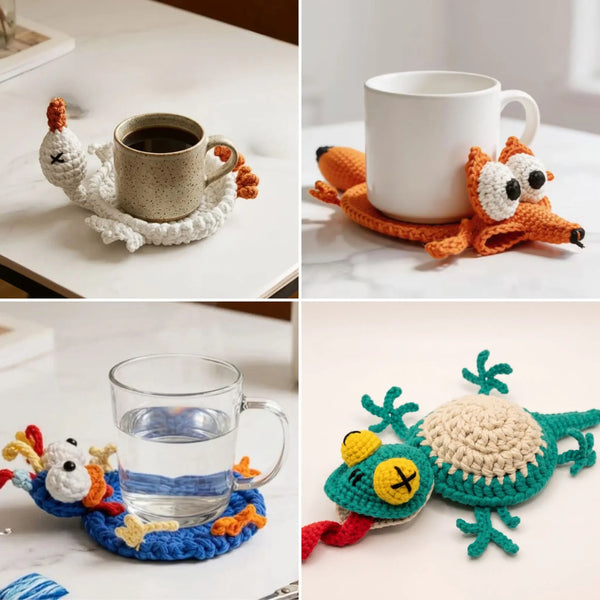
Every one of the 21 animals sits on the same base: a flat round in double crochet with the yarn held double, finished with a crab stitch edge. For the pop-up effect, keep your tension firm and even on the base and avoid working too loosely.
If the base still needs help lying flat, a gentle press under a damp cloth can help. Check your yarn label first: acrylic should not be pressed with a hot iron.
See the 21-in-1 animal coaster patterns
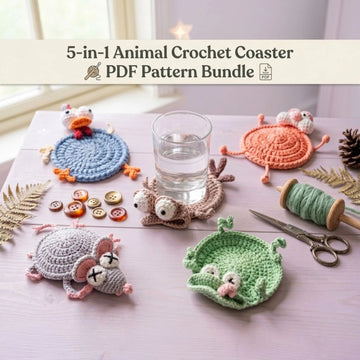
5-in-1 Animal Coasters: keep the 3D part crisp
Each of the five animals has a playful pop-up detail while the base stays flat. A firm, even tension helps the small pieces hold their form, and sewing the pop-up pieces on securely keeps them upright, especially on coasters used every day.
When you block or press, work on the flat base only and shape the raised detail with your fingers. Flattening the 3D part would undo the whole idea.
See the 5-in-1 animal coaster patterns
23-in-1 Pop-Up Flowers: one base, then bend into shape
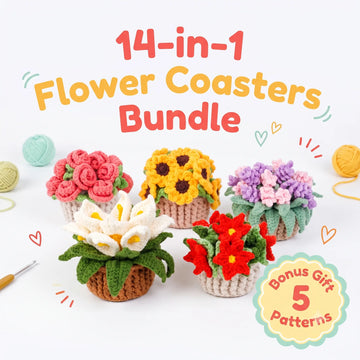
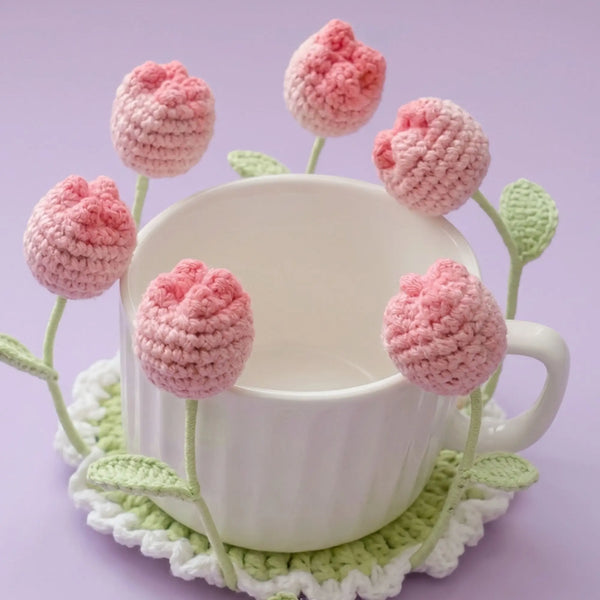
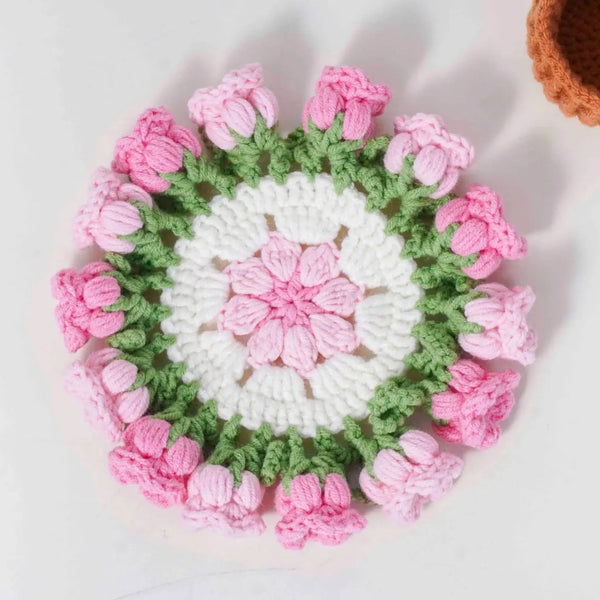
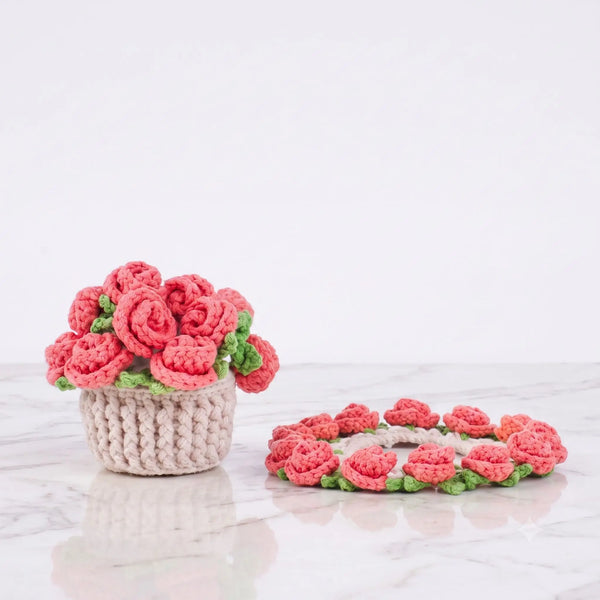
All 23 designs share one Pop-Up Base, taught round by round with stitch counts so you can check you are on track. The flowers and stars stand on thin craft-wire stems. Because of the wire, these coasters should not go in the washing machine. Dust them gently or spot-clean with a damp cloth, then bend the stems back into shape if they get knocked.
See the 23-in-1 pop-up flower coaster patterns
Christmas Coasters Vol. 3: squares that line up
The nine Christmas granny squares each measure 6.7 × 6.7 in (about 17 × 17 cm). Block them to the same size before joining, so the seams line up neatly. The flat coasters in sport-weight cotton can be hand washed in lukewarm water and dried flat; the bulky 3D mug rugs like a gentle hand wash and plenty of time to dry flat. More on squares in our guide to Christmas granny square coasters.
See the Christmas coasters and granny squares bookHow to block crochet coasters
Blocking relaxes the stitches and sets the shape. It cannot fix a wrong stitch count, but it smooths a slight curl or a slightly wavy edge very well. Always read the care symbols on your yarn label before you start. Our full guide on how to block crochet covers every method in depth.
- Wet blocking (good for most cotton coasters). Soak the coaster in lukewarm water, press the water out in a towel without wringing, then lay it flat on a towel or blocking mat. Smooth it into a circle and pin the edge if needed. Let it dry completely before moving it.
- Steam blocking. Pin the coaster flat and hold a steam iron or steamer just above it, without touching. A light steam can help a stubborn edge settle, but check your yarn label first. With acrylic, never let a hot iron touch the yarn; heat can permanently flatten and change it.
- Pressing under a damp cloth. For a stubborn base, lay a damp cloth over it and press gently, again only if your label allows it.
- Spray blocking. Pin the coaster flat, mist it with water until damp and let it dry. The gentlest option, handy for coasters with sewn-on details.
For pop-up and 3D coasters, block only the flat base and shape the raised detail by hand. Coasters with wire stems should not be soaked.
How to stiffen crochet coasters (decorative pieces only)
Sometimes you want a decorative piece, such as a lacy flower coaster on a shelf or a display piece, to hold a crisp shape. Common options are a commercial fabric stiffener, a spray or liquid starch, or a diluted craft glue mixture. Whatever you choose, follow the product's own instructions, pin the piece into shape and let it dry completely.
Read this before you stiffen
- Only stiffen pieces that are purely decorative.
- Do not use stiffened pieces where they touch food or drinks unless the stiffening product is clearly labeled as safe for that use.
- Stiffened pieces may not survive washing, and heat or moisture can soften or mark them.
- For everyday coasters, a firm tension, the right yarn and a good block are the better route to a flat, sturdy coaster.
How to wash crochet coasters
The care notes in our coaster patterns all point the same way: be gentle and dry flat.
- Yarn-only coasters: a gentle hand wash in lukewarm water with a little mild soap is usually all they need. Press the water out in a towel, reshape while damp and let them dry flat.
- Coasters with sewn-on pop-up pieces: make sure every piece is sewn on securely before the first wash, then wash by hand as above.
- Coasters with wire stems: skip the washing machine entirely. Dust or spot-clean with a damp cloth.
- Bulky mug rugs: wash gently by hand and give them plenty of time to dry flat.
Before the first wash, weave in all ends on the back, splitting the yarn and changing direction so nothing works loose. For storage and repair tips, read our guide on how to care for crochet items.
Count first, then check your hook, then block. Nine times out of ten a wobbly coaster is fixed before you ever reach for the iron.— Ava, MrsCrochetWorld
Start with a pattern that counts for you
The easiest way to a flat coaster is a pattern with stitch counts for every round, so you can check your work before a small slip turns into a ruffle. If you are new to coasters, begin with our step-by-step guide on how to crochet a coaster. For ideas across every style, from animals to flowers to Christmas, see our complete guide to crochet coaster patterns.
Coaster patterns with stitch counts for every round
PDF bundles are instant downloads; the paperbacks are ordered through Amazon. All in US crochet terms.

21 pop-up animals on one sturdy base, round tables with stitch counts and a 3-page beginner's guide.
View pattern
Five animals with a playful pop-up detail on a flat base, with QR codes to video tutorials.
View pattern
One Pop-Up Base for every design, a beginner crash course with photos and a video for the base.
View pattern
The animal collection as a printed paperback, beginner to intermediate. Ordered through Amazon.
View the book
Flat coasters, plush mug rugs and 9 granny squares with a joining guide. Ordered through Amazon.
View the book
Every coaster pattern bundle and book in one place. New designs are added here first.
Browse the collectionStitch counts every round
Check your work at the end of each round and catch a slipped increase before it becomes a ruffle.
Human-written, tested
Every pattern is written and test-crocheted by a human designer, never generated.
Care notes included
Our product pages and patterns explain how to finish, press and clean each type of coaster.
Frequently asked questions
Why does my crochet coaster curl up at the edges?
Curling or cupping usually means too few increases or a very tight tension, so each round is too small to lie flat. Recount your stitches against the pattern, then try the larger hook in the pattern's range. A gentle block can settle a mild curl once the count is right.
Why is my crochet coaster wavy or ruffled?
A wavy edge usually comes from too many increases or a loose tension. Find the round where an extra increase slipped in, and try the smaller hook in the pattern's range.
Can blocking fix a coaster that will not lay flat?
Blocking smooths a slight curl or a mildly wavy edge very well, but it cannot correct a wrong stitch count. If the coaster is strongly cupped or ruffled, fix the round on the hook first, then block.
How do I block crochet coasters?
For most cotton coasters, soak in lukewarm water, press the water out in a towel, lay flat, shape and pin if needed, and let dry completely. A light steam can help a stubborn edge, but check your yarn label first, and never press acrylic with a hot iron.
How do I stiffen crochet coasters?
Only stiffen purely decorative pieces, using a fabric stiffener, starch or a diluted craft glue and following the product's instructions. Do not use stiffened pieces where they touch food or drinks unless the product is labeled safe for that. For everyday coasters, firm tension and blocking work better.
How do I wash crochet coasters?
Hand wash gently in lukewarm water with a little mild soap, press the water out in a towel, reshape while damp and dry flat. Coasters with wire stems should not be washed in a machine; dust or spot-clean them with a damp cloth instead.
Can I iron acrylic crochet coasters?
Never press acrylic with a hot iron, as heat can permanently flatten and change the fibers. If your label allows it, hover a steamer above the pinned coaster without touching, or use wet or spray blocking instead.
How do I keep the pop-up part standing on a pop-up coaster?
Work the small pieces with a firm, even tension, sew them on securely, and block only the flat base. Shape the raised detail by hand after washing. On wire-stem designs, simply bend the stems back into place.
Make your next coaster lie flat from the start
Our coaster patterns give stitch counts for every round, so you can check your work as you go. PDFs are instant downloads in US crochet terms.
Browse crochet coaster patterns See the 21-in-1 animal coastersSources
- MrsCrochetWorld: 20-in-1 Animal Crochet Coasters Pattern Book (product page, yarn and hook tips), checked 25 Nov 2026
- MrsCrochetWorld: 21-in-1 Animal Crochet Coasters Pattern Bundle (product page, finishing and care), checked 25 Nov 2026
- MrsCrochetWorld: 5-in-1 Animal Crochet Coaster Pattern Bundle (product page, finishing and care), checked 25 Nov 2026
- MrsCrochetWorld: 23-in-1 Pop-Up Flower Crochet Coaster Patterns (product page, finishing and care), checked 25 Nov 2026
- MrsCrochetWorld: 20-in-1 Christmas Crochet Coasters & Granny Squares Book (product page, care), checked 25 Nov 2026