Why Crocheters Love Granny Squares: Benefits, Projects & Pure Cozy Joy
One small, portable, stash-friendly motif — and an almost endless list of beautiful things you can turn it into.

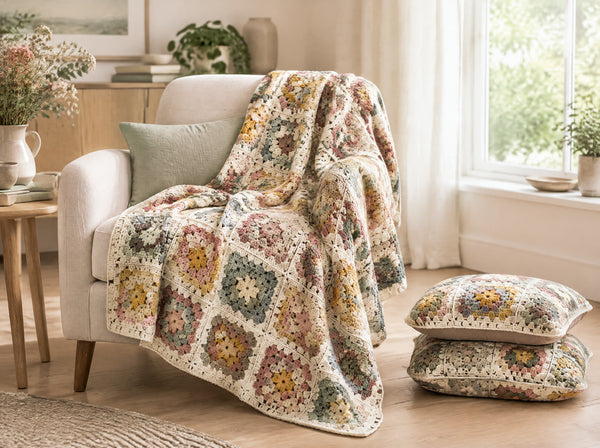
There is a reason the granny square refuses to go out of style. It has survived Victorian parlors, the technicolor 1970s, your grandmother's afghan draped over the back of the sofa, and a full-blown fashion revival — and it is still the motif crocheters reach for when they want something soothing, portable and endlessly useful. This is a love letter to that little square, not a tutorial. Consider it an invitation.
If you have ever wondered why your feed is full of granny square cardigans, why your favorite maker keeps a little project bag in the car, or why the same motif shows up on a runway and on a coaster in the same week — this article is for you. We are going to talk about why it works and what you can make with it. We are deliberately not going to walk you through the stitches today.
Why not? Because we already have a complete step-by-step tutorial for that, and because something rather exciting is coming. More on both of those in a moment.
Four reasons the granny square keeps winning
Portability, stash-busting, color play and a genuinely calming rhythm — the practical case for the world's most beloved motif.

It fits in your bag, your pocket and the gaps in your day
A single granny square is small. That sounds obvious, but it changes everything about how the project fits into real life. You are never carrying a whole blanket — you are carrying one square, a small ball of yarn and a hook. That means the school pickup line, the waiting room, the train, the passenger seat and the twenty quiet minutes before bed all become usable crafting time.
Researchers studying crochet made exactly this point: it is described in the literature as "a relatively low-cost, portable activity that can be easily learnt," which is a large part of why it travels so well through ordinary life. The granny square is the most portable expression of an already portable craft.
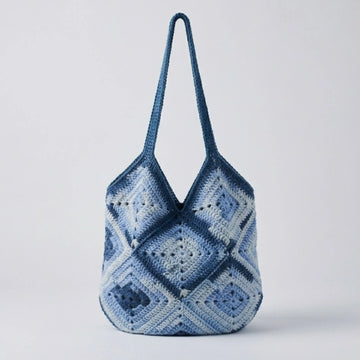
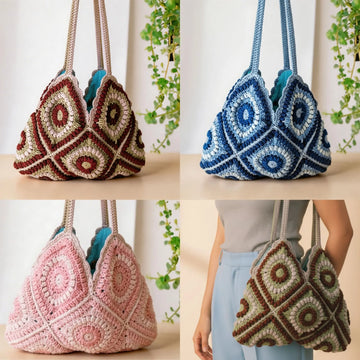
See The Humble Bag granny square tote →
It turns leftovers into something you actually want
Every crocheter has the basket. The one with forty grams of sage, a sad little ball of mustard and three colors you bought for a project you never finished. The granny square is the classic answer to that basket. Because each round uses only a small amount of yarn, and because the motif is built to change color, odds and ends stop being clutter and start being a palette.
This is not a modern life-hack — it is baked into the motif's history. As crochet author Debbie Stoller notes, multicolor granny squares are "an effective way to use up small amounts of yarn left over from other projects," and basic granny square motifs "do not require advanced skills to execute." Thrift and accessibility, in one little square.
Browse all crochet patterns →
The repetition is the point
Ask ten crocheters why they love granny squares and someone will say "it switches my brain off." There is real research behind that feeling. In an international study of crocheters published in Perspectives in Public Health, the three most common reasons people gave for crocheting were to be creative (82.1%), to relax (78.5%) and for a sense of accomplishment (75.2%). Respondents reported that crochet made them feel calmer (89.5%), happier (82%) and more useful (74.7%).
The granny square leans into all three. It is creative because every color choice is yours. It is relaxing because the rhythm repeats. And that third one — accomplishment — is the quiet superpower. A square finishes in one sitting. You get the small, complete, satisfying "done" that a king-size blanket makes you wait months for.
Read our full granny square tutorial →
It is the cheapest design school you will ever attend
A granny square is a tiny, low-stakes canvas. If a color combination does not work, you have lost one square and twenty minutes — not a season of your life. That freedom makes crocheters braver. You start testing: what happens if the center is mustard instead of cream? What if every square shares one color but varies the rest? What if the whole thing is neutral except one single hot pink round?
Interestingly, the survey data suggests texture may matter even more than color to how a project makes us feel — in the knitting study that the crochet research was modeled on, 46% of respondents felt texture affected their mood, compared with 24% for color. Granny squares happen to deliver both: bold color blocking and that distinctive, bumpy, tactile cluster texture.
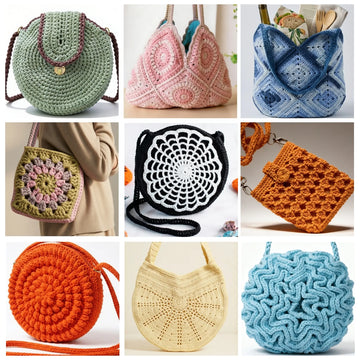
Explore the 9-pattern bag bundle →A surprisingly long history for a "simple" motif
The granny square is older than almost everyone assumes. The earliest known published example of a traditional granny square was designed by a Mrs. Phelps and appeared in the April 1885 edition of the American farming paper Prairie Farmer. She described working an afghan "on the principle of the crazy work so popular now" — a reference to crazy quilting, the patchwork craze of the era. Her instructions called for bright, varied colors in each block, with the outer edge of every one worked in black, echoing the black ribbon borders used between crazy quilt squares.
That black-bordered, scrap-bright square is the direct ancestor of everything in this article. The motif resurfaced in the 1930s in publications such as Fleisher's Afghans, then exploded in the 1970s to the point of parody. As Debbie Stoller wrote of growing up in that decade: "Granny square vests, granny square shorts, granny square hats. Heck, I bet there was some kid out there who was forced to go to school wearing granny square underwear."
It is worth sitting with what that cycle tells us. A motif does not survive 140 years, three major revivals and one fashion backlash because it is trendy. It survives because it is fundamentally, structurally useful — thrifty, modular, teachable and adaptable to whatever each generation wants it to be.
What makes the granny square structurally special
- It is modular. Small units join into any size or shape you want, so one motif scales from a coaster to a bedspread.
- It is worked in the round. You build outward from the center, so the square grows in every direction at once and each round is a natural stopping point.
- It is color-change friendly. The construction gives you a clean, logical place to switch yarn on every single round.
- It cannot be machine-made. Granny squares are traditionally handmade and cannot be manufactured by machine — part of why handmade granny pieces feel special.
- It is forgiving. Small irregularities disappear once squares are joined and the whole piece is blocked.
The granny square is the only project where "I'll just do one more" is both a promise and a lie.— Ava, MrsCrochetWorld
So what can you actually make from granny squares?
This is the part that surprises new crocheters. The honest answer is: far more than blankets.
Because the motif is modular, the question is never really "can I make this from granny squares?" It is "how many squares, what size, and how do I join them?" Here is a realistic map of where the motif goes — from the classics to the ones people do not expect.
| Project | Why granny squares suit it | Good for |
|---|---|---|
| Blankets & afghans | The original use. Scales infinitely; perfect long-term portable project. | All levels |
| Baby blankets | Small size finishes fast; soft color play; a classic handmade gift. | Beginner |
| Tote bags & market bags | Just a handful of squares plus handles. The fastest route to a finished, usable object. | Beginner |
| Cushion covers | Two panels of squares. Instantly updates a sofa and uses very little yarn. | Beginner |
| Cardigans & vests | Garment shaping without complex shaping — you join flat squares into panels. | Confident beginner |
| Scarves & shawls | A single strip of squares. Ideal for testing color combinations. | Beginner |
| Coasters & placemats | One square equals one finished item. Instant gratification. | Absolute beginner |
| Headbands & ear warmers | Tiny, quick, wearable; a great single-evening make. | Beginner |
| Wall hangings & home decor | Pure color play, no fit or gauge pressure at all. | All levels |
| Pouches, purses & pencil cases | Two to four squares and a zip or button. | Beginner |
| Christmas & seasonal decor | Ornaments, garlands, festive coasters and table pieces. | Beginner |
| Gifts & handmade sets | Mix coasters, a cushion and a small bag into a coordinated set. | All levels |
The classics: blankets, afghans and baby blankets
This is where most people meet the motif, and it remains the best possible "slow project." You work squares whenever you have a moment, you store them in a bag, and one day you realize you have enough. Baby blankets are the sweet spot for first-timers: large enough to feel like a real achievement, small enough to finish before the enthusiasm wears off. If you are weighing up the time commitment, our guide on how long it takes to crochet a blanket breaks it down by size and yarn weight.
The gateway: bags, totes and pouches
If blankets are the marathon, bags are the perfect first race. A tote needs only a small number of squares, and the moment it is joined you have something you will genuinely carry. That feedback loop — small effort, real usable object, compliments from strangers — is what converts curious beginners into committed crocheters. It is no accident that granny square totes are having such a long moment.
The flex: cardigans, vests, scarves and headbands
Wearables feel like the advanced tier, and granny squares quietly cheat the difficulty curve. A classic granny square cardigan is, structurally, a set of flat panels joined at the shoulders and sides. You are not decreasing armholes stitch by stitch. You are making squares — a thing you already know how to do — and then assembling them. That is why so many crocheters find their first ever garment is a granny one.
The quick wins: coasters, cushions, decor and gifts
Sometimes you want to finish something tonight. One square, bordered and blocked, is a coaster. Nine squares are a wall hanging. Two panels are a cushion cover. These projects also make the best gifts, because they are fast enough to make in multiples and personal enough that the color choice says something about the person receiving it.
Why it is such a good place to start
Few skills, big payoff
Basic granny square motifs do not require advanced skills. You learn a small set of moves and immediately make something real with them.
Mistakes stay small
If a square goes wrong you redo one square, not an entire afghan. The cost of experimenting is genuinely tiny.
Built-in stopping points
Every round ends cleanly, so you can put it down mid-project without losing your place or your nerve.
Low-cost entry
A hook and leftover yarn. You do not need to buy a full sweater quantity to find out whether you enjoy it.
Gauge pressure is off
For blankets, bags and decor, a slightly different square size simply means a slightly different finished size.
It grows with you
Hundreds of variant motifs exist, and entire books have been devoted to granny square designs. You will not run out of variations.
About that cozy feeling — what the research does and does not say
We want to be careful here, because craft and wellbeing is a topic where it is easy to overclaim. So here is what is actually documented, with sources you can check yourself.
The strongest crochet-specific evidence comes from Burns and Van Der Meer's 2020 study in Perspectives in Public Health, an international survey of crocheters across 87 countries. It found a statistically significant improvement in self-reported mood before versus after crocheting, and concluded that crochet "offers positive benefits for personal wellbeing," with many respondents actively using it to help manage mental health conditions and life events such as grief, chronic illness and pain.
A broader 2024 study by Keyes and colleagues in Frontiers in Public Health found that engaging in creating arts and crafts significantly predicted increased life satisfaction, a sense that life is worthwhile, and happiness.
Two honest caveats. First, these are largely self-report surveys of people who already enjoy the craft, so they describe how crocheters experience crochet rather than proving a clinical effect. Second — and this matters — crochet is not a treatment. It is a lovely, low-cost, accessible thing that a great many people find calming and meaningful. If you are struggling with your health, please talk to a professional. Granny squares are a joy, not a prescription.
What we can say without any hedging at all is this: crocheters consistently report feeling calmer and happier after crocheting, and the granny square — small, rhythmic, finishable, colorful — is one of the most direct routes to that feeling.
Keep exploring

Ready to actually make one? Our complete step-by-step tutorial walks you through it from the very beginning.
Read the tutorial →
A modern granny square tote PDF in US terms. One of the fastest ways to a finished, wearable granny project.
View pattern →
An easy granny square bag pattern PDF that comes with a video tutorial to follow along.
View pattern →
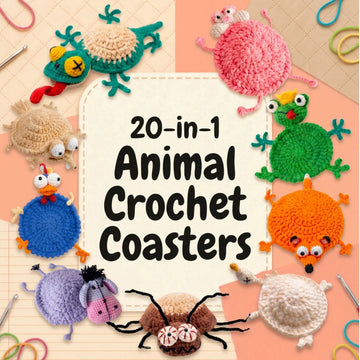
A 20-in-1 paperback of festive coasters and granny squares — small projects, quick finishes.
View the book →Something granny-shaped is coming
Here is the part we have been building up to. We are deep in the middle of designing a new collection of granny square patterns and books at MrsCrochetWorld, and they will be arriving over the coming weeks.
We are not going to pretend we can give you details yet, because they are genuinely still on the hook. No titles, no dates, no promises we cannot keep. What we can tell you is the thinking behind them: modern colorways rather than nostalgic ones, projects that finish in a realistic amount of time, and clear instructions written for people who want to make something lovely without decoding a wall of jargon.
If that sounds like your kind of thing, the best move is simply to be on the list when it lands. In the meantime, there is plenty of granny goodness already waiting for you above — and the full tutorial if you want to make your very first square tonight.
Three ways to be first to know
- Join the newsletter. New pattern and book releases go out there first, along with the occasional free pattern.
- Follow along. We share works in progress, color tests and sneak peeks as designs come together.
- Bookmark the blog. We will publish full project guides as each release goes live.
Frequently asked questions
What exactly is a granny square?
A granny square is a piece of square crochet fabric worked in rounds from the center outward. Crocheters usually make multiple small squares, called motifs, and join them together to create clothing, bags, blankets and household textiles. The traditional version is a double-crocheted square made from a series of chains and double-crocheted blocks.
Are granny squares good for complete beginners?
Yes — they are one of the most recommended starting points in crochet. Basic granny square motifs do not require advanced skills, each square finishes quickly, and mistakes are cheap to fix because you are only ever redoing one small square rather than a whole project.
What can I make from granny squares besides blankets?
Far more than most people expect: tote bags, cushion covers, cardigans and vests, scarves and shawls, coasters and placemats, headbands and ear warmers, wall hangings, pouches and purses, baby blankets, seasonal decorations and coordinated handmade gift sets. Because the motif is modular, almost anything made from flat panels is possible.
Why are granny squares so good for using up leftover yarn?
Each round uses only a small amount of yarn and the construction gives you a natural place to change color on every round. That means small leftover balls become a deliberate palette instead of clutter. Multicolor granny squares are a classic, long-established way to use up small amounts of yarn left over from other projects.
How old is the granny square?
Older than most people think. The earliest known published example of a traditional granny square was designed by a Mrs. Phelps and appeared in the April 1885 edition of Prairie Farmer. The motif reappeared in the 1930s in publications such as Fleisher's Afghans, and granny square apparel peaked as a fashion trend in the 1970s.
Does crocheting granny squares actually help you relax?
Crocheters consistently report that it does. In an international study published in Perspectives in Public Health, respondents reported that crochet made them feel calmer (89.5%), happier (82%) and more useful (74.7%), with relaxation cited by 78.5% as a main reason for crocheting. These are self-reported findings from people who already crochet, and crochet is not a medical treatment — but the pattern in the data is consistent and well documented.
Can granny squares be made by machine?
No. Granny squares are traditionally handmade and cannot be manufactured by machine. That is part of why a handmade granny square piece feels special and why the motif has stayed firmly in the hands of crafters rather than factories.
Is there only one kind of granny square?
Not at all. Hundreds of variant motifs are in use, and entire books have been devoted to granny square designs. Variations use different stitch types or produce other geometric shapes entirely, such as hexagons, which can be joined in the same modular way.
What makes granny squares such a good travel project?
You only ever carry one square's worth of work: a hook, a small ball of yarn and the square in progress. Crochet is described in the research literature as a relatively low-cost, portable activity that can be easily learnt, and the granny square is its most portable form — which is why it fits so well into commutes, waiting rooms and short pockets of free time.
How many squares do I need for a project?
It depends entirely on your square size and your finished dimensions. As a rough guide, a coaster is one square, a cushion cover is two panels, a tote needs only a small handful, a baby blanket is typically a few dozen, and a full afghan can run well over a hundred. Because the motif is modular, you can simply keep going until the piece is the size you want.
Why do granny square cardigans look easier than other crochet garments?
Because structurally they often are. A classic granny square cardigan is built from flat panels of joined squares rather than complex stitch-by-stitch shaping. You are repeating a motif you already know and then assembling it, which is why a granny cardigan is frequently someone's first ever crocheted garment.
Where do I learn to actually make one?
This article is a celebration of the motif rather than a tutorial, so we have kept the how-to out of it on purpose. We have a complete step-by-step granny square tutorial on the blog that takes you through the whole process from the beginning — that is the right place to start if you want to make your first square today.
About the author
Ava — MrsCrochetWorld. Ava designs and tests crochet patterns for MrsCrochetWorld, where the focus is on modern, beginner-friendly designs with instructions written in plain English rather than jargon. Every pattern published on the site is worked up and checked before release, and the blog exists to answer the questions real crocheters actually ask — including the ones that are too basic to feel comfortable asking out loud.
This article is editorial. Historical claims are sourced to the published record of the motif, including the 1885 Prairie Farmer pattern by Mrs. Phelps and Debbie Stoller's Stitch 'n Bitch Crochet. Wellbeing statistics are cited from Burns & Van Der Meer (2020), Perspectives in Public Health, and Keyes et al. (2024), Frontiers in Public Health. Crochet is a hobby, not a medical treatment, and nothing here is health advice.
Start your granny square story today
Browse the granny square patterns already in the shop, or learn the motif from scratch with our full tutorial — and keep an eye out for the new collection arriving over the coming weeks. Our 20% off everything sale is running through November 15, 2026.
Browse crochet patterns Get a free pattern