Benefits of Crochet: 12 Cozy Ways a Hook and Yarn Support Everyday Wellbeing
From steady hands and quiet focus to a finished little bear you can actually hold — here is what regular crochet gives back, and how to build a routine that sticks.

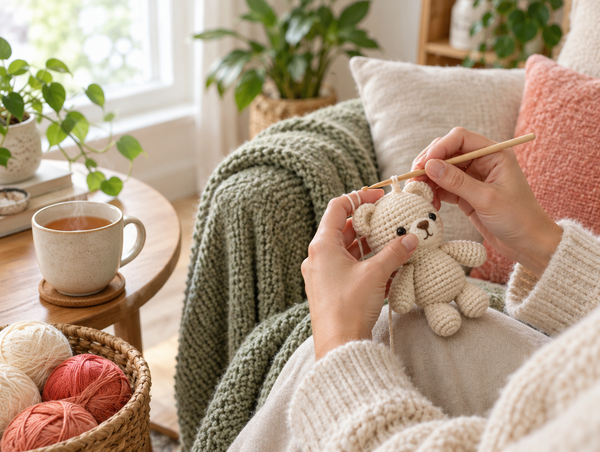
Ask ten crocheters why they keep a project within arm's reach and you will get ten different answers — and almost all of them are about how the craft makes them feel. Some reach for the hook when the day has been loud. Some pick it up because their hands want something to do that is not a phone. Some simply love the moment a shapeless cream oval suddenly becomes a bear's head. Crochet is a hobby, a skill, and a maker's craft all at once, and that combination is exactly why it earns such a loyal place in people's routines.
This guide walks through twelve benefits people report most often, grouped into the four areas where crochet tends to show up in daily life: a calmer pace, sharper focus and skill, creative satisfaction, and connection with other people. We will also cover how much crochet it actually takes to feel a difference, which first projects give the fastest reward, and how to keep a routine going when life gets busy.
One honest note before we start. This article describes general wellbeing and lifestyle benefits that crocheters commonly describe — a calmer evening, a satisfying sense of progress, an absorbing hobby. Crochet is a craft and a leisure activity, not a treatment, and nothing here is medical advice or a health claim. If something in your life feels heavier than a hobby can carry, please talk to a qualified professional. Crochet can sit happily alongside that kind of support, never in place of it.
The three ingredients that make crochet feel so good
Before the list of twelve, it helps to understand the mechanics. Almost every benefit traces back to one of these three features of the craft.

A repetitive motion your hands can run on autopilot
Yarn over, pull through, insert, repeat. Once your hands know a basic stitch, the motion becomes rhythmic and predictable — the same small loop, hundreds of times. That predictability is the point. You are not making decisions every second, so the usual mental chatter has less to grip onto. Many crocheters describe the first twenty minutes of a session as the moment their shoulders finally come down from their ears.
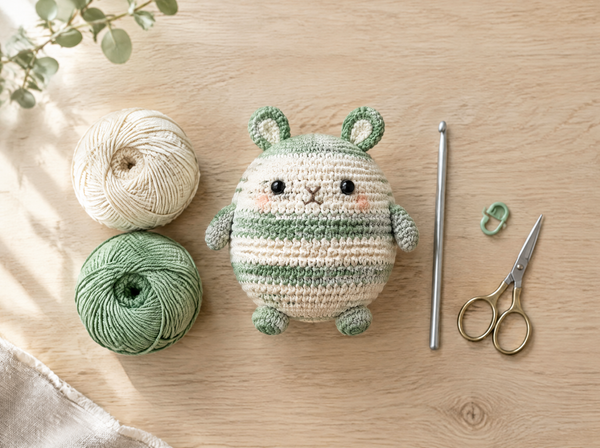
This is also why amigurumi suits wind-down time so well. Worked in continuous spiral rounds of single crochet, it is about as rhythmic as crochet gets. There is no turning, no counting rows, no complex stitch sequence — just a steady, looping motion.
Browse easy beginner patterns →
One task, one place to look
Crochet is quietly single-tasking. You cannot work a round and scroll at the same time — your hands are literally full. That built-in limit is rare in an ordinary evening, and it is a large part of why a crochet session feels different from an hour of television or a feed.
Because the work is physical and immediate, your attention has somewhere concrete to rest: the loop on the hook, the stitch count, the shape taking form. When your mind wanders, the project is right there to come back to, with no penalty for having drifted.
Read the evening wind-down routine →
Something real at the end of it
A great deal of modern work never becomes an object. Crochet always does. Every session moves a project visibly forward, and eventually you are holding a bear, a bag, or a blanket that did not exist before you made it. That closed loop — effort in, object out — is deeply satisfying in a way screen time rarely is.
The scale matters too. A small amigurumi can be finished in an evening or two, so the reward arrives while motivation is still high. That is why we almost always suggest starting small rather than with a blanket.
See amigurumi patterns →A calmer pace: benefits 1 to 4
The most commonly described benefit of crochet is simply that it slows the day down. Here is what that actually looks like in practice.
1. It gives restlessness somewhere to go
Fidgeting, scrolling, picking at things, getting up for the fourth snack you do not want — restless hands look for a job. Crochet gives them a genuinely absorbing one. Instead of trying to sit still, you are occupied, which for many people is far easier than relaxing on command. The hook becomes a kind of permission slip to stay in one place.
2. It makes an evening wind-down routine easy to keep
Routines fail when they feel like chores. Crochet rarely does, because you want to pick it up. Fifteen or twenty minutes with a project, a warm drink, and a lamp turned low is a wind-down ritual that signals the day is closing — and unlike many evening habits, it leaves you with progress to show for it.
3. It breaks the scroll without feeling like deprivation
Putting the phone down is hard when nothing replaces it. Crochet replaces it with something your hands actively prefer. The phone does not have to be banished — it just stops being the default, because your hands are already busy and the project is more immediately rewarding than a feed.
4. It is portable comfort
A small project, a hook, and a ball of yarn fit in a tote bag. Waiting rooms, train journeys, a long passenger drive, the quiet hour at a relative's house — a crochet project turns dead time into something productive and pleasant. Many crocheters keep a deliberately simple travel project exactly for this reason.
Make the habit easy to start
- Keep one project permanently set up in a basket beside your usual chair — visible, hooked, ready.
- Choose a travel project so simple you can work it without reading anything.
- Set the bar at one round, not one hour. You will almost always keep going.
- Wind your yarn before you sit down so nothing interrupts the rhythm later.
- Stop mid-round rather than at the end — it makes picking it up again effortless.
Focus and skill: benefits 5 to 8
Crochet is not only restful — it is a genuine skill that rewards attention and improves with practice. That mix of calm and challenge is what keeps people going for decades.
5. It trains sustained attention in small doses
Keeping a stitch count, noticing a missed increase, recognising when a round has gone wrong — crochet asks for steady, low-pressure concentration. It is challenging enough to hold your attention but forgiving enough that lapses cost you a few minutes, not the whole project. For anyone who struggles to focus on demand, that forgiving quality matters enormously.
6. It builds real fine-motor control
Tension control, hook grip, consistent stitch height — these are learned physical skills. Early work is often tight and uneven; after a few projects, the same hands produce smooth, regular fabric. Watching your own stitches become neater is one of the clearest forms of visible progress in any hobby.
7. It teaches patient problem-solving
Every crocheter eventually faces a lopsided head, a hole where there should not be one, or a count that has drifted by two. Learning to find the error, frog back calmly, and rework the round is a genuinely useful habit — and it transfers. Mistakes stop feeling like failures and start feeling like steps.
8. It gives structure through patterns
A written pattern is a clear plan: do this, then this, then this. On days when deciding anything feels like too much, following a good pattern is a relief. You do not have to invent — you just have to follow, and something lovely appears at the end.
| If you want | Start with | Why it works |
|---|---|---|
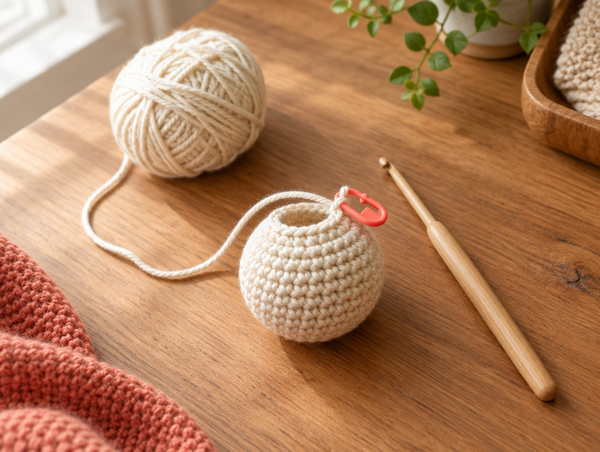
| Pure rhythm, minimal thinking | A plain amigurumi ball or simple bear | Continuous single crochet rounds, no turning, no row counting |
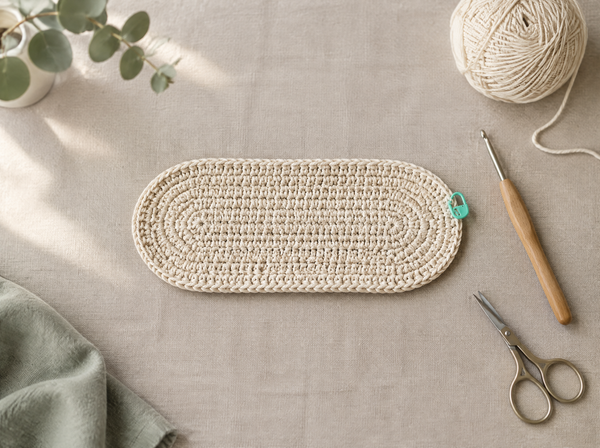
| A fast finish | A keychain charm or small coaster | Complete in one or two evenings while motivation is high |
| Something to use daily | A granny square tote bag | Repeating motif plus a practical, visible result |
| A portable travel project | Flower or coaster motifs | Small, self-contained units you can start and stop anywhere |
| A longer slow project | A blanket in simple stitches | Endlessly repetitive, no pressure to finish quickly |
The hook does not ask you to be calm. It just gives your hands something steady to do until you are.— Ava, MrsCrochetWorld
Creativity and connection: benefits 9 to 12
9. It is a low-risk creative outlet
Choosing colors, combining yarns, adding a scarf to a bear that the pattern never mentioned — crochet invites small creative decisions without demanding talent. There is no blank canvas intimidation, because the pattern carries the structure and you simply make it yours. For people who do not think of themselves as creative, this is often the first hobby that proves otherwise.
10. It produces gifts that genuinely mean something
A handmade bear carries hours of attention in it, and people feel that. Crochet turns your downtime into birthday presents, new-baby gifts, and holiday decorations — which makes the hours feel doubly well spent. Gift-making also provides a gentle deadline, which some people find motivating.
11. It connects you to a large, welcoming community
Crochet has one of the friendliest maker communities anywhere — local yarn shops, library craft groups, cafe meetups, and enormous online spaces where people post progress, troubleshoot each other's stitch counts, and celebrate finished projects. Sharing a hobby gives conversations an easy starting point, and for many people that is the real benefit: a reason to sit with others regularly.
12. It can grow into a side income
Not everyone wants this, but the option is there. Finished amigurumi, charms, and bags sell at craft fairs and online, and some crocheters go further and write and sell their own patterns. Turning a restful hobby into income changes its character, so it is worth being deliberate about it — but knowing the skill has real value is its own quiet satisfaction.
How much crochet does it actually take?
Less than most people assume. The crocheters who describe the biggest difference are rarely the ones doing marathon sessions — they are the ones who pick it up often.
- Start with fifteen minutes. Long enough for your hands to find the rhythm, short enough that you will actually do it on a tired Tuesday.
- Attach it to something you already do. After dinner, with your evening tea, during one episode. An anchor beats willpower every time.
- Keep the project visible. A basket by your chair does more for consistency than any amount of good intention.
- Choose a project below your skill level for routine sessions. Save the challenging makes for when you have energy to spare.
- Let bad days be bad days. Missing a week does not undo anything. The project waits exactly where you left it.
What to make first
If you are starting from zero, the fastest route to feeling the benefits is a small amigurumi. You learn the magic ring, single crochet in rounds, increases, decreases, and stuffing — which together unlock an enormous share of all amigurumi patterns — and you finish something cute quickly enough to stay motivated.
Work with a smooth, light-colored worsted or DK acrylic or cotton so your stitches are easy to see, and use a hook a size or two smaller than the yarn label suggests so the fabric is dense enough to hide the stuffing. If a tight magic ring feels impossible at first, that is completely normal — it is the one step nearly every beginner wrestles with, and it clicks with practice.
Avoid starting with a blanket. Blankets are wonderful and deeply soothing, but they are long, and a beginner who stalls at twenty percent of a blanket often concludes they are bad at crochet when really they just picked a project with a distant reward.
Keep exploring

How to calm a busy mind one stitch at a time with a simple, repeatable session.
Read the guide →
Present-moment focus with hook and yarn, and how to return when your mind drifts.
Read the guide →
Fifty beginner-friendly plushies with almost no sewing — ideal for short cozy sessions.
View pattern →
A rhythmic, satisfying make with clear photos and beginner-friendly instructions.
View pattern →Start tiny
A keychain charm or plain ball teaches the core skills and finishes in an evening.
Keep it visible
A basket beside your chair removes every excuse not to pick the project up.
Lower the bar
One round counts as a session. Consistency matters far more than duration.
About the author
Ava is the designer behind MrsCrochetWorld, where she writes and tests beginner-friendly amigurumi and accessory patterns. She has spent years teaching new crocheters the same handful of foundational skills — the magic ring, working in continuous rounds, even tension, and calm mistake recovery — and most of the advice here comes from watching which habits actually keep people crocheting past their first project. Every MrsCrochetWorld pattern is worked up and photographed before it is published.
This article reflects general wellbeing and lifestyle experiences commonly described by crocheters. It is not medical advice and makes no health claims.
Frequently asked questions
What are the main benefits of crochet?
Crocheters most often describe a calmer pace in the evening, steadier focus, a satisfying sense of progress, and real creative confidence. On top of that, crochet builds a practical skill that produces gifts, home items, and even side income. These are general wellbeing and lifestyle benefits, not medical outcomes.
How long do I need to crochet to feel a difference?
Most people notice the settling effect within the first fifteen to twenty minutes of a session, once their hands find the rhythm. For the broader benefits, frequency matters more than length — short sessions several times a week do more than one long session a month.
Is crochet good for beginners who have never crafted before?
Yes. Crochet uses one hook and one active loop, so there is very little to drop or lose compared with other yarn crafts. A simple amigurumi teaches the five core skills you need for most patterns, and you can finish one in an evening or two.
Which crochet projects are the most relaxing?
Anything highly repetitive. Amigurumi worked in continuous single crochet rounds is the classic choice because there is no turning and no row counting. Plain blankets, coasters, and simple motifs work equally well once you are comfortable with the stitch.
Can crochet help me spend less time on my phone?
It tends to, simply because your hands are full. Crochet replaces scrolling with something physically absorbing rather than asking you to give something up, which is usually why it lasts longer than a strict screen-time rule.
Does crochet really improve concentration?
Many crocheters find that keeping a stitch count gives them steady, low-pressure practice at holding attention on one task. It is forgiving — losing track costs a few minutes, not the project — which makes it easier to sustain than more demanding focus exercises.
What is the best first project for the fastest reward?
A small amigurumi such as a plain ball, a simple bear, or a keychain charm. These finish quickly, teach the magic ring, rounds, increases, decreases, and stuffing, and give you something to hold while motivation is still high.
Is crochet an expensive hobby to start?
No. A single hook, one ball of smooth worsted or DK yarn, a yarn needle, stitch markers, and stuffing will carry you through your first several projects. You can add hook sizes and yarn weights gradually as your projects require them.
What if I keep making mistakes?
That is the normal path, not a sign you are bad at it. Every crocheter frogs work back. Learning to spot a drifted stitch count, undo calmly, and rework the round is part of the skill — and that patient problem-solving is one of the benefits people value most.
Can crochet be done with limited hand strength or stiff hands?
Many people adapt it successfully by using a larger ergonomic hook, a softer yarn, a looser tension, and shorter sessions with regular breaks. Comfort should always come first — if crochet causes pain, stop and check with a qualified professional before continuing.
How do I keep a crochet routine going when I get busy?
Lower the bar and keep the project visible. Set the goal at one round rather than one hour, anchor it to something you already do such as evening tea, and leave the project set up beside your usual chair. Missing a week undoes nothing.
Can I make money from crochet?
Yes, though it is optional. Finished amigurumi, charms, and bags sell at craft fairs and online, and experienced crocheters often write and sell their own patterns. Be deliberate about it, since turning a restful hobby into work changes how it feels.
Pick up a hook tonight
Choose one small project, set it beside your chair, and give yourself fifteen minutes. That is all it takes to start.
Shop beginner patterns Get a free pattern