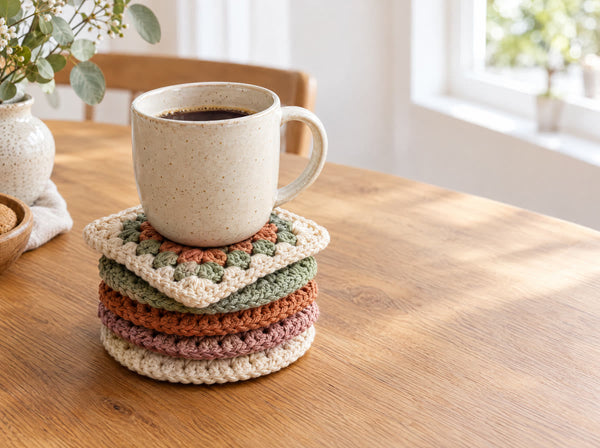
Crochet Morning Routine: A Calm, Cozy Start to Your Day
Ten quiet stitches before the day starts can change how the whole morning feels. Here is how to build a crochet morning routine that actually sticks.

Most mornings do not start gently. The alarm goes off, the phone lights up, and before your feet touch the floor you have already absorbed a dozen notifications, three headlines and someone else's urgent request. By the time you sit down with coffee, your attention has been spent and the day has not even begun. A crochet morning routine is a small, deliberate counter-move: a few quiet minutes with a hook and yarn, claimed before the world gets its hands on you.
This is not about adding another task to an already full list. It is the opposite. A morning crochet ritual is small on purpose, forgiving on purpose, and short enough that you can keep it on the days when everything else falls apart. Many crocheters describe it as the one part of the day that belongs entirely to them — unhurried, undemanding, and finished before anyone else needs anything.
Below you will find what a realistic crochet morning routine looks like, how to set one up in a single evening, which projects work best before you are fully awake, and how to keep the habit alive when mornings get chaotic. Everything here is about general wellbeing, comfort and routine — the simple pleasure of a calm start, not a treatment or a cure.
The three pieces of a crochet morning routine
Every morning routine that survives past week two has the same three parts: a kit you do not have to assemble, a project you do not have to think about, and a finish line you can actually reach.

A kit that is already packed
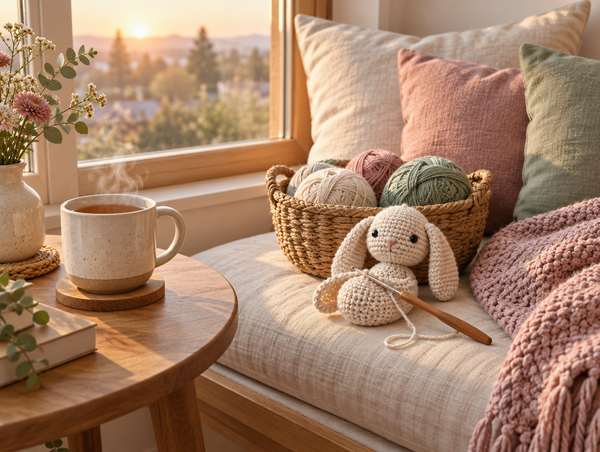
The single biggest reason morning crochet fails is friction. If you have to find the hook, hunt for the right yarn and remember which round you were on, the routine dies in the first week. Pack one basket and leave it where you will sit: your current project, the hook already in use, a small pair of scissors, a few stitch markers and a card with your last row number written on it. Nothing else. A morning kit should be liftable with one hand while the other holds a mug.
Browse easy beginner patterns →
Stitches you can do half-awake
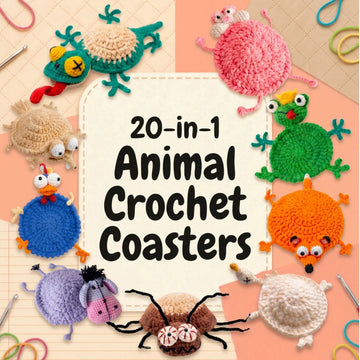
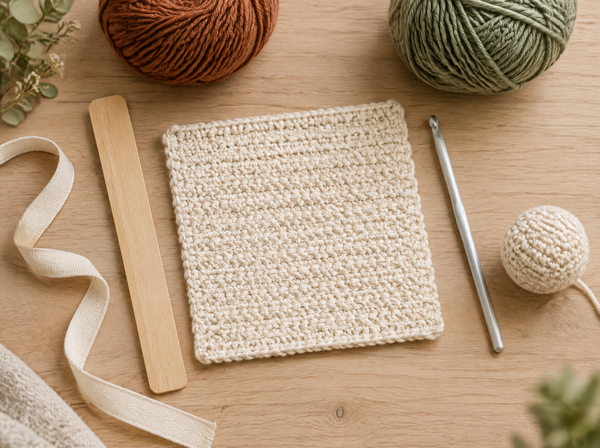
Morning is not the time for a cabled yoke or a chart with forty symbols. The best morning project is repetitive enough to run on autopilot: continuous single crochet rounds on an amigurumi body, a simple coaster spiral, a long scarf in one stitch, or a granny square you have made twenty times. The point is rhythm. When your hands know the motion, your mind is free to be quiet, and that quietness is the whole reason you are sitting there. Save the challenging pattern for a weekend afternoon when you are properly awake.
See no-sew amigurumi patterns →
A stopping point you can actually reach
Open-ended time is surprisingly stressful. "I'll crochet until I have to leave" turns into glancing at the clock every two minutes. Give yourself a defined end instead: one round, ten minutes, until the tea is cool enough to drink, or until the kettle has boiled twice. A clear finish line means you can stop without guilt and without the nagging feeling that you should have done more. Small, complete and repeatable beats ambitious and abandoned every single time.
Find quick coaster patterns →How to build your crochet morning routine in one evening
You do not need a new habit system. You need about fifteen minutes tonight and a decision about where you will sit tomorrow. Work through these steps in order.
- Pick the chair before you pick the project. Choose one specific spot — the window seat, the kitchen chair by the east window, the corner of the sofa. Habits attach to places far more reliably than to intentions. If the spot gets good morning light, better still.
- Anchor it to something you already do. Do not aim for a time on the clock. Aim for an existing trigger: after the kettle goes on, after you feed the cat, after you open the curtains. The old habit pulls the new one along behind it.
- Choose one simple project and only one. A single active morning project removes the decision entirely. Decisions before coffee are expensive. If you have three works in progress, pick the most mindless one and declare it the morning project.
- Pack the basket tonight. Hook in the work, yarn attached, scissors and markers inside, round number written down. Put the basket on the chair, not in a cupboard. Future you should have to do nothing but sit.
- Set a comically small target. Five minutes. One round. Ten stitches. The target should be so small that skipping it feels sillier than doing it. You will almost always do more, but the small number is what gets you into the chair on a bad day.
- Leave the phone in another room. Not face-down on the table — in another room, or at least across the room on a charger. Morning crochet and a phone within arm's reach cannot coexist for long.
- Add one sensory comfort. Tea, coffee, an open window, a blanket over your knees, quiet music or complete silence. One, not five. The warmth and the texture are a large part of why this feels good.
- Write down the stopping point before you start. "Two rounds" on the card in the basket. Then you are working toward something finite rather than watching the clock.
- Do it for seven mornings before you judge it. The first three mornings feel awkward because anything new does. By day seven you will know whether this version fits your life or needs adjusting.
- Adjust one variable at a time. Too rushed? Shorten it. Too fiddly? Change the project, not the routine. Falling asleep over it? Move it to after breakfast rather than before.
Match the routine to the morning you actually have
There is no single correct length. The right crochet morning routine is the one that fits the morning in front of you, not the morning you wish you had. Use this as a starting point and adapt freely.
| Time available | What to work on | Realistic goal |
|---|---|---|
| 5 minutes | Amigurumi body in continuous rounds | One or two rounds, marker moved |
| 10 minutes | Coaster or small flat motif | Half a coaster, or finish yesterday's |
| 15 minutes | Granny square or simple scarf rows | One full square, or four rows |
| 20 minutes | Keychain or mini amigurumi | A complete small piece, start to finish |
| 30+ minutes (weekend) | Any project, including new patterns | Real progress, no clock-watching |
Small things that make a morning routine stick
- Wind the yarn into a center-pull ball the night before so it does not roll across the floor at 6am.
- Keep a spare hook in the basket. Hooks migrate, and hunting for one ends the session before it starts.
- Write the round number on a card every time you stop, even mid-round. It takes four seconds and saves five minutes.
- Choose light-colored yarn for early mornings. Dark navy and black are genuinely hard to see before sunrise.
- If you travel, pack a tiny second kit. A keychain-sized project and a 3.5 mm hook fit in any bag.
- Do not restart the streak counter when you miss a day. Missing one morning is a gap, not a failure.
- Keep a second, even easier project as a backup for the mornings when your brain refuses to cooperate.
- Put the basket back on the chair when you finish, not on the shelf. Visible equals likely.
The stitches are not the point. The ten minutes where nobody needs anything from you — that is the point.— Ava, MrsCrochetWorld
Why mornings suit crochet so well
Crochet works at any hour, but there are a few practical reasons the morning version feels different from an evening session.
Nothing has gone wrong yet. In the evening you bring the whole day with you to the chair. In the morning the slate is still relatively blank, which makes it much easier to settle into a rhythm instead of replaying a difficult conversation.
It sets the tempo before anything else can. The first thing you do in the morning tends to set the pace for the hour that follows. Starting with something slow and tactile is a different opening note than starting with a scroll through notifications. Many crocheters say the difference is less about the crochet itself and more about what it displaces.
The hands are busy, so the mind can wander usefully. Repetitive stitching occupies just enough attention to stop aimless worrying, while leaving room for the kind of loose, unforced thinking that often produces the day's best ideas. It is a well-known phenomenon among people who do any repetitive handwork.
You finish with visible proof. Even two rounds is something that did not exist twenty minutes ago. Starting the day with a small, completed, tangible thing is a quietly satisfying way to begin, especially if your work does not produce anything you can hold.
It is genuinely portable. A morning routine built on a small project travels well. The same ten minutes work on a train, in a waiting room, or in a parked car before a shift starts. The routine belongs to you, not to the room.
What to do when the routine falls apart
It will. Someone gets sick, a deadline lands, the clocks change, you go on holiday. A crochet morning routine is not a streak to protect — it is a chair you can always come back to. When you have missed a week, do not try to make up for it with a long session. Do the smallest possible version instead: sit down, do one round, put it back. The habit rebuilds from the smallest version, never from the most ambitious one.
If the routine keeps collapsing in the same place, the routine is wrong, not you. Too early? Move it later. Too long? Halve it. Project too complicated? Swap it for something you could make with your eyes closed. The routine should bend to your life, every single time.
Three ways to shape your morning
Most people end up with two or three versions of the same routine and switch between them depending on the day. Here are the three that come up most often, and when each one earns its place.
The five-minute version
For packed mornings. Kettle on, basket up, two rounds, basket down. Short enough that there is no excuse, long enough to feel like a real pause before everything starts. This is the version that keeps the habit alive through busy weeks, and the one worth defaulting to whenever you are tempted to skip entirely. Two rounds done beats twenty minutes planned.
The slow-coffee version
Twenty minutes with a hot drink and a simple project. Best on days you can start a little earlier. This is the version most people picture when they imagine a crochet morning, and the one worth protecting on weekends and days off. If you only get it once or twice a week, that is still enough to look forward to.
The commute version
A keychain or mini amigurumi in a small pouch. Works on trains, buses and in waiting rooms, and keeps the routine alive on mornings when home is too hectic to sit down at all. Keep this kit permanently packed in the bag you actually carry, so it is never a decision — just something that is already there when you have ten unexpected minutes.
Keep exploring

Fifty simple plushie patterns worked in continuous rounds — ideal morning autopilot projects.
View pattern book →
Small flat projects you can finish in one or two short sittings. Perfect ten-minute mornings.
View pattern →
How to put the phone down and pick the hook up — the natural companion to a morning routine.
Read the guide →
The evening counterpart: a cozy wind-down routine to close the day as gently as you opened it.
Read the guide →About the author
Ava is the designer behind MrsCrochetWorld, where she has written and tested hundreds of amigurumi and beginner crochet patterns. She crochets most mornings before the studio opens — usually two rounds of whatever small project is currently living in the basket by the window — and writes about the practical, everyday side of crochet: the tools, the habits and the small routines that keep people stitching for years. Everything published here is drawn from her own studio practice and from the questions MrsCrochetWorld readers send in every week.
A note on wellbeing: This guide describes crochet as a comfortable daily routine and a general source of calm and enjoyment. It is not medical advice and makes no health claims. If you are dealing with a health concern, please speak to a qualified professional.
Frequently asked questions
What is a crochet morning routine?
A crochet morning routine is a short, repeated period of stitching at the start of the day, usually five to twenty minutes, done before the day's demands begin. It normally uses one simple project kept in a ready-packed basket so you can sit down and start immediately without any setup.
How long should a crochet morning routine be?
Start with five to ten minutes. That is long enough to settle into a rhythm and short enough to survive a busy week. Many people naturally extend to fifteen or twenty minutes once the habit is established, and keep a longer version for weekends.
What is the best crochet project for mornings?
Anything repetitive that you can work without reading a pattern. Continuous single crochet rounds on an amigurumi body, a spiral coaster, a granny square you know by heart, or a one-stitch scarf are all excellent. Avoid complex charts, color changes and shaping before you are properly awake.
I am a complete beginner. Can I still do this?
Yes, and beginners often benefit most, because daily repetition is exactly how tension and hook grip become automatic. Start with a simple flat square or a coaster in worsted weight yarn and a 4 mm to 5 mm hook. Ten minutes a day builds skill faster than one long session a week.
What should I keep in my morning crochet basket?
Your current project with the hook already in it, the attached yarn, small scissors, a few stitch markers, a spare hook in the same size and a card with your last round or row number. Keep it to one basket you can lift with one hand, and keep it on the chair where you sit.
How do I stop forgetting which round I was on?
Write the round number on a small card every time you stop, even if you stop mid-round. Keep that card in the basket. A locking stitch marker placed in the first stitch of the current round also works well, especially for amigurumi worked in a continuous spiral.
Is it better to crochet before or after breakfast?
Both work, and it depends entirely on your household. Before breakfast suits people who wake early and want quiet. After breakfast suits anyone who needs food and caffeine before fine motor work. Choose whichever one has a reliable, repeatable trigger in your existing morning.
What if I only have five minutes?
Five minutes is a complete routine, not a consolation prize. Two rounds of an amigurumi body or a few rows of a scarf is enough to create the pause. Short and consistent is far more valuable than long and occasional, and it keeps the basket in daily circulation.
How do I keep the habit going when mornings get chaotic?
Shrink it rather than skip it. On difficult mornings do the smallest possible version — sit down, work one round, put the basket back. Keeping the chair, the basket and the trigger intact matters more than the amount of crochet you actually get done.
Does the yarn or hook type matter for a morning routine?
Comfort matters more than anything else. A smooth hook with a grip you like and a soft, light-colored yarn in worsted or DK weight are the easiest to work with in low morning light. Avoid splitty yarns and very dark colors, which make early sessions needlessly fiddly.
Can I combine crochet with an evening wind-down routine too?
Many crocheters do exactly that, using the same simple project at both ends of the day. A morning session sets the pace, and an evening session closes it. Keeping two separate baskets, one by the morning chair and one by the bed, stops the two routines from competing for the same project.
How long before a crochet morning routine feels natural?
Give it at least seven consecutive mornings before deciding anything. The first few days feel deliberate because anything new does. Most people find that somewhere between the second and fourth week they start reaching for the basket automatically, without having to decide.
Pack your morning basket tonight
Pick one simple pattern, wind the yarn, and leave the basket on your chair. Tomorrow morning all you have to do is sit down.
Shop easy beginner patterns Get a free pattern