Why Crochet Coasters Are the Biggest Trend Right Now
Small, fast, scrap-friendly and endlessly giftable — here is why coasters have become the project crocheters keep coming back to, plus the patterns and books to start with.

Ask crocheters what they made last month and you may well hear: coasters. Not blankets, not sweaters, not the ambitious temperature project still sitting in a project bag since spring. Coasters. The humble little circle of cotton that lives under a coffee mug has quietly become a favorite to make, to gift and to photograph, and once you look at what it actually asks of you, the reason is not mysterious at all.
This article is an honest look at why coasters keep winning, what makes a good one, and which patterns are worth your time. A note on evidence before we go further: we are not going to quote viral view counts or invented search statistics at you. What we can tell you is what we see in our own shop. MrsCrochetWorld currently lists a growing range of coaster pattern bundles and printed books (English and German editions) in a dedicated Crochet Coaster Patterns collection, and that collection has kept earning its place rather than being quietly retired. That is a real, verifiable signal of sustained demand, and it is the kind of signal we are willing to stand behind.
There is also something else happening, and it is the part we are most excited about. Our design desk is currently covered in coaster prototypes, and the newest ones are in testing right now. More on that further down — it involves a brand new pattern book we are putting together right now.
Crochet coasters at a glance
| Stitches you need (US terms) | ch = chain, sc = single crochet, dc = double crochet, inc = increase, sl st = slip stitch, rnd = round[3] |
|---|---|
| Worsted = medium (#4) | Yarn label hook range 5.5–6.5 mm (US I-9 to K-10½)[1]; DK = light (#3): 4.5–5.5 mm[1] |
| Hook in this guide | 3.5–4.0 mm for worsted cotton = US E-4 to G-6[2] – deliberately small for a dense coaster |
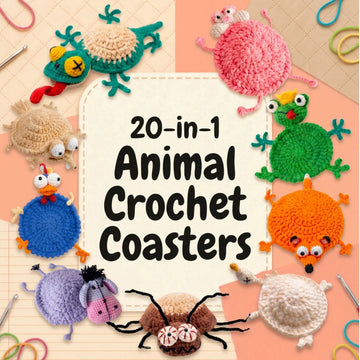
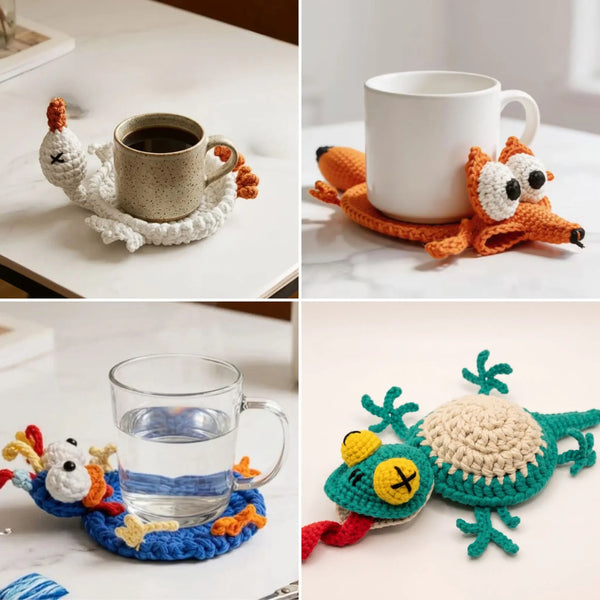
| 21-in-1 Animal Coasters Bundle | 21 pop-up animals, 170+ page PDF; base in double crochet with sport (#2) cotton or acrylic held double on a 3.5 mm (US E-4) hook, small parts on 2.5 mm; about 8–10.5 cm (3¼–4¼ in) across; advanced beginner to intermediate |
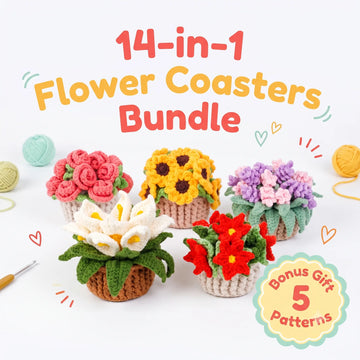
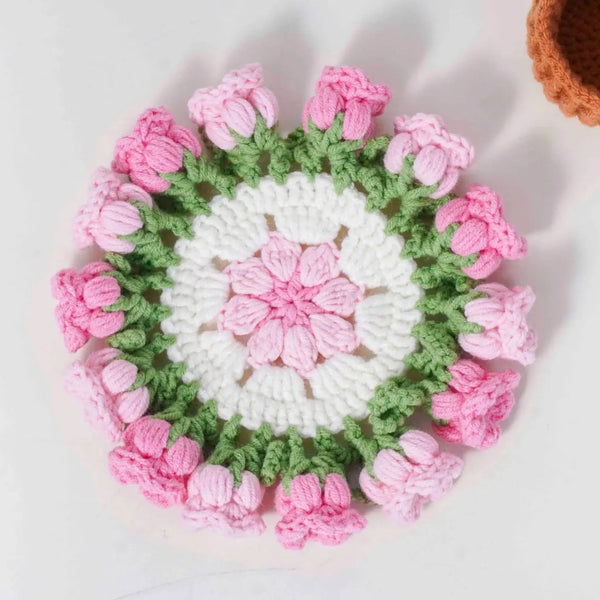
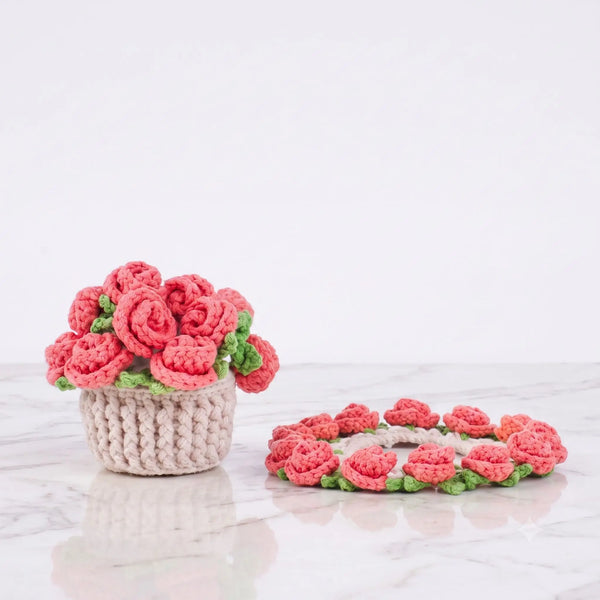
| 14-in-1 Flower Coasters | 14 flower designs that lie flat as a coaster or roll into a bouquet in a matching crochet pot; PDF bundle or printed paperback |
| Books | 20-in-1 Animal Coasters Book (20 designs) and 14-in-1 Flower Coasters Book are printed paperbacks, ordered through Amazon |
| Selling what you make | Allowed for all finished coasters from MrsCrochetWorld patterns and books – no limits, credit appreciated, never required. Not allowed: copying, sharing, reselling or uploading the patterns or books |
Hook and circle math: the 3.5–4.0 mm hook for worsted cotton is 1.5–3.0 mm below the worsted label range (5.5 − 4.0 = 1.5; 6.5 − 3.5 = 3.0)[1] – that is the density that stops a mug base sinking in. A hexagon has six corners because a flat circle typically gets six increases per round; stacked on top of each other they form six straight edges, so shift where each increase falls from round to round.
Hook sizes are Craft Yarn Council guidelines; the hook in your pattern and your yarn label come first. Prices and product line-ups can change – the product page always shows the current ones.
Four honest reasons coasters took over
No hype needed. The appeal comes down to time, yarn, skill and gifting — four things every crocheter is constantly negotiating.

A whole finished object in one evening
Most crochet projects ask for a relationship. A blanket wants weeks. A cardigan wants gauge swatches, measurements and a willingness to rip back a sleeve. A coaster wants a single sitting, and at the end of it you are holding something complete.
That matters more than it sounds. The feeling of finishing is what keeps people crocheting, and a project that delivers that feeling the same day it starts is psychologically very hard to beat. It is also why coasters are so often the project people reach for between bigger makes — a palate cleanser that still produces something you can use.
Animal coasters push this even further, because a stack of five different characters gives you five small finishes instead of one long slog.
See the 21-in-1 animal coaster bundle →
They turn your leftover yarn into something useful
Every crocheter has the basket. Half a ball of cream cotton, a sad little nugget of mustard, the rust colored remainder from a market bag, three shades of sage that never quite matched. Too good to throw away, too small to do anything with.
A coaster typically takes between fifteen and thirty grams of worsted or DK cotton. That is precisely the size of the scraps clogging your storage, which means coasters are one of the few projects where your leftovers are not a compromise but the ideal material. A mismatched set in five different colors does not look like a mistake — it looks deliberate, and it is often more charming than a matched set.
The practical upshot: you can make a full set of four from scraps without buying a single new skein.
Browse all coaster patterns →
The handmade gift that actually gets used
Handmade gifting has a known problem: not everyone wants a scarf, and nobody knows what to do with a doily. Coasters sidestep this entirely. They are useful, they are neutral enough for almost any home, they do not need to fit anybody, and they do not take up space.
Tie four of them with a length of jute twine, add a kraft tag, and you have a present that looks like it came from a boutique. It works for a housewarming, a teacher, a coworker, a host, a neighbor or the relative who genuinely has everything. Because the time investment is small, you can make several sets in a weekend and keep a couple in reserve for the gift emergencies that always arrive unannounced.
This is also why coasters are a staple at craft fairs and in small handmade shops — low material cost, fast production, immediate appeal.
See the 14-in-1 flower coaster bundle →
A low-risk way to practice real technique
A coaster is a laboratory. Working in the round, the magic ring, increasing evenly, joining and turning, color changes, invisible joins, surface stitches, edging — almost every foundational crochet skill can be practiced on a piece of fabric the size of your palm.
The risk is close to zero. If your magic ring gapes or your increases stack into visible corners, you have lost half an hour and twenty grams of cotton, not a month of work. That makes coasters the sensible place to learn the technique you have been avoiding, right before you commit it to something larger.
Flower shapes add petal construction and layered rounds to the list, which is why they tend to be the next step after plain circles.
See the flower coaster pattern book →The granny square effect
There is one more cultural piece worth naming. Granny squares are a familiar look in home decor, and coasters are the smallest possible expression of that look. A single granny square is a coaster. You do not need to commit to a blanket to get that retro, textured, color-blocked aesthetic into your living room — you need four squares and an afternoon.
That overlap with interior styling is also why coasters photograph so well. A stack of them next to a ceramic mug on a wooden table is, frankly, an easy photo. It reads as warm, handmade and intentional without any styling expertise. For anyone sharing their makes online, that is a meaningful advantage over a project that is hard to photograph flatteringly.
None of this requires exaggeration. Coasters are not a miracle. They are simply the project where speed, cost, usefulness and looks all line up at once, and that combination is rare enough to keep them in permanent rotation.
What separates a good coaster from a bad one
Most coaster complaints trace back to three things: the yarn, the density of the fabric, and the edge. Get those right and the rest is decoration.
- Use cotton, not acrylic. Cotton absorbs condensation, tolerates heat far better and washes repeatedly without pilling or losing shape. Acrylic can melt under a genuinely hot mug and tends to shed water instead of holding it, which defeats the entire purpose.
- Go down in hook size. Use a hook clearly smaller than your yarn label suggests: the table below uses 3.5 to 4.0 mm for worsted cotton, well under the worsted label range of 5.5–6.5 mm[1]. A coaster should be dense enough that a mug base cannot push through the stitches and firm enough to lie flat. Loose, drapey fabric makes a floppy coaster.
- Keep increases staggered. If you place every increase directly above the one in the round below, your circle turns into a hexagon. Shift the increase position each round and the edge stays genuinely round.
- Finish the edge deliberately. A round of single crochet, a reverse single crochet border or a simple slip stitch edge is what makes a coaster look finished rather than abandoned. This step takes only a few minutes and does most of the visual work.
- Block it once. A quick wet block and a flat dry sets the shape permanently. Unblocked coasters curl at the rim, and no amount of good stitching hides that.
- Weave ends in properly. Coasters get washed often. Ends woven in casually will work loose within a few cycles, so split the yarn and change direction at least twice.
| Choice | Recommended | Why it matters |
|---|---|---|
| Fiber | 100 percent cotton, worsted or DK | Absorbent, heat tolerant, machine washable |
| Hook | 3.5 to 4.0 mm for worsted cotton | Creates a dense fabric a mug cannot sink into |
| Finished size | 4 to 4.5 inches across | Fits standard mugs and most glasses with a margin |
| Yarn per coaster | Roughly 15 to 30 grams | Exactly the size of a typical leftover scrap |
| Time per coaster | Depends on your speed and the design | One sitting, start to finish |
| Set size | Four to six pieces | The standard expectation for a gift set |
Small details that make a big difference
- Make the back of an animal coaster a plain circle in the same color, then join the two layers. The result is reversible and far sturdier.
- If your coaster cups upward, you have too few increases. If it ruffles at the edge, you have too many.
- Use a stitch marker from round one. Losing the start of a round on a coaster is the single most common cause of a lopsided circle.
- Mercerized cotton gives a subtle sheen and sharper stitch definition, which is worth it for sets you plan to gift or sell.
- Wash finished coasters before gifting. It sets the fibers and shows you exactly how the set will behave in real use.
A coaster is the only project that fits in your hand, empties your scrap basket, teaches you something, and still counts as a real gift.— Ava, MrsCrochetWorld
Coaster Designs Beyond the Plain Circle
Once the basic round feels easy, these are the styles worth trying next.
Flower coasters turn the round base into petals: a sunflower with textured petals and a contrasting center, a daisy with flat petals worked in the round, or a rose-style coaster where rounds of double crochet build up a petal effect. They look just as good in soft pastels as in bold seasonal colors.
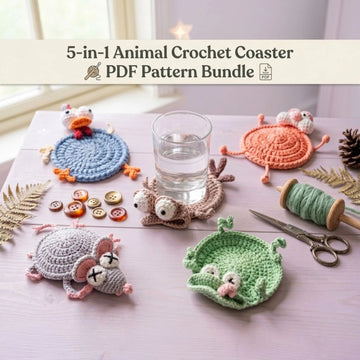
Animal coasters usually share one base circle, and the character comes from the face: embroidery, small crocheted ears, or surface slip stitches. Learn the base once and the animals become the playful part.
Geometric and granny square coasters are among the quickest to finish, and every round can be a new color. With a little tapestry crochet you can add stripes, diamonds or checkerboards, which gives a cleaner, more modern look than the character designs. Our guide to crocheting a granny square is a good starting point.
Making Coasters to Sell at Craft Fairs
Coasters are affordable, practical and easy to pick up on impulse, which is why they turn up at so many markets. A few choices make a stall noticeably stronger:
- Themed sets. Autumn leaves, winter snowflakes or spring flowers sell well at seasonal markets, and animal sets in coordinated colors appeal to gift buyers.
- Offer sets of four and six. Four covers a small household, six suits people who entertain. A small per-piece saving on the larger set nudges buyers up.
- Show the same design in several colorways. Customers love choosing their favorite rather than accepting what you happened to make.
- Package them like a gift. Stack the coasters, tie them with twine and add a small card listing the fiber content and care instructions.
For pricing, see our guide to pricing handmade crochet items, and for more product ideas read easy crochet projects to sell at craft markets.
How to Stiffen Decorative Coasters
If you want petals or scalloped edges to hold their shape, stiffening is a simple finishing step. Mix roughly equal parts white craft glue and water, or use a commercial fabric stiffener as directed. Soak the finished coaster or brush the mixture on evenly, pin it into shape on a foam board, and leave it to dry completely, which can take a day.
Stiffened coasters look crisp, especially flower designs with open petals. Keep them for decoration, though: heavy stiffening can crack under a very hot mug and does not survive repeated machine washing, so do not stiffen coasters you want to use every day.
Coming soon: our newest coaster designs in one book
Here is the part we have been waiting to share. Our team is currently designing and testing an entirely new generation of coaster patterns — fresh shapes, new color stories, and construction details refined over repeated test rounds rather than published straight off the hook.
Those newest designs are becoming a brand new MrsCrochetWorld pattern book. It will collect the latest coaster patterns we have been working on, written in the same step-by-step US-terms style as our existing books, with stitch counts for every round and photographs for the steps that genuinely need them.
We are deliberately not linking to it yet, because it is not live at the time of writing and we would rather send you to a working page than a broken one. It is still in design and testing, so we are not going to promise you a release date we cannot keep. It will appear in the Crochet Coaster Patterns collection first, which is where every new design goes. In the meantime, the five picks below and the rest of the collection are available right now.
Coaster patterns and books worth starting with
The bundles are instant PDF downloads; the two books are printed paperbacks you order through Amazon. Bundles give you the patterns; books give you the fuller, more structured treatment.

Twenty-one animal coaster patterns in one instant PDF download. The best value starting point if you want variety. 14.99 US dollars.
View pattern →
The printed paperback edition of the animal collection (20 designs), laid out for comfortable reading and gifting. 19.90 US dollars.
View the book →
Fourteen flower coaster designs for petal construction and layered rounds. 14.99 US dollars.
View pattern →
The flower collection as a printed paperback, ideal if you prefer a book on your lap over a screen. 19.90 US dollars.
View the book →
A smaller five-pattern set. The right size for a first coaster project or a single gift set. 9.99 US dollars.
View pattern →Every coaster pattern and book we currently publish, in one place. New designs are added here first.
Browse the collection →Bundle or book?
Bundles are the economical route to a lot of designs. Books are structured, easier to read front to back, and make a better gift for another crocheter.
Instant download
Every PDF bundle is delivered immediately after checkout. Nothing ships, nothing waits, and you can start the same evening; the printed books are ordered through Amazon.
US terms throughout
All patterns use US crochet terminology with full stitch counts for every round, so you always know where you should be.
Frequently asked questions
How long does one crochet coaster take to make?
There is no fixed time: it depends on your speed and the design. A plain round coaster in worsted cotton is at the fast end, while an animal or flower design with ears, petals and embroidered details sits at the slower end. Either way, it is a single-sitting project, which is a large part of the appeal.
What is the best yarn for crochet coasters?
One hundred percent cotton in worsted or DK weight. Cotton absorbs condensation from a cold glass, tolerates the heat of a hot mug and survives repeated machine washing without pilling or stretching out of shape. Mercerized cotton adds a subtle sheen and crisper stitch definition if you are making a set to gift or sell.
Can I use acrylic yarn for coasters?
It is not recommended. Acrylic is a synthetic fiber that can soften or melt under a genuinely hot mug, and it does not absorb moisture the way cotton does, so condensation tends to run off onto the table. If acrylic is all you have, limit those coasters to cold drinks and treat them as decorative rather than functional.
What size should a crochet coaster be?
Aim for four to four and a half inches across. That comfortably fits a standard mug base with a visible margin around it, and it still looks proportional under a tumbler or a wine glass. Much smaller and the mug overhangs the edge; much larger and it starts reading as a mug rug or small trivet instead.
Why does my crochet coaster curl up at the edges?
Curling means you have too few increases for the number of stitches in the round, so the fabric is being forced into a bowl shape. Add an extra increase per round and check your stitch count against the pattern. If the shape is otherwise correct, a wet block and a flat dry will usually settle a mild curl permanently.
Why is my coaster ruffling instead of lying flat?
Ruffling is the opposite problem: too many increases, which adds more fabric than the circle can hold flat. Recount your stitches at the end of each round against the pattern. Ruffling almost always traces back to a single round where an extra increase slipped in, so it is worth checking round by round rather than starting over.
Why does my circle look like a hexagon?
Because your increases are stacking directly on top of each other, which creates six straight edges and six corners. Shift the position of your increases each round, for example by working one extra stitch before the first increase, and the edge immediately reads as a true circle.
How much yarn does one coaster use?
Roughly fifteen to thirty grams of worsted or DK cotton, depending on size, hook and stitch density. That is one of the reasons coasters are such a good scrap project: the amount needed matches almost exactly the leftovers most crocheters already have in a basket.
Are crochet coasters a good project for absolute beginners?
Yes, and they are one of the best. A plain round coaster needs only a magic ring, single or double crochet, even increases and a basic edge. The piece is small enough that mistakes cost minutes instead of hours, which makes it a low-pressure place to learn working in the round before attempting anything larger.
How do I wash crochet coasters?
Cotton coasters can go in a mesh laundry bag on a gentle machine cycle with cool or warm water. Lay them flat to dry and reshape while damp. Avoid hot tumble drying, which can shrink cotton. Weave your ends in thoroughly before the first wash, since repeated cycles will find any end that was secured casually.
Can I sell coasters made from your patterns?
Yes. You may sell all finished items you make from our patterns and books, with no quantity limits; credit to MrsCrochetWorld is appreciated but never required. What you may not do is copy, share, resell or upload the patterns (PDF files) or books themselves. Questions about your plans? Email info@mrscrochetworld.com.
What is the difference between the bundles and the pattern books?
The bundles collect many individual patterns in one discounted download and are the most economical way to get a lot of designs. The books are printed paperbacks that present the same kind of content in a structured, laid-out format that reads comfortably front to back and makes a nicer gift for another crocheter. Content quality is the same; the difference is presentation and price.
When is the new coaster pattern book available?
The new book with our latest coaster designs is still in design and testing, so we are not announcing a release date yet — we would rather give you a date we can actually keep. It is not live at the time this article was written, so there is intentionally no link here yet. It will appear in the Crochet Coaster Patterns collection as soon as it is published, which is the first place new designs go.
How do I stiffen crochet coasters?
Soak the finished coaster in a mix of roughly equal parts white craft glue and water, or brush on a commercial fabric stiffener or liquid starch. Pin it into shape on a foam board and let it dry completely, which can take about a day. Use stiffened coasters for decoration, since heavy stiffening can crack under hot mugs and does not wash well.
How many coasters should I sell as a set?
Sets of four and six are the most common. Four suits a small household and six suits people who entertain. Offering both, with a small saving per coaster on the larger set, gives buyers an easy choice, and coordinated colors or a seasonal theme make a set feel like a ready-made gift.
Which coaster styles are good after the basic round?
Flower coasters such as daisies, sunflowers and rose-style designs, animal coasters built on the same base circle with embroidered or appliqued faces, and granny square or colorwork designs with stripes, diamonds or checkerboards are all natural next steps.
About the author
Ava is the designer and writer behind MrsCrochetWorld, where she publishes beginner-friendly amigurumi and accessory patterns along with practical guides for crocheters who want to work more confidently and finish more of what they start. Coasters have been part of that work from the beginning: they are what she hands to a nervous beginner who has never worked in the round, and they are still what she reaches for when a larger project needs interrupting.
Every guide on MrsCrochetWorld is written from hands-on crochet experience rather than aggregated from elsewhere. The technique advice in this article — hook sizing, increase placement, blocking and edge finishing — comes from working these pieces repeatedly and from the questions real crocheters ask most often. Where this article describes popularity, it is deliberately framed as qualitative reasoning and our own shop experience rather than as statistics we cannot verify.
Written by Ava Collins · MrsCrochetWorld · Updated October 12, 2026 · 11 min read
Start your first set tonight
Pick a pattern, pull four scraps out of the basket and have a finished coaster before bed. Every bundle is an instant PDF download in US terms.
Browse coaster patterns Get the 21-in-1 animal coaster bundleRelated guides
Sources
- Craft Yarn Council: Standard Yarn Weight System (yarn weights and recommended hook sizes), checked 21 Nov 2026
- Craft Yarn Council: Hooks & Needles (mm to US hook size chart), checked 21 Nov 2026
- Craft Yarn Council: Crochet Abbreviations Master List (US and UK terms), checked 21 Nov 2026