Crochet Yarn Weights Explained: The Complete US Guide from Lace to Jumbo
Learn what the little numbered yarn symbol actually means, which hook belongs with each weight, and how to swap yarns without ruining your project.

You found the perfect pattern. You bought yarn you loved. You followed every single round exactly as written — and the finished piece came out twice the size it should be, with gaps you could post a letter through. Nine times out of ten, the culprit is not your technique. It is yarn weight.
This guide walks through all eight categories in plain US English: what each one is called, what it is good for, which hook size usually pairs with it, and where crocheters most often go wrong. We will also cover how to read a yarn label, how to substitute one yarn for another safely, and why amigurumi plays by slightly different rules than garments and blankets.
Nothing here requires special equipment or a maths degree. By the end you will be able to pick up any ball of yarn, glance at the label, and know in about three seconds whether it will work for the project in your hands.
What "yarn weight" actually means
The word "weight" is genuinely confusing, because it has nothing to do with what the ball weighs on a kitchen scale. A 100 g ball of lace yarn and a 100 g ball of super bulky yarn weigh exactly the same. The difference is thickness: the lace ball contains several hundred yards of hair-fine strand, while the super bulky ball might hold only forty yards of thick rope.
So when a pattern says "worsted weight yarn," it is describing the diameter of the strand, which in turn determines how many stitches fit into a given measurement. Thicker yarn means fewer, larger stitches. Thinner yarn means more, smaller stitches. Change the weight and you change the whole scale of the finished object.
To stop every brand inventing its own vocabulary, the Craft Yarn Council publishes the Standard Yarn Weight System. It assigns a number from 0 to 7 and prints it inside a small skein-shaped symbol on the label. That symbol is the most useful thing on the whole ball band, and most crocheters walk straight past it.
| Weight | Also called | Gauge per 4 in | Typical hook |
|---|---|---|---|
| 0 Lace | Fingering, thread | 32–42 sc | 1.4–2.25 mm |
| 1 Super Fine | Sock, baby | 21–32 sc | 2.25–3.5 mm |
| 2 Fine | Sport, baby | 16–20 sc | 3.5–4.5 mm |
| 3 Light | DK | 12–17 sc | 4.5–5.5 mm |
| 4 Medium | Worsted, aran | 11–14 sc | 5.5–6.5 mm |
| 5 Bulky | Chunky, rug | 8–11 sc | 6.5–9 mm |
| 6 Super Bulky | Roving | 7–9 sc | 9–15 mm |
| 7 Jumbo | Jumbo | 6 sc or fewer | 15 mm and up |
In US letter sizes, those hook ranges run roughly from a steel hook at the lace end, through B-1 to E-4 for super fine, E-4 to 7 for fine, 7 to I-9 for light, I-9 to K-10.5 for medium, K-10.5 to M-13 for bulky, M-13 to Q for super bulky, and Q and larger for jumbo. "Gauge" here means single crochet stitches measured across four inches.
Read that table once and a lot of pattern language suddenly makes sense. "Aran weight" and "worsted weight" both live in category 4, which is why they are often used interchangeably even though aran is usually a touch thicker. "DK" sits in category 3, one step down. "Sock yarn" is category 1. And crochet thread for doilies lives at the very bottom in category 0.
One important caveat: these gauge numbers are the knitting and crochet council's guidance, not a law of physics. Brands vary. A chunky from one mill can be noticeably thinner than a chunky from another. The number narrows your search; a gauge swatch confirms it.
Four weights, four very different projects
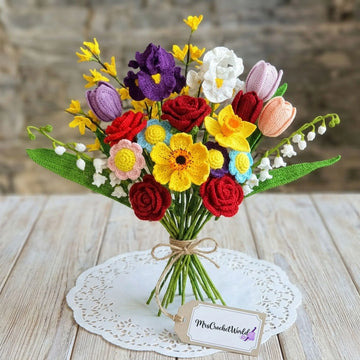
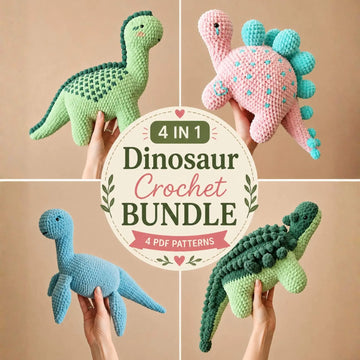
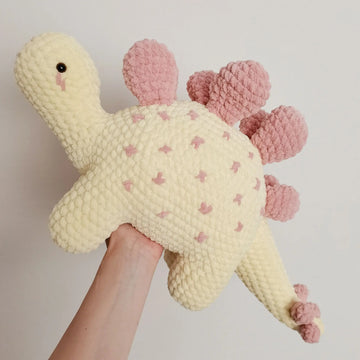
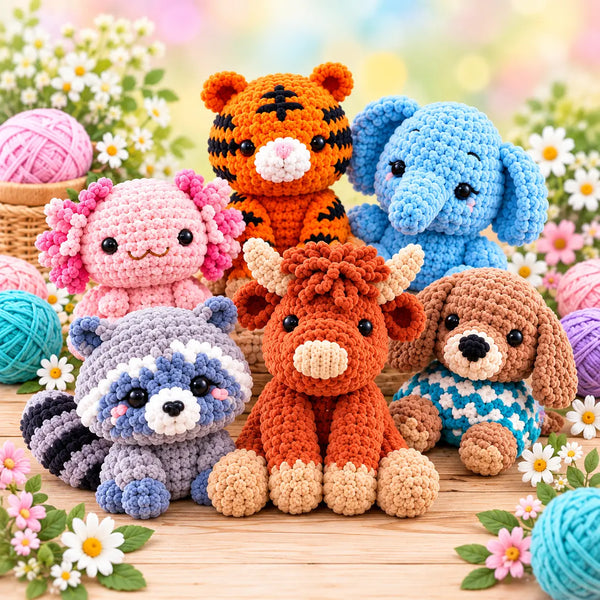
The quickest way to understand yarn weight is to see what the same technique produces at different thicknesses. Here are four of our own designs, each built around a different category.

Chunky and velvet yarn: fast, squishy, forgiving
Plush toys like these teddy bears rely on thick, soft yarn — usually a chenille or velvet in the bulky to super bulky range. The appeal is obvious: rounds fly by, the fabric is instantly cuddly, and the pile hides small tension wobbles. The trade-off is detail. Thick yarn rounds off sharp features, so muzzles, paws and tiny accessories need to be scaled up or simplified. Velvet is also slippery, which makes stitch counting harder, so a stitch marker is not optional here.
See the plush teddy bear bundle →
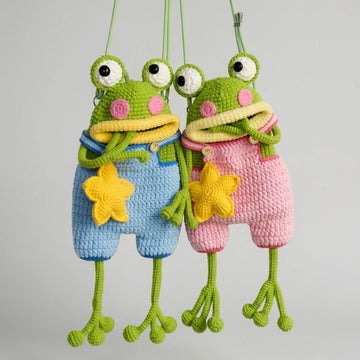
Worsted weight: the all-rounder bags and blankets love
Category 4 is the workhorse of US crochet. It is thick enough to build structure — which is exactly what a bag needs so it does not sag when you load it — but fine enough to keep granny square motifs crisp and readable. Most written patterns in the US default to worsted, which means more free online tutorials and charts match it than any other weight. If you are learning a new technique, worsted in a smooth light color is the easiest fabric to actually see your stitches in.
See the granny square bag pattern →
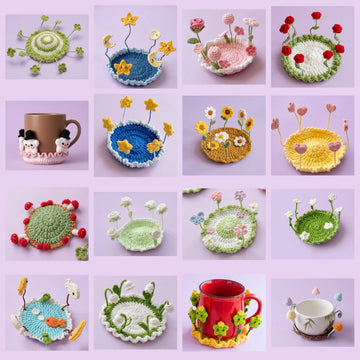
Sport and DK cotton: where the fine detail lives
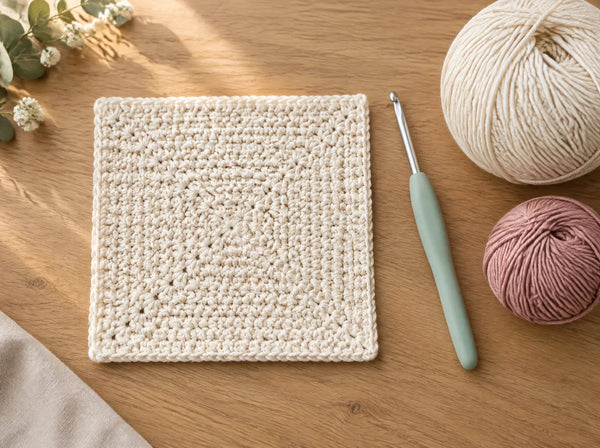
Drop down to categories 2 and 3 and small, sculptural work becomes possible. Petals stay separate instead of blurring together, leaves hold a point, and a coaster stays flat enough to actually sit a cup on. Fine mercerized cotton also has very little stretch, so shaped pieces keep their form for years. The cost is time: a motif that takes twenty minutes in worsted may take an hour in sport weight. For flowers, appliqués and anything you want to look refined rather than cuddly, it is worth every extra round.
See the flower coaster bundle →
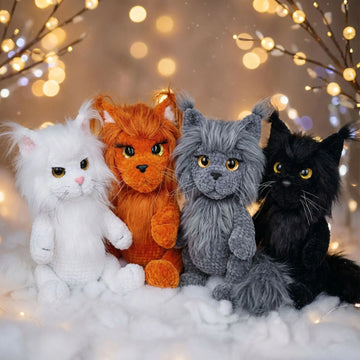
Fuzzy and brushed yarns: the label number tells only half the story
Novelty yarns are where the numbering system shows its limits. A brushed mohair-style yarn may be labelled super fine because its core strand is thin, yet the halo makes the finished fabric look and behave much heavier. Realistic animal fur is built this way, often by holding a fine fuzzy strand together with a smooth base yarn. The practical lesson: with textured yarn, trust the swatch and the look you want, not only the number in the symbol.
See the long-haired cat pattern →How to read a yarn label in 30 seconds
Every ball band is laid out slightly differently, but the same six pieces of information are nearly always there. Work through them in this order and you will never buy the wrong yarn again.
- Find the numbered skein symbol. A small drawing of a skein with a number from 0 to 7 inside it. That is the category. If it is missing — common on imported and indie yarns — fall back on the recommended hook size and the stated gauge.
- Check the recommended hook. Usually given in millimetres and sometimes in US letters. This is the manufacturer's suggestion for a soft, drapey fabric, which is perfect for garments and blankets and far too loose for stuffed toys.
- Read the gauge box. A little grid showing how many stitches and rows fit into a 4 in or 10 cm square. If the label's gauge is close to your pattern's gauge, the yarn is a plausible substitute.
- Note the yardage, not the grams. Yardage (or metres) is what tells you how far a ball will go. Two 100 g balls of different weights can differ by hundreds of yards. Always compare yardage when substituting.
- Check the fiber content. Cotton, acrylic, wool and blends behave differently even at identical weights. Cotton has almost no stretch and shows stitch definition beautifully. Acrylic is springy and forgiving. Wool blocks into shape.
- Note the dye lot. If your project needs more than one ball of a color, buy them together with matching dye lot numbers. Two balls from different lots can show a visible stripe in daylight.
Quick label shortcuts
- No symbol on the label? Compare the recommended hook to the table above — the hook range alone places the yarn within one category.
- Wraps per inch is the old-school test: wrap the strand snugly around a ruler for one inch and count. Roughly 18+ wraps is fingering, 11–14 is worsted, 6–8 is bulky.
- Keep one ball band from every yarn you love in a small envelope. It is the fastest reference library you will ever build.
- Photograph the label before you throw it away. You will want the dye lot six months later.
The number on the label tells you what the yarn is. Your swatch tells you what it will become in your hands.— Ava, MrsCrochetWorld
Why amigurumi ignores the recommended hook
Here is the rule that trips up almost every crocheter moving from blankets to stuffed toys: for amigurumi, you deliberately use a smaller hook than the yarn label recommends.
The reason is structural. A ball band's recommended hook is chosen to create soft, flexible fabric with a little air in it — lovely for a scarf, disastrous for a toy. Stuffed pieces need a dense fabric so that the filling stays invisible and the shape holds. If you can see white fiberfill peeking through your stitches, your hook was too big for the yarn.
As a working starting point, go down roughly one to one and a half millimetres from the label's suggestion. With a worsted weight yarn that recommends a 5.5 mm hook, many amigurumi makers reach for a 4.0 mm or 4.5 mm instead. With a DK that recommends 4.5 mm, a 3.5 mm often gives a better toy fabric.
That tighter fabric does have consequences. It is harder on your hands, so shorter sessions and a cushioned handle help. It also makes frogging slower, because dense stitches grip each other. And it changes finished size: the same pattern worked in DK on a 3.5 mm hook will come out noticeably smaller than in worsted on a 4.0 mm hook, which is exactly why two people can follow identical instructions and end up with toys of different sizes.
| Yarn weight | Label hook → toy hook | What you get |
|---|---|---|
| 1 Super Fine | 2.25–3.5 → 2.0–2.5 mm | Miniature charms and tiny detail |
| 2 Fine | 3.5–4.5 → 2.5–3.0 mm | Small, finely shaped figures |
| 3 Light / DK | 4.5–5.5 → 3.0–3.5 mm | Neat mid-size toys, crisp features |
| 4 Worsted | 5.5–6.5 → 3.5–4.5 mm | The standard amigurumi size |
| 5 Bulky | 6.5–9 → 5.0–6.0 mm | Large squishy plushies, fast |
| 6 Super Bulky | 9–15 → 6.5–8.0 mm | Oversized cuddle toys, little detail |
Treat these as starting points rather than fixed rules. Tension is personal: a naturally tight crocheter may need to go up a size, a loose crocheter down another step. The test is simple — crochet a small flat circle, hold it up to a window, and see how much light comes through. Barely any light means you are ready to stuff.
Substituting yarn without ruining the project
You will not always find the exact yarn a pattern names. Here is how to swap safely.
- Match the category first. Stay inside the same number if you can. Swapping a category 4 for another category 4 is usually safe. Swapping a 4 for a 2 changes the finished size dramatically and almost always means the pattern has to be re-sized.
- Then match the yardage. Compare yards per ball, not grams. Work out the total yardage the pattern calls for and buy at least that much, plus a little extra for safety. Running out part way through with no matching dye lot is a genuinely miserable experience.
- Think about the fiber. Cotton is crisp and heavy with no bounce. Acrylic is light, springy and hard-wearing. Wool is warm and blocks beautifully but may felt in the wash. A cotton version of a wool pattern will hang quite differently even at identical gauge.
- Swatch whenever fit matters. For toys, coasters and bags you can often eyeball it. For anything worn on a body, make a gauge swatch in the stitch the pattern uses, measure it flat and unstretched, then adjust hook size until your numbers match the pattern.
- Consider holding two strands. Two strands of DK worked as one behave roughly like a bulky. It is a useful trick for using up stash yarn, or for recreating a thicker weight you cannot buy locally. Expect a slightly different texture and plan for double the yardage.
- Be careful with texture yarns. Boucle, chenille, velvet and fuzzy yarns hide stitches. Even when the category number matches, they are much harder to count and to frog. Save them for simple shapes and patterns you already know well.
Five yarn weight mistakes worth avoiding
Most yarn problems come down to the same handful of habits. If something in your work is not behaving, start here.
The usual suspects
- Assuming "weight" means grams. It means thickness. A heavier ball is not a thicker yarn; it may simply contain more of a fine strand.
- Using the label's hook for a stuffed toy. The label aims for soft drape. Toys need dense fabric, so size down and check that no filling shows through.
- Mixing weights within a project by accident. Two balls that look similar in the basket can be a category apart. Check both symbols before you join a new ball mid-piece.
- Trusting category numbers across brands. One brand's bulky can be another's aran. Within one project, stick to one brand and line if you possibly can.
- Skipping the swatch on anything fitted. Ten minutes of swatching has saved more cardigans than any other single habit in crochet.
If your stitches themselves feel uneven rather than simply the wrong size, the issue is tension rather than yarn weight — and that is a separate fix. Loose, inconsistent stitches usually improve with a smoother yarn, a lighter grip and a short practice swatch rather than a different ball band.
Keep exploring

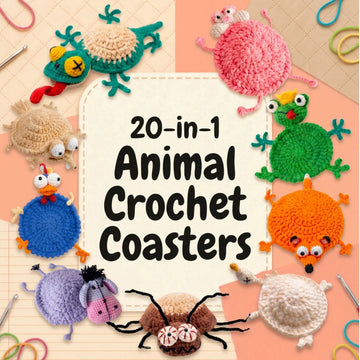
Twenty amigurumi animal patterns with step-by-step photos and clear yarn and hook notes for every project.
View the book →
Once you know the weight, pick the fiber: cotton, acrylic, velvet and blends compared for stuffed toys.
Read the guide →
If the weight is right but the stitches still look wrong, your tension is the next thing to fix.
Read the guide →More help on the site
- Hook sizes in detail. Our complete US hook size guide pairs every letter and millimetre with the yarn weights it suits best, including the amigurumi exceptions covered above.
- Work out your yardage. Not sure how many balls to buy? Our yarn calculator guide shows how to estimate total yardage from a small swatch before you commit to a project.
- Stitch library. Our stitch library covers the US abbreviations used throughout our patterns, with clear photos for each basic stitch.
Frequently asked questions
What does yarn weight mean in crochet?
Yarn weight describes how thick a single strand of yarn is, not how much the ball weighs. In the US, the Craft Yarn Council sorts yarn into eight numbered categories from 0 (Lace) to 7 (Jumbo). The number appears inside a small skein symbol on the ball band and tells you which hook sizes and stitch gauges the yarn is designed for.
What yarn weight is worsted?
Worsted is category 4, also called Medium. Aran and afghan yarns sit in the same category. A typical single crochet gauge for category 4 is 11 to 14 stitches over 4 inches, with a recommended hook of roughly 5.5 to 6.5 mm (I-9 to K-10.5). Worsted is the most common weight in US crochet patterns, which makes it the easiest weight to find tutorials and charts for.
Is DK the same as worsted weight?
No. DK is category 3 (Light) and worsted is category 4 (Medium), so DK is one step thinner. Substituting DK where a pattern asks for worsted will give you a smaller, denser finished piece unless you adjust the hook or the stitch counts. Some yarns labelled "light worsted" sit right on the boundary, which is why a swatch is still worth doing.
What yarn weight is best for amigurumi?
Category 4 worsted and category 3 DK cover the large majority of amigurumi patterns. Worsted works up faster and suits standard-size toys; DK gives smaller, more refined shaping. Whichever you choose, use a hook roughly one to one and a half millimetres smaller than the label recommends so the fabric is dense enough to hide the stuffing.
Why does my amigurumi show the stuffing through the stitches?
Your hook is too large for the yarn weight you are using. The recommended hook on a ball band is chosen for soft, airy fabric, not for stuffed toys. Drop one or two hook sizes and crochet a small flat circle as a test. Hold it up to a window: if light passes through easily, go smaller again.
How do I find the yarn weight if the label has no number?
Use two clues. First, the recommended hook size — compare it to the standard hook ranges for each category. Second, the wraps per inch test: wrap the strand snugly around a ruler for one inch and count the wraps. Roughly 18 or more suggests fingering, 11 to 14 suggests worsted, and 6 to 8 suggests bulky.
Can I substitute a different yarn weight in a pattern?
You can, but expect the finished size to change. Going one category thinner makes everything smaller; one category thicker makes it larger. For toys, bags and coasters that is often acceptable. For anything that has to fit a body, either stay in the same category or rework the pattern using a gauge swatch to recalculate your stitch counts.
Does fiber content change the yarn weight?
Not the category, but it changes how the fabric behaves. Cotton at category 4 is heavier, crisper and has almost no stretch. Acrylic at the same category is lighter and springier. Wool blocks into shape and holds warmth. Two yarns can share a number and still produce very different results, so always consider fiber alongside weight.
What is the difference between bulky and super bulky?
Bulky is category 5 with a typical single crochet gauge of 8 to 11 stitches over 4 inches and hooks around 6.5 to 9 mm. Super bulky is category 6, with a gauge of about 7 to 9 stitches and hooks from roughly 9 to 15 mm. Super bulky works up faster and produces much chunkier texture, but loses almost all fine detail.
Can I hold two strands of yarn together to make a thicker weight?
Yes, and it is a useful trick. Two strands of DK held as one behave roughly like a bulky yarn, and two strands of fingering roughly like a DK. Use a hook suited to the combined thickness and plan for double the yardage. The texture will differ slightly from a single thicker strand, so swatch before committing to a large project.
What yarn weight should a complete beginner start with?
A smooth worsted weight in a light, solid color. Category 4 is thick enough that individual stitches are easy to see and count, it works up quickly enough to stay motivating, and most beginner patterns are written for it. Avoid dark colors, fuzzy yarns and velvet at the start, because all three hide your stitches.
Why do two people get different sizes from the same pattern and yarn?
Because tension is individual. Two crocheters using identical yarn and hooks can produce fabric of noticeably different gauge depending on how tightly they hold the yarn. That is precisely why patterns give a gauge measurement rather than only a yarn weight. Make a swatch, measure it, and change hook size until your gauge matches the pattern.
Put your yarn weight knowledge to work
Every MrsCrochetWorld pattern lists the exact yarn weight and hook size we used, so you can match it or adapt it with confidence.
Browse all crochet patterns Open the stitch library