Crochet Terms Explained: The Complete US Glossary for Every Pattern
Every crochet term, stitch name and instruction word you will meet in a written pattern, translated into plain English so you never stall mid-row again.

The hardest part of crochet is rarely the hook work. It is the vocabulary. A pattern tells you to "work even in BLO, ch 1, turn, do not join," and suddenly a project you were excited about feels like a language test you did not study for.
This glossary covers the terms you will actually meet in written patterns: the stitch family, the shaping words, the construction instructions, the punctuation that controls repeats, and the amigurumi vocabulary that trips up beginners working their first ball of yarn into a head. Every pattern sold at MrsCrochetWorld is written in US terms, so that is the system this guide uses as its base, with the UK equivalents given side by side wherever they differ.
Read it once from top to bottom and the next pattern you open will feel noticeably less like a puzzle. Bookmark it, and you have a reference you can check mid-project without hunting through a search results page.
The four term groups every pattern uses
Almost every instruction in a written crochet pattern belongs to one of four groups. Once you can sort a word into the right group, you can usually work out what it is asking you to do.

Stitch names: what your hook actually does
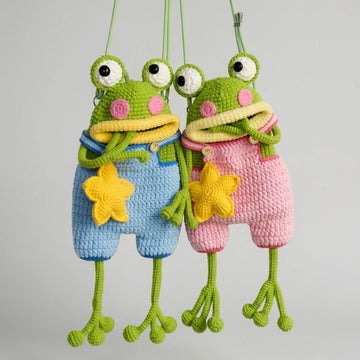
These are the building blocks: chain, slip stitch, single crochet, half double crochet, double crochet, treble crochet. They describe how many times you wrap the yarn over the hook before you insert it, and how many times you pull through afterwards. Everything taller than a single crochet is simply the same motion repeated with an extra yarn over at the start. The round bags above are built from two of them: a dense single crochet band at the top and an open mesh panel made from chains and taller stitches below.
See a pattern written in US terms →
Shaping words: increase, decrease, work even
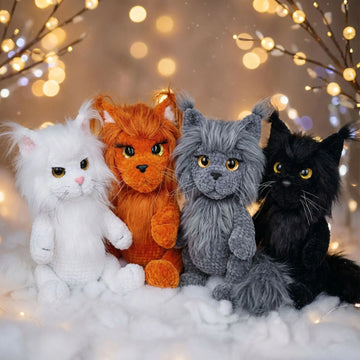
Shaping terms tell you how the stitch count changes. An increase puts two stitches into one stitch and widens the piece. A decrease joins two stitches into one and narrows it. "Work even" means neither: repeat the round with no change at all. The cats above are shaped almost entirely with these three instructions, which is why amigurumi patterns look repetitive on paper and still produce a rounded head, a tapered muzzle and a straight body.
View the Maine Coon pattern →
Construction terms: join, turn, fasten off
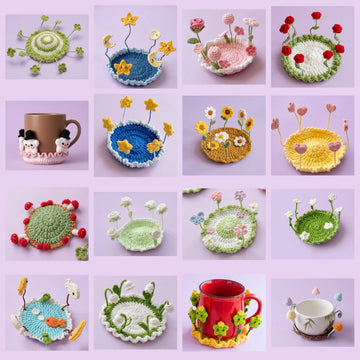
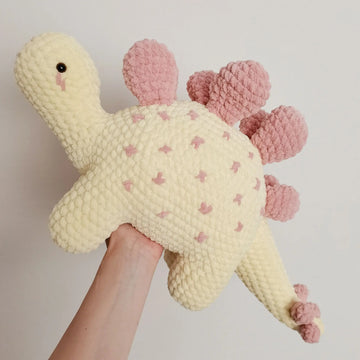
Construction words control what happens between rows and rounds. "Join" closes a round with a slip stitch. "Do not join" keeps you spiralling. "Turn" flips the work so the next row runs the other way. "Fasten off" cuts the yarn and secures the last loop. The low-sew dinosaur above uses a construction term you will meet often in modern amigurumi: join as you go, where a shape is attached to the body while it is being worked rather than sewn on afterwards.
Browse low-sew amigurumi patterns →
Placement terms: where the hook goes in
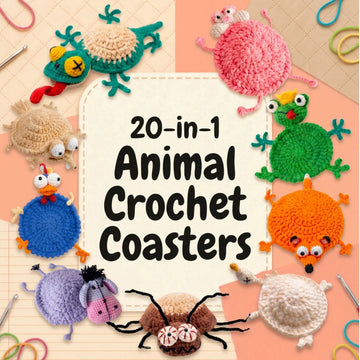
Placement words are the ones beginners skip and later regret. BLO means back loop only, FLO means front loop only, and both change the texture and flexibility of the fabric dramatically. "In the next st" means one stitch along. "In the same st" means back into the stitch you just used. "Around the post" means you work around the body of a stitch from the previous row instead of into its top. The animals above owe their crisp seams and defined limbs to exactly these instructions.
Explore amigurumi patterns →US terms vs UK terms: the one check to do first
This is the single most useful thing in this guide. The US and UK systems use the same words for different stitches, offset by one height. A UK double crochet is a US single crochet. A UK treble is a US double crochet. Nothing warns you, because both patterns look perfectly correct on the page.
The symptom is unmistakable once you know it: your fabric comes out noticeably taller, looser and more open than the photo, or your amigurumi has gaps you can see stuffing through. If that happens on row one, stop and check the terminology note rather than blaming your tension.
| US term | UK term |
|---|---|
| Chain (ch) | Chain (ch) |
| Slip stitch (sl st) | Slip stitch (ss) |
| Single crochet (sc) | Double crochet (dc) |
| Half double crochet (hdc) | Half treble (htr) |
| Double crochet (dc) | Treble (tr) |
| Treble crochet (tr) | Double treble (dtr) |
| Double treble (dtr) | Triple treble (trtr) |
Three quick ways to identify the system
- Look for a terminology line near the materials list. Most well-written patterns state "US terms" or "UK terms" explicitly before row one.
- Scan the abbreviation key. If you see "sc" anywhere, the pattern is almost certainly US. If you see "htr" or "ss", it is UK.
- Check for a missing stitch. A UK pattern will never list "single crochet" as a stitch, because that term does not exist in the UK system in everyday use.
The core US abbreviation glossary
These are the abbreviations that appear in nearly every pattern we publish. Learn this block and you can read the majority of a written pattern without looking anything up.
| Abbreviation | Full term | What it means in practice |
|---|---|---|
| ch | Chain | Yarn over, pull through the loop. The starting foundation and the spacer between stitches. |
| sl st | Slip stitch | The flattest stitch. Used to join rounds, travel across stitches and finish edges. |
| sc | Single crochet | The short, dense workhorse stitch. The default for amigurumi and sturdy bags. |
| hdc | Half double crochet | One step taller than sc, with a soft squashy texture and a third loop at the back. |
| dc | Double crochet | Tall and quick. Builds blankets, garments and granny squares fast. |
| tr | Treble crochet | Taller again, used for lacy and open fabrics. |
| inc | Increase | Two stitches worked into one stitch. Adds one to your count. |
| dec | Decrease | Two stitches joined into one. Removes one from your count. |
| sc2tog | Single crochet two together | A specific decrease worked across two stitches. |
| invdec | Invisible decrease | A tidier amigurumi decrease worked through front loops only. |
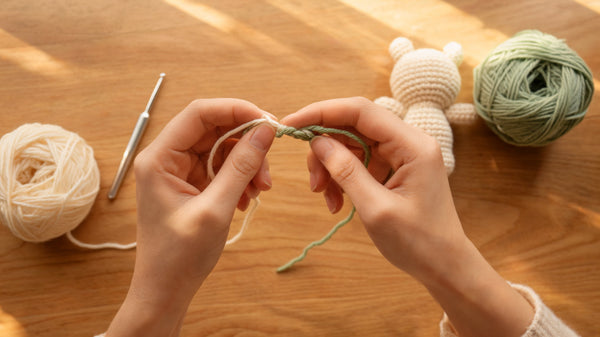
| MR / MC | Magic ring / magic circle | An adjustable starting loop that closes to leave no hole in the center. |
| BLO | Back loop only | Work into the back loop of the stitch. Creates a ridge and a hinge. |
| FLO | Front loop only | Work into the front loop. Leaves a visible horizontal bar. |
| st / sts | Stitch / stitches | Individual stitches, usually as a count at the end of a row or round. |
| rep | Repeat | Work the named section again as instructed. |
| rnd | Round | One full circuit when working in the round. |
| RS / WS | Right side / wrong side | The public-facing side and the hidden side of the fabric. |
| yo | Yarn over | Wrap the yarn over the hook from back to front. |
| FO | Fasten off | Cut the yarn and pull it through the final loop to secure it. |
| ch-sp | Chain space | The gap created by chains, worked into as if it were a stitch. |
A pattern is not a test. It is a set of directions written by someone who already made the thing and wants you to make it too.— Ava, MrsCrochetWorld
Punctuation: the terms that are not words
Half of a written pattern's meaning lives in its brackets, asterisks and commas. These symbols are terms in their own right, and misreading one is the most common reason a stitch count comes out wrong.
- Asterisks. An instruction like *sc 2, inc; rep from * around means the section between the asterisk and the semicolon is your repeat unit. Work it over and over until the round ends.
- Parentheses used as a repeat. (sc 2, inc) x 6 means work the contents six times in total, not six times after an initial pass. Six repeats, not seven.
- Parentheses used as a group. (sc, ch 2, sc) in next ch-sp means all three of those stitches go into the same chain space. Context tells you which meaning applies: a multiplier after the bracket means repeat, a placement instruction after it means group.
- Square brackets. Usually a repeat nested inside another repeat. Work the square-bracket instruction as a self-contained unit inside the larger one.
- The number at the end of the line. (24) or [24 sts] is your stitch count after that row or round. It is a checkpoint, not an instruction. If your count does not match, the error is in the line you just finished.
- The colon after a round number. Rnd 4: simply separates the label from the work. It carries no instruction of its own.
When your stitch count is off
- Recount the previous round before you undo anything. The mistake is almost always one round earlier than it feels.
- Check whether you worked an increase into the same stitch twice, which is the most common single-stitch error in the round.
- Confirm you did not skip the final stitch of a round, which hides easily on a spiral where there is no join to mark the end.
- Mark the first stitch of every round. A marker turns a guessing game into a two-second check.
Amigurumi terms you will not find in a blanket pattern
Amigurumi has its own working vocabulary because the construction is different: tight fabric, worked in the round, stuffed, and assembled. These are the terms that appear in a plush pattern and almost nowhere else.
| Term | What it means |
|---|---|
| Continuous rounds / spiral | You never join or chain up. Each round flows into the next, which avoids a visible seam line. |
| Joined rounds | Each round closes with a slip stitch and starts with a chain. Produces a neat edge but a visible seam. |
| Stitch marker | A clip or scrap of yarn in the first stitch of a round so you can find the start of a spiral. |
| Invisible decrease | A decrease worked through the front loops of two stitches, so the join does not leave a bump. |
| Yarn under | Wrapping the yarn the opposite way to a standard yarn over, producing tighter, more uniform X-shaped stitches. |
| Closing round | The final round, drawn tight with a tapestry needle through the front loops to seal an opening. |
| Safety eyes | Plastic eyes secured with a washer from inside the piece, inserted before the head is closed. |
| No-sew / low-sew | Construction where limbs and features are worked into the body rather than sewn on at the end. |
| Color change | Completing the final pull-through of a stitch with the new color so the change looks clean. |
| Stuff firmly | Fill until the piece holds its shape without the fabric stretching enough to show stuffing through the stitches. |
If you are moving from flat projects to plush ones, these ten terms do most of the heavy lifting. Our amigurumi patterns are written in US terms throughout and spell out the first use of each term in the pattern notes, so nothing arrives without warning.
Instruction words that quietly change everything
Some terms are not stitches at all. They are small English words doing heavy structural work, and skipping past them is how a project ends up the wrong shape.
- Turn. Flip the work so you can crochet back along the row you just made. Rows turn, spiral rounds do not.
- Turning chain. The chain or chains worked at the start of a row to bring the yarn up to the height of the coming stitch. Whether it counts as a stitch varies by pattern, so check the notes.
- Skip. Pass over a stitch without working into it. Nearly always paired with a chain to keep the count even.
- Work even. Keep going with no increase and no decrease. Your stitch count stays identical.
- At the same time. Two instructions run in parallel. Read the whole paragraph before you start the row, because one of them usually began several rows earlier.
- Reverse shaping. Usually in garments: make a mirrored second piece by swapping the order of the increases and decreases.
- Do not fasten off. Leave the loop live. The pattern will come back to it, often to work an edging straight on.
- Leave a long tail. The yarn end will be used for sewing, so cut generously. Most patterns mean roughly a forearm's length.
- Block. Wet or steam the finished fabric and pin it to shape so stitches even out. Essential for lace, optional for plush.
- Gauge / tension. How many stitches and rows fit in a measured square. It is the only reliable way to predict finished size.
Keep exploring

Take the glossary further: rounds, rows and a full worked example line by line.
Read the guide →
Lace to jumbo, and what the weight number on a label actually controls.
Read the guide →
The small hook move behind tight, even amigurumi stitches.
Read the guide →
A clearly written US-terms pattern to practice chain spaces and joins on.
View pattern →Related terms worth learning next
- Magic ring. The adjustable starting loop behind every piece worked in the round, and the fix for a hole in the center of your first round.
- Stitch markers. The tool that makes spiral rounds countable, so a miscount is caught in one round instead of ten.
- Gauge and tension. Why two crocheters following identical terms still finish at different sizes, and how to predict yours.
- Frogging and tinking. The two ways to undo work: unraveling back several rows, or picking out one stitch at a time.
How to learn crochet terms without memorising a list
Nobody learns this vocabulary by reciting it. You learn it by meeting each term in context, once, while your hands are busy. Here is the approach that works fastest for the crocheters we hear from.
- Read the pattern notes before the first row. Every term the designer expects to be unusual is defined there. Two minutes of reading saves an hour of unpicking.
- Highlight every abbreviation you do not recognize. Look up only those. Four or five unknown terms is normal; thirty is a sign the pattern is pitched above your current level.
- Work one practice swatch. Make a small square using the pattern's main stitch before you start the real project. You will meet the awkward terms on something you do not mind undoing.
- Say the instruction out loud. Reading "star, s c two, increase, repeat from star around" aloud forces you to parse the punctuation, which is where silent reading goes wrong.
- Count at every checkpoint. The number in brackets exists so you can catch an error within one round instead of within ten.
- Keep a personal term list. Three lines in a notebook for the terms that caught you out. You will stop needing it within a handful of projects.
And one reassurance worth stating plainly: finding crochet terms confusing is not a sign that you are bad at crochet. The notation was never designed to be intuitive. It was designed to be compact, because printing patterns in full sentences would have made old pattern books three times as long. Compactness costs clarity, and every crocheter pays that cost at the start.
Frequently asked questions
What are crochet terms?
Crochet terms are the standard names, abbreviations and instruction words used in written crochet patterns to describe stitches, shaping and construction. They include stitch names such as single crochet and double crochet, shaping words such as increase and decrease, placement instructions such as back loop only, and symbols such as asterisks and brackets that control repeats.
What is the difference between US and UK crochet terms?
The two systems use the same words for stitches of different heights, offset by one step. A US single crochet is called a double crochet in the UK, a US double crochet is a UK treble, and a US treble is a UK double treble. The chain and slip stitch are the same in both. Always check which system your pattern uses before starting, because the pattern will look correct either way.
How can I tell whether a pattern uses US or UK terms?
Look for a terminology note near the materials list, which most good patterns include. If there is none, scan the abbreviation key: the presence of "sc" indicates US terms, while "htr" or "ss" indicates UK terms. A UK pattern will not list single crochet as a stitch at all. All MrsCrochetWorld patterns are written in US terms.
What does BLO mean in crochet?
BLO stands for back loop only. Instead of inserting your hook under both loops at the top of a stitch, you work into the back loop alone. This leaves the front loop as a visible horizontal ridge and creates a flexible hinge, which is why it is used for the base of amigurumi bodies, ribbed brims and anywhere a fold is wanted.
What does it mean when a pattern says "work even"?
Work even means continue the row or round with no increases and no decreases, so your stitch count stays exactly the same. It appears in amigurumi after the shaping of a head or body is complete, and in garments between shaping sections.
What do asterisks and brackets mean in a crochet pattern?
An asterisk marks the start of a repeat; "rep from * around" means work everything after the asterisk again until the round ends. Parentheses can mean either a repeat or a group: a multiplier after the bracket, such as "(sc 2, inc) x 6", means repeat six times, while a placement phrase after it, such as "(sc, ch 2, sc) in next ch-sp", means work all of those stitches into one space. Square brackets usually mark a repeat nested inside a larger one.
What does the number in brackets at the end of a round mean?
It is your stitch count after completing that round, not an instruction. If the pattern says (24) and you have 23 or 25, the error is in the round you just finished. Checking it every round catches mistakes while they are still easy to fix.
What is the difference between continuous rounds and joined rounds?
In continuous rounds, also called a spiral, you never join or chain up; each round flows into the next, which avoids a visible seam and is standard for amigurumi. In joined rounds you close each round with a slip stitch and start the next with a chain, which gives a tidy defined edge but leaves a seam line up the piece.
What is an invisible decrease and when should I use it?
An invisible decrease is worked through the front loops of the next two stitches rather than through both loops, so the resulting join sits flat instead of forming a bump. It is used in amigurumi wherever a decrease would otherwise be visible on the surface, such as the top of a head or the shaping of a muzzle.
Do I need to know gauge terms for amigurumi?
Gauge matters less for amigurumi than for garments, because a plush toy has no fitted measurement to match. What matters is that your fabric is tight enough that stuffing does not show through the stitches. Most amigurumi patterns therefore give a finished size rather than a gauge square, and recommend a hook one or two sizes smaller than the yarn label suggests.
What does "fasten off" mean, and how is it different from "do not fasten off"?
Fasten off means cut the yarn, pull the end through the final loop and tighten it so the work cannot unravel. "Do not fasten off" means leave the working loop live on your hook, because the pattern will return to it, usually to add an edging or continue into another section directly.
Which crochet terms should a complete beginner learn first?
Start with eight: ch, sl st, sc, inc, dec, st, rnd and rep. Those cover most beginner amigurumi patterns end to end. Add BLO, FLO, hdc and dc next, then the magic ring and invisible decrease once you are working in the round confidently. Everything else can be looked up as you meet it.
Put the glossary to work
Every MrsCrochetWorld pattern is written in US terms, with a full abbreviation key and step photos, so you can read a line once and crochet it.
Browse amigurumi patterns Browse beginner patterns