Crochet Hook Sizes Explained: US Letters, mm Conversion and How to Pick the Right Hook
One clear conversion chart plus the simple logic behind every hook size, so you stop guessing and start matching your pattern the first time.

Crochet hook sizes are the single most confusing thing a new crocheter runs into, and it is not your fault. The same hook can be called a G, a 4.00 mm, a number 6, or nothing at all depending on who made it and which country it was made in. You buy a hook labelled H, open an American pattern that says 5.00 mm, and spend ten minutes wondering whether you own the right tool. You do. Nobody ever explained the mapping to you.
This guide gives you the full conversion chart, explains why the letters exist at all, shows you how hook size changes your finished fabric, and walks you through choosing a hook for amigurumi, blankets, garments and thread work. By the end you will be able to pick up any hook from any brand and know exactly what it does.
I have been crocheting and writing patterns for years, and I still keep a conversion chart taped inside my yarn cupboard. Not because I cannot remember it, but because the fastest way to ruin three evenings of work is to assume. Let us remove the assuming entirely.
What hook size actually measures
Three things decide how your stitches look. Hook size is the one you control most directly.

Size is the diameter of the shaft
When a hook says 4.00 mm, that is the diameter of the straight shaft just behind the hook head, not the pointed tip and not the handle. That shaft is what your loop wraps around, so it sets the size of every single stitch you make. A wider shaft means a bigger loop, a bigger loop means a taller and wider stitch, and a few hundred of those add up fast. This is why going up one hook size can add several centimetres to a finished blanket row.
How to measure a gauge swatch →
Smaller hook, firmer fabric
For amigurumi you deliberately go smaller than the yarn label suggests. A worsted yarn that recommends 5.00 mm gets worked on 3.50 mm or even 3.00 mm, because you need a dense fabric with no gaps for the stuffing to peek through. The work feels tight and your hands will tell you about it, but the finished toy holds its shape and looks professional. For blankets and wearables you do the opposite and go with or above the label, because drape matters more than density.
Browse amigurumi patterns →
Hook size follows yarn weight
Every yarn weight has a working hook range, and the yarn label prints a suggested size for a reason. Lace thread wants 1.50 to 2.25 mm. Sport wants 3.50 to 4.50 mm. Worsted wants 5.00 to 6.50 mm. Bulky wants 6.50 to 9.00 mm. Those ranges are starting points for standard fabric, and you move within them based on what you are making and how tightly you naturally crochet. The label is advice, your swatch is the verdict.
Work out how much yarn you need →The complete crochet hook size conversion chart
This is the chart to bookmark. US letter and number sizes are the common American labels, millimetres are the universal truth, and the UK column covers older British patterns you may inherit from a relative or find in a vintage magazine. Where a cell is blank, that size simply has no standard equivalent in that system.
| Millimetres | US size | UK size | Typical yarn weight |
|---|---|---|---|
| 1.50 mm | steel 7 | — | Lace thread |
| 1.75 mm | steel 5 | — | Lace thread |
| 2.00 mm | steel 4 | 14 | Lace |
| 2.25 mm | B / 1 | 13 | Lace to fingering |
| 2.50 mm | — | 12 | Fingering |
| 2.75 mm | C / 2 | — | Fingering |
| 3.00 mm | — | 11 | Fingering, tight amigurumi |
| 3.25 mm | D / 3 | 10 | Sport, amigurumi |
| 3.50 mm | E / 4 | 9 | Sport, amigurumi |
| 3.75 mm | F / 5 | — | Sport to DK |
| 4.00 mm | G / 6 | 8 | DK |
| 4.50 mm | 7 | 7 | DK to worsted |
| 5.00 mm | H / 8 | 6 | Worsted |
| 5.50 mm | I / 9 | 5 | Worsted |
| 6.00 mm | J / 10 | 4 | Worsted to aran |
| 6.50 mm | K / 10.5 | 3 | Aran to bulky |
| 8.00 mm | L / 11 | 0 | Bulky |
| 9.00 mm | M / N / 13 | 00 | Bulky to super bulky |
| 10.00 mm | N / P / 15 | 000 | Super bulky |
| 12.00 mm | — | — | Super bulky |
| 15.00 mm | P / Q | — | Jumbo |
| 16.00 mm | Q | — | Jumbo |
| 19.00 mm | S | — | Jumbo, arm crochet |
Notice the awkward part of the chart. Around M, N and P the US letters genuinely overlap and disagree between manufacturers. One brand's N is 9.00 mm and another brand's N is 10.00 mm. This is not a typo in the chart, it is a real inconsistency in the industry, and it is the main reason experienced crocheters quietly ignore letters at the large end and read millimetres only.
Reading the chart without errors
- Find the mm number first, then look sideways for the letter. Never the other way round.
- If a hook has only a letter and no mm, measure the shaft with a hook gauge before trusting it.
- UK numbers run backwards: a bigger UK number means a smaller hook.
- Steel hooks use their own numbering, also backwards, and are for thread rather than yarn.
- Half sizes like 3.75 mm exist for a reason. They are often the fix when you are between gauges.
Why US letter sizes exist and why they confuse everyone
The letter system is a historical leftover. Before metric labelling became standard, American manufacturers each ran their own sizing scales, and letters were a convenient shorthand for the sizes they happened to produce. There was no central authority deciding that H must be exactly 5.00 mm, so for decades it roughly meant that, and roughly was good enough.
Then metric labelling arrived and the industry mostly aligned at the small and middle sizes. That is why B through K map cleanly and reliably today. Above K, the alignment never finished. Jumbo hooks were a later arrival driven by chunky yarn trends, different makers assigned letters independently, and nobody went back to standardise it.
The practical consequence is simple. For hooks up to roughly 6.50 mm you can use letters confidently. Above that, treat letters as a rough hint and read the millimetre marking. If a large hook has no mm marking at all, measure it. A hook gauge is a small flat plate with graded holes, costs very little, and settles every argument in about four seconds.
One more wrinkle worth knowing: the number system. US patterns sometimes write a hook as a number rather than a letter, so H is also called 8 and G is also called 6. These numbers are not the same as UK numbers and not the same as steel hook numbers. Three separate numbering systems, all using plain digits. When a pattern gives you a bare number with no context, the millimetre value in the materials list is your only safe reference.
How to choose the right hook for your project
Here is the decision process I actually use, in order. It takes about five minutes and saves whole evenings.
- Read the pattern first. The materials list names a hook size in millimetres and a yarn weight. That pairing is your starting point, not your final answer.
- Check the pattern gauge. Look for a line like sixteen stitches and eighteen rows equals ten centimetres. If the pattern gives gauge, it matters, and hook size is how you hit it.
- Crochet a swatch. Work at least a ten by ten centimetre square in the pattern stitch with the stated hook, then measure the middle of it rather than the edges.
- Compare and adjust. Too many stitches in ten centimetres means your work is too tight, so go up a hook size. Too few means it is too loose, so go down a size.
- Re-swatch after changing. One size change usually shifts gauge by about one stitch per ten centimetres. If you are still off, move another half size rather than fighting your natural tension.
- Adjust for project type. Amigurumi goes one to two sizes smaller than the label. Blankets and shawls often go one size larger for drape. Garments follow the gauge exactly because fit depends on it.
- Write down what worked. Note the yarn, the hook and the resulting gauge in a notebook or on your phone. After a handful of projects you will know your own tension offset by heart.
Project cheat sheet
- Amigurumi and toys: worsted yarn on 3.00 to 3.50 mm for a dense, gap-free fabric.
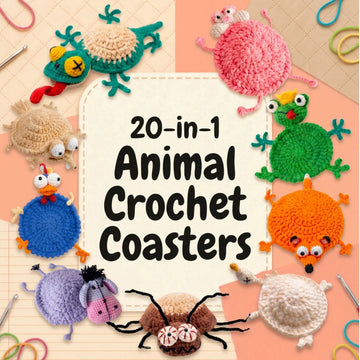
- Coasters and home decor: cotton DK on 3.50 to 4.00 mm for a firm, flat, well-behaved disc.
- Blankets and throws: worsted on 5.50 to 6.50 mm so the fabric drapes instead of standing up.
- Garments: whatever hook hits the pattern gauge, no exceptions, because fit is the whole point.
- Doilies and thread work: steel hooks from 1.50 to 2.25 mm with crochet cotton thread.
- Chunky scarves: super bulky on 9.00 to 12.00 mm for fast, squishy results.
The hook size on the label is a suggestion. The hook size in your swatch is the truth.— Ava, MrsCrochetWorld
Hook materials and handles matter too
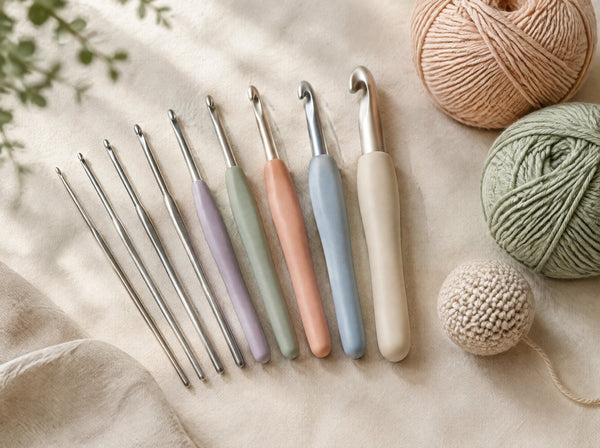
Two hooks can be the same 4.00 mm and still feel completely different in your hand.
Aluminium
The everyday workhorse. Yarn slides smoothly, the hooks are light, cheap and available in every size. Best all-round choice for acrylic and wool, and the sizing is usually clearly stamped.
Steel
Only for thread and the very smallest sizes. Strong enough to be thin without bending, which is exactly what lace and doily work needs. Uses its own reversed numbering system.
Bamboo and wood
Warm, quiet and slightly grippy, which helps slippery yarn stay put. Lovely for larger sizes and long sessions, though very thin wooden hooks can snap under pressure.
Plastic and resin
Mostly found in jumbo sizes where metal would be too heavy. Light and comfortable for chunky yarn, but the surface varies a lot between brands.
Ergonomic handles
A soft rubber or moulded grip around a standard metal shaft. The shaft diameter is unchanged, so a 4.00 mm ergonomic hook is still a 4.00 mm hook. Worth it if your hands ache.
Inline versus tapered
Inline heads are cut straight into the shaft and give very consistent stitch size. Tapered heads have a rounded throat and glide more easily. Preference, not quality, but it does shift your gauge slightly.
Common hook size mistakes and how to fix them
Almost every hook-related problem traces back to one of these five situations. Each has a clean fix.
| What you see | Likely cause | Fix |
|---|---|---|
| Stuffing shows through your amigurumi | Hook too large for the yarn | Drop one to two sizes, for example 5.00 mm down to 3.50 mm |
| Your hand cramps after ten minutes | Hook too small, or tension too tight | Go up half a size and consciously loosen your yarn hand |
| Finished blanket is much wider than stated | Gauge not checked before starting | Swatch first, then go down a size until gauge matches |
| A pattern letter does not match your hook | Brand labelling difference | Ignore the letter, match the millimetre value |
| Flat circle ruffles or cups | Wrong hook for the stitch count, not a counting error | Re-check gauge, then adjust hook rather than the increase rhythm |
That last one surprises people. A circle that ruffles is usually read as a mistake in the increase pattern, and sometimes it is, but just as often the hook is too large for the yarn and the fabric has nowhere to put the extra ease. Swatch before you frog.
Keep exploring

The other half of the equation: estimate yarn amounts before you commit to a project.
Read the guide →
Step-by-step swatching so your hook choice is based on measurement, not hope.
Read the guide →
When changing hooks is not enough, fix the tension habit underneath it.
Read the guide →
Fifty beginner-friendly patterns with the exact hook and yarn listed for each one.
View pattern →About the author
Ava is the designer and pattern writer behind MrsCrochetWorld. She has written and tested hundreds of amigurumi and home decor patterns, works daily with hook sizes from 1.50 mm steel through to 12.00 mm jumbo, and has personally frogged more projects over gauge than she would like to admit. Every chart and recommendation in this guide reflects sizes she keeps in her own working hook roll and the conversions she checks against manufacturer specifications before publishing a pattern.
MrsCrochetWorld patterns always state hook size in millimetres first, with the US letter in brackets, precisely because of the labelling inconsistencies described above. If you ever find a pattern of ours where a hook size is ambiguous, that is a bug and we want to hear about it.
Frequently asked questions
What crochet hook size should a beginner start with?
Start with a 5.00 mm hook, which is a US H or 8, paired with a smooth worsted weight acrylic yarn in a light solid colour. That combination is large enough to see your stitches clearly, small enough to stay comfortable in your hand, and it matches the most common beginner pattern materials list. Avoid very dark yarn and avoid fluffy textured yarn while learning, because both hide the stitch structure you need to see.
Is a US H hook the same as 5.00 mm?
Yes. US size H, also written as 8, is 5.00 mm on every mainstream brand. The letter and millimetre systems agree reliably for all sizes from B through K, so you can treat H and 5.00 mm as interchangeable. The agreement breaks down above K, where letters such as M, N and P mean different millimetre values depending on the manufacturer.
What hook size is best for amigurumi?
For worsted weight yarn use 3.00 mm to 3.50 mm, which is one to two sizes smaller than the yarn label suggests. The deliberately tight fabric prevents stuffing from showing through the stitches and helps the toy hold its shape. If your hands struggle with that tightness, move up to 3.75 mm and accept that you may need slightly less stuffing, rather than fighting a hook that hurts to use.
Why do my hooks have letters and numbers that disagree?
Because American hooks carry two parallel naming systems that both appear on the packaging. A 5.00 mm hook is called H in the letter system and 8 in the number system, so the label may read H/8. Neither of those is the UK number for that hook, which is 6. The millimetre value is the only label that means the same thing everywhere, so use it as your reference point.
How much does changing one hook size affect my gauge?
Moving one standard size, for example from 4.00 mm to 4.50 mm, typically changes your gauge by roughly one stitch per ten centimetres. If your swatch is off by two or three stitches you will need a two-size jump or a half-size step. Always re-swatch after changing, because the effect depends on your yarn, your stitch pattern and your personal tension.
Can I just use a different hook size than the pattern says?
You can, as long as you understand the consequence. For items where exact size does not matter, such as a scarf, a blanket or a dishcloth, a different hook simply gives you a slightly different size and drape. For garments and for anything that has to fit a specific object, changing hook without re-checking gauge will change the finished dimensions, sometimes dramatically across a large piece.
What are steel crochet hooks for?
Steel hooks cover the very small sizes used for crochet thread rather than yarn, roughly 0.60 mm to 2.25 mm. They are used for doilies, lace edging, fine jewellery and miniature work. They use their own reversed numbering, so a steel 7 is 1.50 mm and a steel 4 is 2.00 mm, meaning a higher number is a thinner hook.
Do ergonomic handles change the hook size?
No. The ergonomic grip surrounds the handle portion, while the working shaft that forms your stitches keeps its stated diameter. A 4.00 mm ergonomic hook makes the same size stitches as a plain 4.00 mm aluminium hook. What can change slightly is your tension, because a more comfortable grip often means a more relaxed yarn hand, so swatch if you switch mid-project.
How do I find the size of an unmarked hook?
Use a hook gauge, a small flat plate with graded holes labelled in millimetres. Slide the hook shaft into the holes until you find the smallest one it passes through cleanly, and that is your size. Do not measure across the hook head or the handle, and do not rely on comparing it by eye to another hook, because half sizes are almost impossible to judge visually.
What is the difference between inline and tapered hook heads?
An inline head is cut straight down into the shaft, so the throat sits flush and every loop is formed at exactly the shaft diameter, which gives very consistent stitches. A tapered head has a rounded, scooped throat that slides into stitches more easily and feels faster to many crocheters. Neither is better, but switching between them can shift your gauge slightly, so pick one style for a project and stay with it.
Which hook size works for chunky and jumbo yarn?
Super bulky yarn generally wants 9.00 mm to 12.00 mm, and jumbo yarn wants 15.00 mm and above. At these sizes the US letters become unreliable, so shop by millimetre value only. Plastic or resin hooks are common here because a solid metal hook that thick becomes uncomfortably heavy over a long session.
Do I need a full hook set or just a few sizes?
A basic set covering 2.50 mm through 6.00 mm handles the vast majority of yarn-weight patterns, and that is where most crocheters should start. Add a 3.00 mm and 3.50 mm if you make amigurumi, add 8.00 mm and above if you work with bulky yarn, and add steel hooks only if you move into thread work. Buying the half sizes matters more than buying the extremes, because half sizes are what you reach for when gauge is close but not quite right.
Put your hooks to work
Every MrsCrochetWorld pattern lists the exact hook size in millimetres, the yarn weight and the finished dimensions, so you know before you start.
Browse amigurumi patterns Get a free pattern